Your OB mentioned adenomyosis. Then your reproductive endocrinologist said it could be affecting your chances. Then you started looking up what any of this actually costs — and that’s when it got complicated.
Adenomyosis, a condition where endometrial tissue grows into the muscular wall of the uterus, doesn’t just cause painful periods. ASRM data shows it affects 20–35% of women undergoing IVF and significantly reduces implantation rates when it’s left unmanaged before a transfer cycle. The good news: medical pretreatment can meaningfully improve your odds. The bad news: it adds time and cost to an already expensive process.
Here’s what you’ll actually be looking at financially, from first diagnosis through whichever treatment path fits your situation.
Getting a Diagnosis
Adenomyosis is famously difficult to diagnose without removing the uterus entirely. A hysterectomy with biopsy is technically the only definitive confirmation — which is obviously not an option if you’re trying to build a family. In practice, RE clinics rely on imaging.
| Diagnostic Method | Cost Range |
|---|---|
| Transvaginal ultrasound | $200 – $600 |
| Pelvic MRI (most sensitive imaging) | $500 – $1,500 |
| Sonohysterogram | $300 – $800 |
| Endometrial biopsy (rules out other causes) | $200 – $500 |
MRI is the gold standard for imaging adenomyosis — it can detect focal adenomyomas and diffuse disease better than ultrasound alone. But even a clear MRI result carries uncertainty. Some women with mild imaging findings have significant uterine dysfunction; others with striking MRI findings have successful pregnancies. Your RE’s clinical interpretation matters as much as the images themselves.
If you already have a diagnosis in hand, you can skip this workup entirely. If you’re starting from scratch, budget $700–$2,000 for imaging before any treatment decisions.
Medical Management Before IVF: GnRH Agonist Pretreatment
The most evidence-backed fertility-sparing approach to adenomyosis is GnRH agonist suppression — typically leuprolide acetate (Lupron) — for 1–3 months before beginning an IVF stimulation cycle. This down-regulates the disease, reduces uterine inflammation, and appears to improve endometrial receptivity.
Leuprolide acetate runs $500–$2,000 per treatment cycle depending on depot formulation and your pharmacy. Many clinics prescribe 1–2 months of Lupron suppression as standard before a frozen embryo transfer if adenomyosis is suspected or confirmed.
Yes — the evidence is meaningful. A 2019 meta-analysis found that 3–6 months of GnRH agonist treatment before IVF significantly improved clinical pregnancy rates and live birth rates in women with adenomyosis compared to no pretreatment. The tradeoff: it adds 1–3 months and $500–$2,000 to your timeline. Most REs consider it worthwhile for moderate-to-severe cases. Mild or incidental adenomyosis found on imaging without symptoms may not require pretreatment at all.
IUI With Adenomyosis: Lower Success, Same Cost
IUI is an option if your adenomyosis is mild and your tubes are open, but you should go in with realistic expectations. Success rates for IUI in women with adenomyosis hover around 10–15% per cycle compared to roughly 20% in women without uterine pathology. The cost structure is the same — $1,000–$3,000 per cycle including monitoring and insemination — but you’re likely to need more cycles to achieve the same cumulative success.
For most women with adenomyosis who’ve already been trying for a while, most REs recommend moving directly to IVF rather than spending several cycles on IUI.
IVF With Adenomyosis: What It Actually Costs
Standard IVF costs don’t change because of adenomyosis. What changes is the preamble to a transfer cycle.
| IVF Component | Cost Range |
|---|---|
| Egg retrieval cycle (stimulation + retrieval) | $8,000 – $14,000 |
| Embryo storage (per year) | $500 – $1,000 |
| Frozen embryo transfer cycle | $3,000 – $6,000 |
| GnRH agonist pretreatment (1–2 months Lupron) | $500 – $2,000 |
| PGT-A genetic testing (optional) | $3,000 – $6,000 |
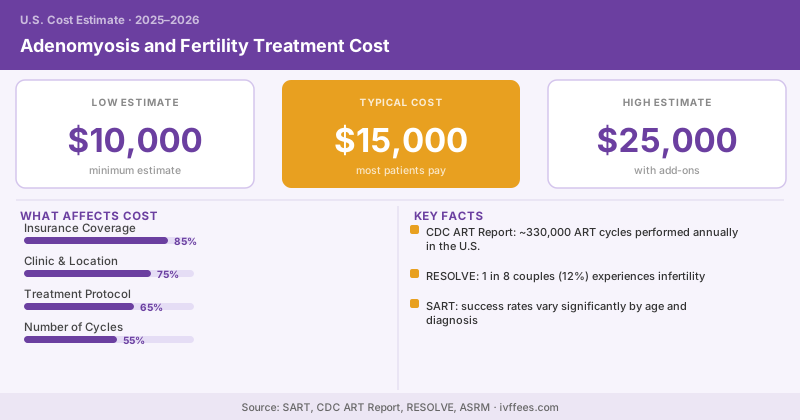
Total IVF cost with adenomyosis pretreatment: roughly $14,000–$25,000 for one complete cycle. If you’re doing multiple retrievals to bank embryos before transferring, costs scale accordingly. Some women with adenomyosis also benefit from ERA (Endometrial Receptivity Analysis) testing to optimize transfer timing, which adds $600–$800.
The key financial takeaway: adenomyosis itself doesn’t make IVF cost more per cycle — it tends to require more preparation and, in some cases, more cycles.
Gestational Surrogacy: When the Uterus Can’t Carry
In severe adenomyosis — thick, globally affected myometrium with poor response to suppression — the uterus simply may not be able to sustain a pregnancy. If multiple transfers have failed or your uterine cavity is substantially distorted, your RE may raise the possibility of gestational surrogacy using your own embryos.
Surrogacy is a significant financial and logistical leap. Expect $80,000–$150,000 total, including agency fees, carrier compensation, legal work, and the IVF cycle to create embryos. It’s not a path most people plan on, but for women with severe adenomyosis and repeated implantation failure, it’s sometimes the most realistic route to a live birth.
What Insurance Covers
Coverage varies wildly by state and plan. GnRH agonist medications are often covered under pharmacy benefits for their FDA-approved indications, which can cut your Lupron costs significantly. IVF coverage depends entirely on your state’s mandate laws and employer plan. In states with strong mandates, the egg retrieval and transfer cycles may be covered — though pretreatment costs may still come out of pocket.
NIH research has consistently found that delays in diagnosing and treating adenomyosis contribute to prolonged infertility and increased overall treatment costs. Getting an accurate picture of your uterine health early — and building a realistic plan with your RE — is the most cost-efficient thing you can do.