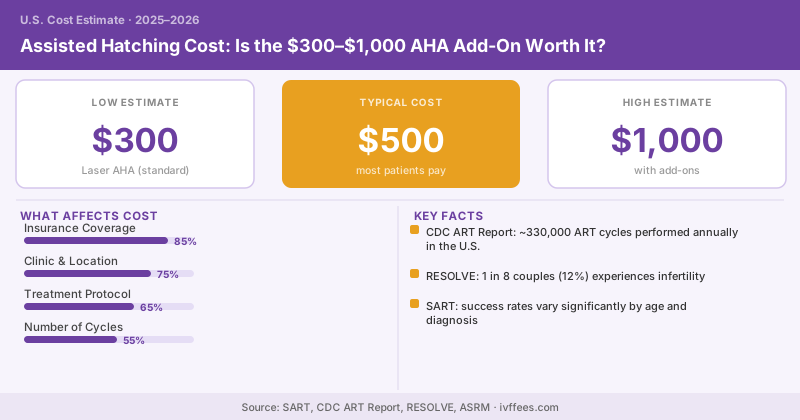
Assisted hatching (AHA) is one of those IVF add-ons that’s been around for decades — and the research on it is less clear than its continued use suggests. For some patients, it may improve implantation. For most, the evidence is mixed. The cost is $300 to $1,000.
Here’s what you need to know before agreeing to it.
What Assisted Hatching Is
Before an embryo can implant in the uterine lining, it has to “hatch” out of its outer shell — the zona pellucida. This happens naturally around day 5–6 of development. Assisted hatching creates a small opening in the zona pellucida before the embryo is transferred, with the goal of making hatching easier and improving implantation chances.
Modern clinics primarily use a laser (hence the full name: laser-assisted hatching). Earlier techniques used acid (Tyrode’s acid) or mechanical methods, but laser AHA has largely replaced both.
The procedure adds about 5–10 minutes to the embryo preparation process before transfer.
Who Might Benefit — According to Evidence
ASRM has reviewed the evidence on assisted hatching multiple times. Their position as of their most recent guidance: AHA may benefit certain patient subgroups, but the evidence doesn’t support routine use for all IVF patients.
Subgroups with the clearest potential benefit:
- Patients with prior failed IVF cycles — particularly multiple failures where embryo quality appeared good
- Frozen-thawed embryos — the zona can thicken or harden slightly during vitrification; some REs recommend AHA routinely for FET cycles
- Older patients (typically 38+) — the zona pellucida can be thicker in older patients’ embryos
- Embryos with elevated zona pellucida thickness — measured at the time of embryo assessment
Subgroups where evidence doesn’t support routine use:
- First IVF cycles in women under 37 with good prognosis
- Blastocyst-stage transfers where the embryo is already in advanced hatching
- Normal responders with high-quality embryos
| Assisted Hatching Type | Low | Typical | High |
|---|---|---|---|
| Laser AHA (standard) | $300 | $500 | $1,000 |
| AHA for frozen embryo transfer | $200 | $400 | $800 |
| Bundled with clinic’s FET package | $0 | $0 | $0 |
The Blastocyst Exception
Here’s an important nuance: if you’re transferring blastocysts (day-5 embryos), assisted hatching is largely unnecessary. At the blastocyst stage, the embryo has already expanded significantly and is in the process of natural hatching. Many embryologists consider AHA at the blastocyst stage pointless at best.
AHA is most relevant for day-3 cleavage-stage embryo transfers, which are less common in modern IVF practice but still performed in specific clinical scenarios.
Before agreeing to AHA, ask your embryologist or RE: “Is this for a day-3 or day-5 transfer? Is there a specific reason you’re recommending AHA for my embryos, or is this routine practice?” Understanding the clinical rationale helps you make an informed decision rather than defaulting to a $500 add-on.
What ASRM and the Research Say
A 2019 Cochrane review of 31 randomized controlled trials found that assisted hatching “may” improve live birth rates — but the quality of evidence was rated as low to moderate. The benefit, if real, appeared most pronounced in patients with poor prognosis or prior failed cycles.
The problem is that many of the studies included in these reviews used day-3 transfers, which are less common now. Modern high-quality evidence on AHA specifically for blastocyst transfers (day 5–6) is limited.
The bottom line from the evidence: AHA is not harmful, may be modestly beneficial in specific subgroups, and isn’t clearly helpful for routine use in good-prognosis patients.
Is AHA Covered by Insurance?
Rarely. Assisted hatching is typically classified as an elective add-on even in states with IVF insurance mandates. It’s almost universally a pay-out-of-pocket expense.
If you’re paying out of pocket for IVF and your clinic is recommending AHA for your first cycle as a straightforward patient under 37 with good ovarian reserve and no prior failed cycles — it’s reasonable to ask why. The cost is relatively modest in the context of a full IVF cycle, but it adds up when combined with other add-ons like ICSI, time-lapse imaging, and embryo glue.
Clinics that bundle multiple add-ons (AHA + ICSI + EmbryoGlue + time-lapse imaging) for every patient without individual clinical justification are a yellow flag. Each add-on should have a reason specific to your case.
Bottom Line
Assisted hatching costs $300 to $1,000. The clearest evidence supports it for frozen embryo transfers, prior failed cycles, and day-3 transfers in older patients. For first-time blastocyst transfers in good-prognosis patients, the evidence is weak. Ask your clinic which category you’re in before agreeing to the add-on.