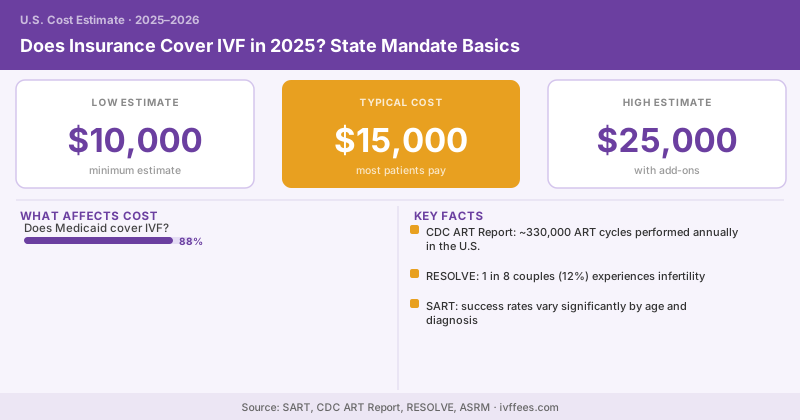
Most patients assume IVF works like any other medical procedure — you pay a copay, insurance covers the rest. Wrong. For the majority of Americans, IVF is a cash-pay expense, and a single cycle can run $15,000 to $30,000 out of pocket. Whether your plan helps at all depends mostly on one thing: what state you live in and who writes your policy.
So let’s answer the real question you’re asking: will your insurance pay, and how do you find out fast?
The Short Answer
As of 2025, roughly 21 states have passed some form of fertility insurance law, according to RESOLVE: The National Infertility Association. But “fertility law” doesn’t always mean “IVF covered.” Some states only require diagnosis coverage. Others mandate IVF but exempt small employers and self-funded plans. And about 15 states specifically require IVF coverage in at least some plans.
That patchwork is why two neighbors with the same diagnosis can have wildly different bills.
What State Mandates Actually Do
There are two kinds of laws to know:
- Mandate to cover — insurers selling plans in the state must include fertility benefits. These are the strong ones (Illinois, Massachusetts, New Jersey, and others).
- Mandate to offer — insurers only have to make a fertility option available; your employer can decline to buy it.
Here’s the catch that surprises people: if your employer is “self-funded” (they pay claims directly instead of buying a state-regulated plan), state mandates don’t apply to you — even in a strong mandate state like Massachusetts. Self-funded plans are governed by federal ERISA law, which has no fertility requirement. Roughly 65% of covered workers are in self-funded plans, per KFF’s 2023 employer survey. Ask HR directly: “Is our health plan fully insured or self-funded?”
Typical Out-of-Pocket Costs by Coverage Level
| Your Coverage Situation | What You Typically Pay Per Cycle |
|---|---|
| Full IVF mandate, in-network | $0–$3,000 (deductible + coinsurance) |
| Diagnosis only covered, treatment not | $13,000–$28,000 |
| Employer fertility benefit (lifetime max) | Varies; often $0 until cap hit |
| No coverage / cash pay | $15,000–$30,000 |
| Medications (often billed separately) | $3,000–$7,000 |
How to Find Out If You’re Covered
Don’t guess from the booklet. Call the member services number on your card and ask these exact questions:
- “Does my plan cover IVF, IUI, and fertility diagnosis?”
- “Is there a lifetime maximum or a cycle limit?”
- “Are fertility medications covered under medical or pharmacy benefits?”
- “Do I need pre-authorization, and is there an infertility diagnosis requirement?”
Write down the rep’s name and the reference number for the call. If you’re denied something you believe should be covered, that documentation matters for an appeal.
Many plans require a formal infertility diagnosis — often defined as 12 months of failed conception (6 months if you’re over 35) — before any benefit kicks in. Single people and same-sex couples have historically been excluded by this definition, though several states updated their laws in 2023–2024 to broaden eligibility. Check your state’s current rules.
What If Your State Has No Mandate?
You still have options. Check whether your employer offers a fertility benefit voluntarily — big tech, finance, and consulting firms increasingly do. Beyond that, look into IVF financing options, and read our guide on how to reduce IVF cost for practical levers like mini-IVF, medication shopping, and multi-cycle discount packages.
Frequently Asked Questions
How many states mandate IVF coverage in 2025? About 21 states have some fertility insurance law, but only roughly 15 specifically require IVF coverage, and most include exemptions for small employers and self-funded plans. The exact count shifts as legislatures pass new bills, so confirm your state’s current status through RESOLVE.
Does the Affordable Care Act cover IVF? No. The ACA does not list IVF or infertility treatment as an “essential health benefit,” so it’s left to states and employers. There’s no federal requirement to cover IVF.
Will insurance cover my fertility medications even if it won’t cover the procedure? Sometimes. Medications are frequently handled under a separate pharmacy benefit, so it’s possible to have drugs partially covered while the cycle itself isn’t. Always check both medical and pharmacy benefits — they’re often administered by different companies.
My plan denied my IVF claim. Can I appeal? Yes, and appeals succeed more often than people expect. Get the denial reason in writing, gather your physician’s documentation, and file a formal appeal. See our guide on fighting a fertility insurance denial for the step-by-step process.
Does Medicaid cover IVF? Almost never. A small number of states cover limited fertility services through Medicaid, but full IVF coverage is extremely rare. Diagnosis and some medications are more likely to be covered than the cycle itself.
Do state mandates apply if I work for a company headquartered elsewhere? Generally the law follows where the plan is issued and regulated, not where you live. If your employer is large and self-funded, no state mandate applies regardless of location. This is why two people with identical diagnoses can have completely different coverage.
Mandate counts based on RESOLVE: The National Infertility Association’s 2024–2025 state coverage tracking. Self-funded plan statistics from the KFF Employer Health Benefits Survey, 2023. For state-by-state detail, see our IVF insurance mandate by state guide.