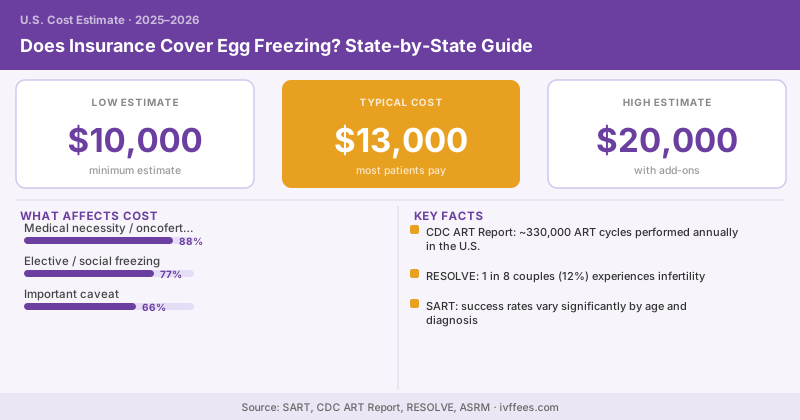
Most patients assume insurance won’t cover egg freezing. For elective “social” freezing, that’s mostly true. But for medically necessary fertility preservation — and increasingly for employees at large companies — the story is more complicated, and more hopeful.
Here’s what actually gets covered, and where.
The Medical vs. Elective Distinction
Insurance draws a sharp line between two types of egg freezing:
Medical necessity / oncofertility: Egg freezing before cancer treatment (chemotherapy, radiation, or surgery that could impair ovarian function) is widely recognized as medically necessary. According to ASCO (American Society of Clinical Oncology) 2023 guidelines, fertility preservation before cancer treatment should be discussed and offered to all patients of reproductive age — and many insurers cover it as a result.
Elective / social freezing: Freezing eggs to delay childbearing for personal, professional, or relationship reasons. Most insurance plans do NOT cover this, regardless of state law.
The practical line: if your RE documents a medical reason — cancer, an upcoming surgery, a condition like endometriosis or premature ovarian insufficiency that threatens fertility — you have a much stronger case for coverage.
States That Mandate Infertility Coverage (Including Egg Freezing)
As of 2025, these states have infertility insurance mandate laws that may cover egg freezing procedures:
| State | Mandate Type | Egg Freezing Coverage |
|---|---|---|
| Illinois | Comprehensive IVF mandate | Yes — including elective |
| New York | Diagnosis required | Medical/diagnostic necessity |
| New Jersey | IVF mandate | Procedural coverage |
| Maryland | Diagnosis required | Limited, medical necessity |
| Massachusetts | Diagnosis required | Medical basis required |
| Connecticut | Diagnosis required | Medical basis required |
| Hawaii | IVF mandate | Retrieval covered |
| Rhode Island | IVF mandate | Retrieval covered |
| West Virginia | IVF mandate | Limited coverage |
| Montana | Diagnostic coverage | Varies by plan |
Important caveat: Having a mandate in your state doesn’t guarantee your specific plan covers egg freezing. Self-insured employer plans (most large companies) are governed by federal ERISA law, which exempts them from state mandates. And even mandate-state plans often require a medical diagnosis of infertility before coverage kicks in.
Illinois: The Most Comprehensive Coverage
Illinois has the broadest egg freezing coverage in the country. Under Illinois law, insurers must cover egg freezing for patients who face medical conditions that will impair fertility — and, notably, some Illinois plans cover elective freezing as well. If you’re on an employer-based Illinois-regulated plan, call your insurer and ask directly whether elective oocyte cryopreservation is covered. Some are.
Employer Benefits: The Fastest-Growing Coverage Source
The biggest coverage expansion in the past decade hasn’t come from state legislatures — it’s come from employers.
Companies including Apple, Google/Alphabet, Meta/Facebook, Amazon, Salesforce, Netflix, Spotify, Starbucks, and hundreds of others now offer fertility benefits that include egg freezing — typically $10,000–$30,000 in lifetime benefit coverage.
According to a 2023 RESOLVE (National Infertility Association) survey, approximately 47% of large employers (500+ employees) offer some form of fertility benefit, and egg freezing is increasingly included. That number has roughly doubled since 2018.
If you work for a large company:
- Check your HR benefits portal under “family planning,” “reproductive health,” or “fertility benefits”
- Call your HR benefits line directly — ask specifically whether egg freezing (oocyte cryopreservation) is covered
- If your employer uses a fertility benefits platform (Carrot Fertility, Progyny, Maven Clinic, WINFertility), log into that platform — it often has better detail than the general HR portal
Carrot Fertility and Progyny are the two dominant employer fertility benefits platforms. Both offer egg freezing coverage, but Progyny uses a “smart cycle” model (bundles procedure + medications + monitoring), while Carrot offers a flexible reimbursement account. Carrot is more flexible about which clinics you use; Progyny has a network. Know which one your employer uses — they work very differently.
Medical Necessity Documentation Tips
If you have a potential medical reason for egg freezing — a cancer diagnosis, autoimmune condition, low ovarian reserve, upcoming surgery — here’s how to strengthen an insurance claim:
- Get documentation in writing: Your RE or oncologist should write a letter citing the specific medical condition and why fertility preservation is medically indicated
- Use the right diagnosis codes: ICD-10 codes for ovarian failure (E28.39), malignant neoplasm (varies), or other conditions that qualify as medically impairing fertility
- Appeal denials: Initial denials are common. A well-documented appeal citing ASCO, ASRM, or ACOG guidelines is often successful
- Request peer-to-peer review: Your RE can speak directly with the insurance medical director to argue clinical necessity
RESOLVE estimates that approximately 65% of fertility insurance appeals are overturned when properly documented — meaning the first denial is often not the final answer.
What Coverage Typically Looks Like
When coverage applies (employer benefit or state mandate), it typically covers:
- The retrieval procedure
- Monitoring (ultrasounds, blood work)
- Some or all medications
- Sometimes: first year of storage
What it usually does NOT cover even with benefits:
- Long-term storage (after the first year)
- Multiple cycles beyond the benefit cap
- The future thaw and transfer (often requires a separate benefit claim)
If You Don’t Have Coverage
The honest answer: most people don’t. If you’re self-paying, your options are:
- Clinic payment plans: 0% financing for 12–24 months is common
- Medical credit cards (CareCredit, Carecredit Synchrony)
- Fertility loans: Prosper Healthcare Lending, Future Family, CapexMD
- Clinic discount programs: Some academic centers offer reduced fees for research participation or financial hardship
State mandate information based on RESOLVE 2025 insurance guide. Employer statistics from RESOLVE 2023 survey. ASCO guidelines referenced per 2023 clinical practice update.