In 2010, a 30-year-old who froze her eggs was a rare exception. Today she’s one of tens of thousands — and a lot of those women are now looking at decade-long storage bills they didn’t fully price into their original decision.
Here’s the math that clinics don’t put front and center.
What Annual Storage Actually Costs
Egg cryostorage fees vary by clinic but generally run:
- Budget clinics: $300–$500/year
- Typical fertility clinics: $500–$800/year
- Major metro / academic centers: $800–$1,200/year
Some clinics include the first year of storage in the retrieval cycle fee. Others bill it immediately. Most start billing annually on the anniversary of your retrieval date.
| Storage Duration | Low ($400/yr) | Typical ($700/yr) | High ($1,000/yr) |
|---|---|---|---|
| 1 year | $400 | $700 | $1,000 |
| 3 years | $1,200 | $2,100 | $3,000 |
| 5 years | $2,000 | $3,500 | $5,000 |
| 10 years | $4,000 | $7,000 | $10,000 |
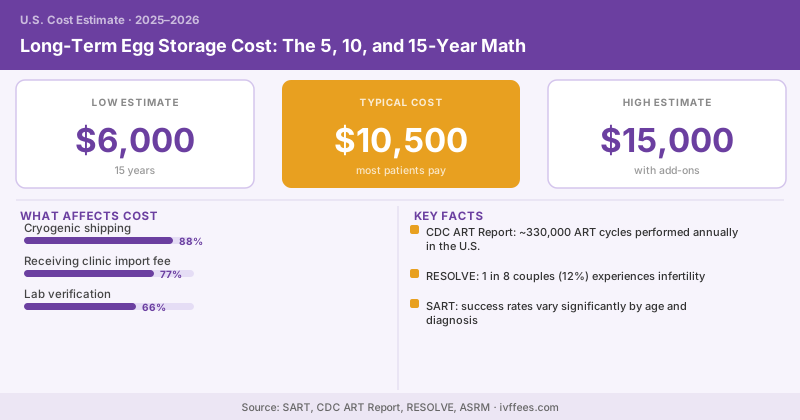
| 15 years | $6,000 | $10,500 | $15,000 |
At typical rates, a woman who freezes eggs at 30 and doesn’t use them until 43 — or decides to let them expire — will have paid $9,100 in storage fees on top of her original $13,000 retrieval cycle. That’s $22,000+ total before she ever does a transfer.
Prepaid Long-Term Storage: Worth It?
Some clinics offer prepaid multi-year storage contracts:
- 5-year prepaid: $2,000–$3,500 (vs. $2,500–$5,000 pay-as-you-go)
- 10-year prepaid: $3,500–$6,000 (vs. $5,000–$10,000 pay-as-you-go)
- Lifetime storage: offered by a handful of clinics, $5,000–$10,000 one-time
Prepaid contracts make financial sense if you’re reasonably confident you won’t use the eggs in the next 1–2 years. They also protect against price increases — storage fees can and do go up over time.
The best time to negotiate prepaid storage is before your retrieval cycle, not after. Some clinics won’t offer multi-year contracts post-cycle, or will charge more. Ask specifically: “Do you offer prepaid storage contracts, and what’s the per-year rate if I prepay 5 years?”
What Happens If You Switch Clinics?
Life happens. You might move, your clinic might close, or you might find a better transfer clinic in your city. Moving your eggs involves:
Cryogenic shipping: A specialized cryogenic courier (companies like CryoStork, IVFMailbox, or FeliX) ships eggs in a liquid nitrogen dry shipper. Cost: $400–$800 for domestic shipping, $1,500–$3,500 for international.
Receiving clinic import fee: The new clinic charges a receiving and import fee of $200–$500 to accept and re-inventory your eggs.
Lab verification: Some receiving clinics require a brief storage period before transfer to verify the eggs survived transport.
Total switching cost: typically $600–$1,300 domestically. It’s manageable — but factor it in if your retrieval clinic and future RE are in different cities.
What Happens If You Stop Paying?
This is the question nobody asks until they need the answer.
If you miss a storage payment, most clinics send 30–90 days of notices before taking any action. Eventually, they’ll either:
- Offer to discard the eggs and close your account, or
- Transfer legal responsibility to the patient in writing (sometimes eggs are held until the patient responds)
Some states have laws about the required notice period before disposition. No ethical clinic will discard your eggs without explicit written consent — but if you stop communicating and stop paying, the outcome may not be what you’d want.
If you genuinely can’t afford storage fees and don’t plan to use the eggs, contact the clinic proactively. Some clinics have financial hardship policies. Others will help coordinate donation (to another patient or to research) at no cost.
The Math on Never Using Your Eggs
Research published in Fertility and Sterility (2023) found that roughly 20–30% of frozen eggs are ultimately never used — either because the patient achieves pregnancy naturally, decides not to pursue transfer, or ages past the point where using own eggs is recommended.
That means a meaningful percentage of women who freeze eggs will pay storage fees for years and never use what they banked. It’s a real scenario to plan for. The decision to freeze is still often rational — but the full cost calculation should include the possibility that you’re banking insurance you may never collect on.
Eggs don’t expire in the traditional sense — they can remain viable in liquid nitrogen for a decade or longer. But your chance of success using them does decline with your age at transfer, not the age of the eggs. A 45-year-old using eggs frozen at 32 still has meaningful success odds. A 45-year-old using fresh eggs has much lower odds. The storage costs are worth it if there’s a real plan to use them.
Smart Storage Strategy
If you’re planning for long-term storage, here’s what actually saves money:
- Compare clinics on storage fees, not just retrieval fees — a $1,500 lower retrieval cost evaporates if storage is $400/year more expensive
- Ask about prepaid contracts before signing anything
- Negotiate the first year included in your retrieval fee
- Set a calendar reminder annually so you don’t miss payments and accidentally trigger a lapse
- Have a decision date in mind — if you haven’t used them by X age, what’s your plan? Having an answer prevents drifting into unplanned storage years
Figures based on national clinic surveys, Fertility and Sterility research literature, and cryogenic transport company pricing as of 2025.