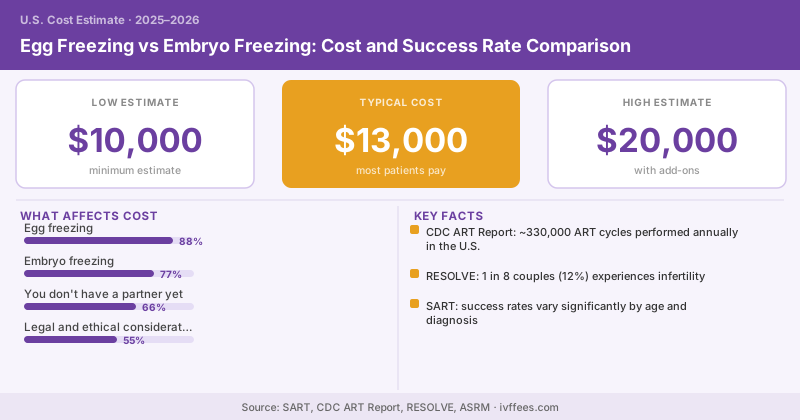
Most patients assume embryo freezing and egg freezing cost roughly the same. They’re close — but the differences matter, and the decision isn’t just about money.
Here’s a side-by-side breakdown.
The Key Difference
Egg freezing stops at the egg stage. You retrieve eggs, vitrify them, and store them unfertilized. When you’re ready, you thaw, fertilize with sperm (from a partner or donor), grow to blastocyst, and transfer.
Embryo freezing goes one step further at the time of retrieval. Eggs are fertilized immediately — with a partner’s sperm or donor sperm — grown to blastocyst, and then frozen. When you’re ready, you thaw a blastocyst and transfer it.
The retrieval process is identical for both. The difference is what happens in the lab after the eggs come out.
Cost Comparison
| Cost Component | Egg Freezing | Embryo Freezing |
|---|---|---|
| Retrieval cycle (clinic fee) | $5,500–$12,000 | $5,500–$12,000 |
| Fertility medications | $2,500–$6,500 | $2,500–$6,500 |
| Lab fee / embryology | $500–$1,500 | $1,500–$3,000 |
| ICSI (if needed) | $0 now / $1,000–$2,500 later | $1,000–$2,500 now |
| Annual storage | $500–$1,000/yr | $500–$1,000/yr |
| First-year total | $9,500–$21,000 | $11,000–$23,500 |
Embryo freezing typically costs $1,000–$2,500 more upfront because fertilization and embryo culture happen immediately. Egg freezing defers those costs to the future thaw cycle — but you’ll still pay them eventually.
Success Rate Difference
This is where embryo freezing has a real advantage.
Frozen embryo transfers using previously frozen blastocysts consistently show higher success rates than frozen egg cycles, primarily because embryos tolerate freeze-thaw better than unfertilized eggs.
According to 2022 SART data:
- Frozen embryo transfers from own eggs: ~40–48% live birth rate per transfer for women under 35
- Frozen oocyte cycles (using own previously frozen eggs): ~35–42% per intended egg retrieval for women under 35
The difference narrows at younger ages and widens as age increases. By 38+, frozen egg cycles show meaningfully lower success rates than frozen embryo cycles with the same patient’s eggs — in part because the egg-to-blastocyst attrition is higher when eggs are thawed individually rather than fertilized fresh.
With frozen eggs, you might thaw 10, get 8 survivors, fertilize 6, and grow 3 to blastocyst. With frozen embryos, that 3-blastocyst endpoint is already reached — you’re just thawing the finished product. That makes embryo freezing more efficient per cycle.
When Egg Freezing Makes More Sense
You don’t have a partner yet. If you’re single and don’t want to use donor sperm, freezing unfertilized eggs preserves your flexibility. You can use your own eggs with a future partner’s sperm later.
Legal and ethical considerations. Frozen eggs belong entirely to you. Frozen embryos created with a partner’s sperm are legally shared property in most states — which complicates things if the relationship ends. The legal and emotional implications of “what happens to our embryos” in a breakup or divorce are significant.
You prefer not to fertilize now. Some patients have religious, ethical, or personal reasons for not creating embryos until they’re actively trying to conceive.
When Embryo Freezing Makes More Sense
You have a long-term partner or are open to donor sperm. If you’re in a stable relationship or comfortable using donor sperm, the higher success rates of frozen embryo cycles make them worth the extra upfront cost.
You’re over 37. Older eggs don’t survive the freeze-thaw cycle as well as younger eggs. Creating embryos immediately after retrieval maximizes the number of viable blastocysts you’ll have to work with — rather than discovering the attrition rate when you thaw years later.
You want to do PGT-A testing. Preimplantation genetic testing requires a blastocyst — so if you plan to test for chromosomal abnormalities before transfer, you’ll need embryos regardless.
The Transfer Cycle: Same Either Way
Once you’re ready to use your frozen material, the transfer process is nearly identical whether you’re using frozen eggs or frozen embryos. You’ll pay:
- Thaw fee: $500–$1,500
- Transfer procedure: $1,000–$3,000
- Medications: $500–$1,500
The difference is that with frozen eggs, you also pay for ICSI and embryo culture at transfer time. With frozen embryos, that step already happened.
Neither option guarantees a baby. Egg freezing and embryo freezing are both preservation strategies — they give you options, not certainty. The statistics on live birth rates improve with age at freeze (younger is better), number of eggs or embryos banked (more is better), and lab quality.
Bottom Line
If you have a partner and you’re over 35, embryo freezing is almost always the better choice — higher success rates justify the modest additional cost. If you’re single, younger, or have concerns about shared embryo ownership, egg freezing preserves flexibility that’s genuinely valuable.
The financial difference is smaller than most people think. The biological and legal differences are bigger.
Data sourced from SART 2022 National Summary Report, ASRM committee opinions on oocyte cryopreservation 2023, and clinic fee surveys.