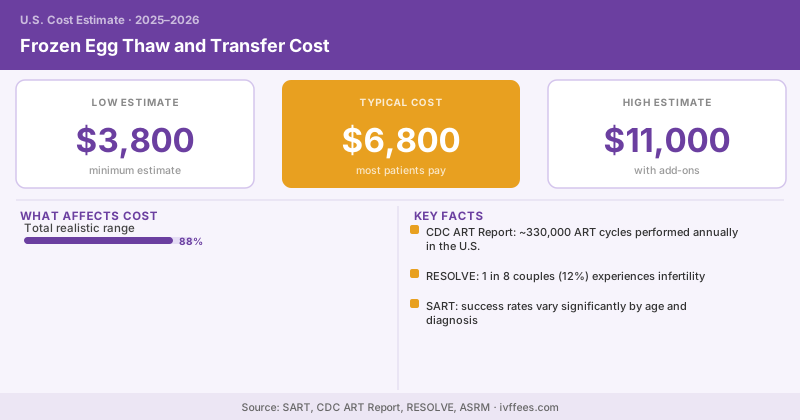
Freezing your eggs is step one. Actually having a baby from them? That’s a whole second bill — and plenty of people are surprised to learn it costs another $3,000–$7,000 when the time comes.
Here’s exactly what you’re paying for at each stage of the thaw and transfer process.
The Four Steps (and Their Costs)
When you decide to use your frozen eggs, the clinic walks through four distinct procedures, each billed separately:
1. Egg thaw: The lab warms your vitrified eggs using a controlled protocol. Not all eggs survive. Clinics typically charge $500–$1,500 for the thaw procedure itself.
2. Fertilization via ICSI: Frozen eggs that have been through the freeze-thaw process have a hardened zona pellucida (the outer shell). That makes conventional insemination ineffective — ICSI (intracytoplasmic sperm injection) is required for virtually all frozen egg cycles. ICSI adds $1,000–$2,500 to the bill.
3. Embryo culture: After fertilization, embryos are cultured in the lab for 5–6 days until they reach the blastocyst stage. The clinic charges a culture/lab fee of $500–$1,500.
4. Embryo transfer: The final step — transferring one (or sometimes two) blastocyst(s) into the uterus. Transfer fees run $1,000–$3,000, plus medications to prepare the uterine lining ($500–$1,500).
| Cost Component | Low End | Typical | High End |
|---|---|---|---|
| Egg thaw procedure | $500 | $1,000 | $1,500 |
| ICSI (fertilization) | $1,000 | $1,500 | $2,500 |
| Embryo culture (to blastocyst) | $500 | $1,000 | $1,500 |
| Embryo transfer procedure | $1,000 | $2,000 | $3,000 |
| Uterine prep medications | $500 | $800 | $1,500 |
| Monitoring appointments | $300 | $500 | $1,000 |
| Total | $3,800 | $6,800 | $11,000 |
Thaw Survival Rates: What to Expect
Not every egg you thawed will fertilize, and not every embryo will reach blastocyst. The attrition is normal — here’s how the math typically plays out.
According to SART 2022 data on cryopreserved oocyte cycles, the average thaw survival rate for vitrified eggs is approximately 80–85%. Of surviving eggs, roughly 70–80% will fertilize after ICSI. Of fertilized eggs, about 40–60% will develop to blastocyst (Day 5/6 embryo) suitable for transfer.
So if you start the thaw with 10 eggs:
- ~8–9 survive the thaw
- ~6–7 fertilize successfully
- ~3–4 reach blastocyst stage
- You’d likely transfer 1–2, possibly banking 1–2 extras if PGT-A testing is done
That’s why reproductive endocrinologists recommend banking 10–15 mature eggs if you want a reasonable probability of at least one live birth.
Before your thaw cycle, ask the clinic what their specific oocyte survival rate is. Top-tier IVF labs report 85–90% survival; less experienced labs may see 70–75%. This matters because your outcome depends as much on the embryology team as on your age at freeze.
Does PGT-A Testing Add Cost?
Some patients choose to do PGT-A (preimplantation genetic testing for aneuploidy) on any resulting blastocysts before transfer. This adds $2,000–$4,000 to the total, but provides information about which embryos are chromosomally normal — potentially reducing miscarriage risk and increasing per-transfer success.
It’s not required. Many patients transfer without PGT-A, especially if they’re under 37 and have limited embryos to test.
Medications for the Transfer Cycle
The thaw and transfer cycle requires medications to prepare your uterine lining for implantation. Typically this is an estrogen/progesterone regimen — oral or injectable estradiol for 10–14 days, followed by progesterone injections or suppositories starting 5–6 days before transfer.
These medications run $500–$1,500 depending on the protocol. They’re usually cheaper than the stimulation medications used during the original egg freeze cycle, but they’re not trivial.
What if No Embryos Develop?
This is the hardest part of the egg thaw process to talk about — but it happens. If your eggs don’t survive the thaw, or none fertilize, or none reach blastocyst, the cycle may end with no embryos to transfer.
In that case, you’ve paid for the thaw procedures ($2,000–$4,500 for thaw + ICSI + culture) without a transfer to show for it. The clinic won’t refund those lab costs.
Some clinics build embryo development guarantees into their pricing — if no blastocysts develop, the transfer fee is waived. Ask about this before you start.
A frozen egg is not a baby. Even with 10 frozen eggs, a 38-year-old has approximately a 40–50% cumulative live birth rate — meaning the odds are real, but so is the chance that the cycle doesn’t result in a pregnancy. Budget for more than one transfer attempt.
Total Cost: Freeze + Thaw + Transfer
If you want the all-in number from “let’s freeze eggs” to “I’m pregnant”:
- One retrieval cycle: $10,000–$17,000
- Annual storage (3–5 years): $1,500–$5,000
- Thaw + fertilization + transfer: $3,800–$11,000
Total realistic range: $15,000–$33,000 for the complete journey, before any repeat transfer cycles.
That’s a significant number. It’s also the clearest way to understand what egg freezing actually costs — not just the procedure, but the full path to using what you’ve banked.
Figures based on SART 2022 national data, ASRM 2024 guidelines, and current clinic fee surveys.