You’ve retrieved 8 embryos. Three transferred. Five frozen. Now what? The storage bill arrives every year — and it’s not always what people expect.
Embryo storage is one of those costs that sneaks up on IVF patients. You pay attention to the big-ticket procedure costs, and then you’re caught off guard by the annual cryopreservation fee that just keeps coming. This guide explains exactly what you’re paying for, how clinics charge it, and how to think about the long-term math.
How Much Does Embryo Storage Cost?
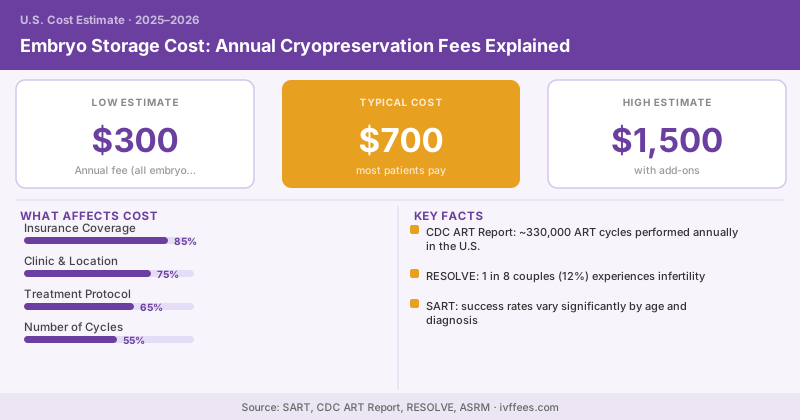
Annual storage fees in the United States range from $300 to $1,500 per year, depending on the clinic and what’s included. Most patients pay around $600–$900 annually.
Many clinics bundle the first year of storage into the IVF cycle cost. After that, it’s a recurring annual charge. Some charge per embryo; others charge a flat rate for however many you have stored.
| Storage Scenario | Low | Typical | High |
|---|---|---|---|
| Annual fee (all embryos, flat rate) | $300 | $700 | $1,500 |
| Initial freezing setup (one-time) | $500 | $1,000 | $2,000 |
| 5-year cumulative cost | $1,500 | $3,500 | $7,500 |
| Transfer to another clinic | $300 | $500 | $1,000 |
| Indefinite storage (10+ years) | $3,000 | $7,000 | $15,000 |
What You’re Actually Paying For
Your embryos are stored in liquid nitrogen at -196°C. That extreme cold is what keeps them viable for years — sometimes decades. The storage fee covers:
- Tank maintenance — liquid nitrogen replenishment and monitoring
- Quality control — temperature logging, alarm systems, 24/7 monitoring
- Documentation — labeling, chain-of-custody records, consent tracking
- Staff — embryologists who manage the storage system
The American Association of Bioanalysts (AAB) and the American Association of Tissue Banks (AATB) set standards for embryo banking safety, and accredited labs must maintain rigorous protocols. That infrastructure isn’t free.
The Long-Term Math
Here’s what most patients don’t think about upfront: if you’re 32 and freeze embryos you might use in your late 30s, you’re looking at 5–7 years of storage fees. At $700/year, that’s $3,500–$4,900 on top of everything else.
According to a 2022 survey by RESOLVE: The National Infertility Association, nearly 40% of fertility patients reported surprise at ongoing storage costs that hadn’t been fully explained at the outset. It’s worth asking your clinic directly: what’s the annual fee, when does it start, and what happens if you don’t pay?
Some clinics have started offering multi-year prepayment discounts — paying 3–5 years upfront can save 10–20%. If you know you’ll be waiting, that math often works in your favor.
What Happens to Abandoned Embryos?
Clinics can’t hold embryos indefinitely without consent and payment. Most have policies that require patients to renew storage consent annually and pay fees on time. If you stop paying and don’t respond to contact attempts, clinics may:
- Assess late fees
- Place embryos on an “abandoned” list
- Eventually seek legal or ethical disposition guidance
The ethical and legal landscape here is genuinely complex. Courts in multiple states have treated frozen embryos as marital property in divorce proceedings. Before you start IVF, both partners should understand what they’ve agreed to in the storage consent form — including what happens to embryos in case of divorce, death, or changed intentions.
Read your embryo storage consent form carefully before signing. It typically covers: what happens in divorce, who has decision-making authority, your options if you no longer want the embryos (donation, destruction, continued storage), and the clinic’s abandonment policy. This isn’t paperwork — it’s a legal document.
Embryo Donation vs. Disposal
If you’ve completed your family and have embryos remaining, you have options that eliminate ongoing storage costs:
- Donate to another family — through a clinic-based or third-party program (more on that in our embryo adoption cost guide)
- Donate to research — some patients choose to contribute to embryology research
- Compassionate transfer — a procedure during a non-fertile time, allowing embryos to end naturally
- Disposal — labs can thaw and discard embryos; clinics typically require signed consent
None of these are free, but they end the recurring annual cost. Some donation programs may even cover your storage fees as an incentive.
How Storage Fees Compare Across Clinic Types
Academic medical centers sometimes charge less because they’re not profit-driven — but they may also have longer waitlists or more bureaucratic processes. Large for-profit fertility chains often standardize fees and may be slightly higher but more predictable.
Boutique or independent clinics vary the most. Some are genuinely affordable; others charge premium rates in markets where demand is high (New York, Los Angeles, San Francisco).
- Is the first year of storage included in my IVF package price?
- What is the annual storage fee, and when does it start?
- Do you offer multi-year prepayment discounts?
- What is your abandoned embryo policy?
- Can I transfer embryos to another clinic later, and what does that cost?
Insurance and HSA/FSA Coverage
Most insurance plans don’t cover ongoing embryo storage, even in states with IVF mandates. However, the initial freezing procedure is sometimes covered. Check your specific plan — freezing that happens as part of a medically covered IVF cycle may be treated differently than elective freezing.
Good news: embryo storage fees are generally HSA and FSA-eligible as a qualified medical expense. That lets you pay with pre-tax dollars, which effectively reduces the real cost by 20–35% depending on your tax bracket.
The Bottom Line
Embryo storage is a real, recurring cost — not a one-time line item. Budget $600–$900 per year, and think ahead about how long you’ll realistically be storing. Ask your clinic for the full fee schedule, not just the IVF sticker price. The families who navigate this cost best are the ones who plan for it from day one.