Wrong question: “Does my employer cover IVF?”
Right question: “What’s the lifetime maximum, which clinics are in-network, are medications included, and do I need a diagnosis first?”
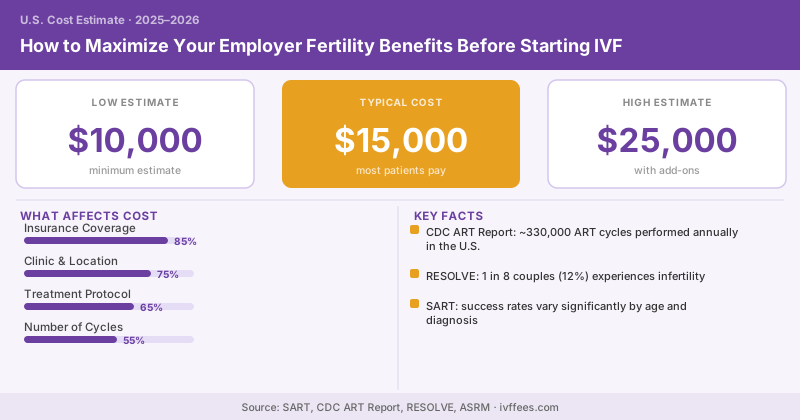
The difference between those two questions can be $20,000. Here’s how to get every dollar your employer owes you.
Why the Details Matter More Than the Headline
According to SHRM’s 2023 Employee Benefits Survey, 40% of employers with 500+ employees now offer some fertility coverage—up from 27% in 2019. But “fertility coverage” can mean anything from $2,000 toward diagnostic testing to $50,000 toward IVF with medications included.
The headline answer your HR rep gives you—“yes, we cover fertility”—tells you almost nothing useful.
The Exact Questions to Ask HR
Email these questions before your first fertility appointment. Get the answers in writing.
Coverage scope:
- What’s the lifetime maximum benefit amount?
- Is that per person or per family?
- Does the limit reset if I switch insurance plans?
- Are fertility medications covered under the medical benefit or pharmacy benefit (or both)?
Procedure details:
- Which IVF procedures are covered: fresh transfers, frozen transfers, ICSI, PGT?
- Is egg freezing for elective fertility preservation covered, or only for medical necessity?
- Is IUI covered?
Network requirements:
- Must I use a network fertility clinic, or can I go out of network?
- Which clinics are in-network in my area?
Medical requirements:
- Do I need an infertility diagnosis to access coverage?
- How many months of “trying” are required before I qualify?
- Are same-sex couples and single individuals covered without a diagnosis requirement?
Process:
- Do I need a referral from my OB/GYN?
- Do I need pre-authorization before starting a cycle?
Understanding Lifetime Maximums
Most employer fertility benefits have a lifetime cap. Common structures:
| Benefit Tier | Typical Lifetime Max | What It Covers |
|---|---|---|
| Basic | $5,000–$10,000 | Diagnostics, IUI, partial IVF |
| Mid-tier | $15,000–$25,000 | 1–2 IVF cycles |
| Premium (Carrot, Progyny) | $25,000–$50,000+ | Multiple cycles, medications, donor |
| Full coverage | No cap (rare) | All medically necessary fertility care |
If your plan has a $15,000 lifetime max and your IVF cycle costs $20,000, you’ll pay $5,000 out of pocket after benefits—but you still need to hit any deductible and out-of-pocket maximum first.
The Three Major Fertility Benefits Platforms
Many employers outsource fertility benefits management to a dedicated platform. These are the three you’re most likely to encounter:
Carrot Fertility — Used by companies including Salesforce, Microsoft, and thousands of others. Carrot provides a wallet-style benefit (e.g., “$20,000 toward fertility, adoption, or surrogacy”) that employees draw down through reimbursements. Notable: Carrot often covers fertility preservation, adoption, and surrogacy under the same wallet, giving you flexibility. Coverage quality varies by employer plan design.
Progyny — Focuses on IVF specifically and uses a “Smart Cycle” model that bundles monitoring, retrieval, transfer, and a frozen embryo transfer into a single unit. Used by major employers including Amazon, Meta, and Goldman Sachs. Progyny tends to direct employees to higher-success-rate clinics and has published outcome data showing above-average live birth rates for its members.
WINFertility — Takes a case management approach, assigning a nurse care manager who helps coordinate treatment, insurance, and pharmacy. Used by many Fortune 500 companies for benefits administration.
If your employer uses one of these platforms, ask for the plan documents—not just the summary. Details like whether medications are included and whether out-of-network exceptions are available often vary by company even within the same platform.
Open Enrollment: When to Act
Benefits elections during open enrollment are your best—and often only—window to upgrade your plan. Key timing considerations:
- Review options in October/November for most plan years starting January 1
- Choose the highest-fertility plan if you know you’ll start IVF in the coming year—the premium difference is almost always worth it
- Check if a Health Savings Account (HSA)-compatible plan is available: pairing an HSA with a high-deductible plan lets you save pre-tax dollars specifically for fertility expenses
- Qualifying life events (marriage, domestic partnership, loss of other coverage) let you change elections outside open enrollment
Don’t wait until you’re in a cycle to figure out your benefits. By the time you’re buying medications, it’s too late to change plans.
Negotiating With Your Employer
If your employer doesn’t currently offer fertility benefits, you may have more leverage than you think—especially if you’re a valued employee. A few approaches:
- Request it directly in writing — HR departments track employee requests. Enough requests signal demand.
- Frame it as recruitment and retention — SHRM data shows fertility benefits are among the top-5 most-requested benefits by employees under 40.
- Ask for a one-time exception — some employers will authorize a benefits exception for a specific employee situation even without a formal policy.
- Timing: annual benefits reviews typically happen in Q3. That’s when HR is evaluating plan changes.
Job-Switching for Fertility Benefits
It sounds extreme, but it’s increasingly common. Some employers offer $50,000 in fertility benefits—enough to cover two or three full IVF cycles. The math can make sense.
What to research before switching jobs for benefits:
- Waiting periods: Many plans require 6–12 months of employment before fertility benefits activate. A company that says “we cover IVF” might not cover yours until you’ve been there a year.
- Annual vs. lifetime limits: Some plans offer $10,000 per year, which could cover more than a one-time lifetime benefit.
- In-network clinics: If the plan requires a specific network, verify your preferred clinic is included before you accept an offer.
- Pre-existing condition exclusions: Most employer plans don’t exclude pre-existing infertility diagnoses, but verify this explicitly.
The breakeven analysis: if switching jobs would cover $30,000 in IVF costs and the new salary is comparable, you’re effectively getting a $30,000 raise. Factor in any signing bonus, equity vesting periods, and the real cost of leaving your current role.