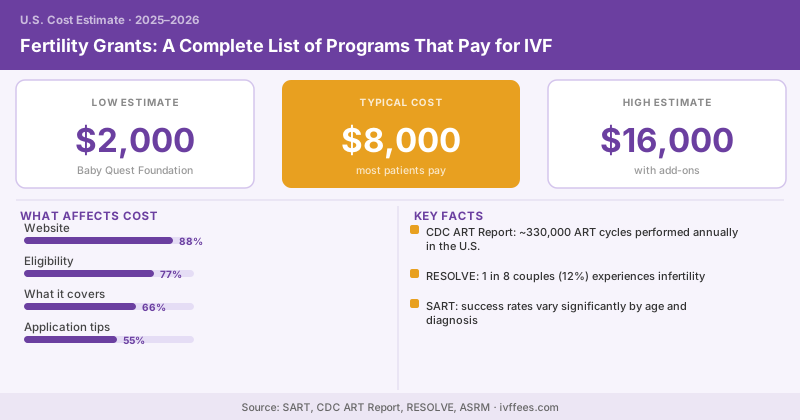
In 2010, Barbara Collura’s organization began tracking something nobody else was counting: how many fertility patients got help paying for treatment through grants. By 2023, RESOLVE: The National Infertility Association reported that grant programs collectively distributed over $5 million in fertility assistance annually—and demand still outpaces supply by a factor of 10 to 1.
That ratio is discouraging. But the families who do get funded received $2,000 to $16,000 each. Here’s every major program, what they pay, and how to build the strongest possible application.
Grant Programs at a Glance
| Program | Award Amount | Low End | Typical | High End |
|---|---|---|---|---|
| Baby Quest Foundation | $2,000–$16,000 | $2,000 | $8,000 | $16,000 |
| RESOLVE Hope Award | Varies | $500 | $3,000 | $10,000 |
| Pay It Forward Fertility | Up to $15,000 | $5,000 | $10,000 | $15,000 |
| Tinina Q. Cade Foundation | $10,000 | $10,000 | $10,000 | $10,000 |
| CNY Fertility Warrior Grant | $10,000 | $10,000 | $10,000 | $10,000 |
| Military/Veteran programs | Varies | $1,000 | $5,000 | $20,000 |
Baby Quest Foundation
Website: babyquestfoundation.org
Baby Quest is one of the largest independent fertility grant programs in the country. They award $2,000–$16,000 per cycle and accept applications twice a year, typically in spring and fall, with cycles opening in January and July.
Eligibility: Open to U.S. residents of any gender, orientation, or marital status. No income limit, but the application asks for financial documentation. Medical necessity is required—you’ll need documentation from a fertility specialist.
What it covers: IVF, frozen embryo transfer, egg or embryo donation, sperm donation, gestational carrier cycles, and surrogacy-related fertility treatments.
Application tips: Baby Quest reviews essays heavily. Their stated selection criteria include financial need, medical diagnosis, emotional readiness, and how the applicant plans to use the grant. Specific, personal narratives outperform generic “infertility is hard” essays. Include your diagnosis, your treatment history, and what this cycle means to you.
Success rate: Baby Quest doesn’t publish acceptance rates, but community reports suggest roughly 1 in 10–15 applicants receives an award in competitive cycles.
RESOLVE Hope Award for Fertility Preservation
Website: resolve.org/hope
RESOLVE is the country’s oldest and most recognized infertility patient advocacy organization. Their Hope Award program funds fertility preservation specifically for patients facing medical necessity—cancer patients, people facing premature ovarian insufficiency, and similar diagnoses.
Award amounts vary by cycle and available funding. Recipients have received $3,000–$10,000 in recent award years.
Eligibility: Medical necessity for fertility preservation. Strong preference for applicants with time-sensitive diagnoses (cancer patients beginning chemotherapy, for example).
Pay It Forward Fertility Foundation
Website: payitforwardfertility.com
Pay It Forward was founded by fertility patients who wanted to create a pay-it-back model: recipients are asked (not required) to contribute to future grants after their family is complete.
Award amounts: Up to $15,000. They fund IVF cycles at partner clinics, which means the grant goes directly to the clinic, not as cash to the applicant.
Eligibility: U.S. residents, demonstrated financial need, no prior children (some exceptions). Accepts applications from single individuals and LGBTQ+ couples.
Application cycle: Annual. Watch their website for application windows, which typically open once per year in the fall.
Tinina Q. Cade Foundation
Website: cadefoundation.org
The Cade Foundation specifically supports families of color and those facing significant financial hardship. Awards are $10,000 per recipient.
Eligibility: Formal financial need documentation required. Applications accepted from married couples and single individuals.
Timeline: Applications reviewed on a rolling basis. Contact the foundation directly for current cycle timing.
CNY Fertility Warrior Grant
Website: cnyfertility.com
CNY Fertility—a regional clinic network known for below-market IVF pricing—awards $10,000 grants annually. Recipients must use treatment at a CNY Fertility location (New York, Rochester, Albany, Syracuse, or Buffalo). For patients who’d consider CNY anyway, this is effectively a full-cycle grant.
Eligibility: Open to anyone; reviewed based on story and financial need. Apply through their website.
Military and Veteran Grants
Veterans and active military face unique fertility challenges, including service-related injuries that affect reproductive capacity. Several programs specifically serve this population:
Fisher House Foundation: Provides direct financial assistance to military families for fertility treatments, particularly when infertility results from combat injuries. Awards have reached $20,000 for qualifying veterans.
Pat Tillman Foundation: Doesn’t fund IVF directly, but its scholarship and support programs for veterans may free up financial resources for fertility treatment.
TRICARE: Active duty service members with medically necessary fertility care from a combat injury may qualify for coverage under TRICARE’s extended fertility benefit, added in 2016 under the National Defense Authorization Act.
How to Write a Winning Grant Application
Grant committees review hundreds of applications. The ones that succeed share specific characteristics:
1. Be specific about your diagnosis and history. “We’ve been trying for three years” is weak. “We were diagnosed with diminished ovarian reserve in 2023, completed two IUI cycles that failed, and our RE has recommended IVF with PGT-A given my AMH of 0.4” is strong.
2. Show financial need with real numbers. List income, existing debt, what you’ve already spent on fertility treatment, and what you could realistically afford to contribute. Grant committees want to fund people who genuinely can’t afford treatment without help, not people who could manage with more sacrifice.
3. Tell your story with emotional specificity. This isn’t a medical record. Write as a human being. Why does becoming a parent matter to you? What have you already given up? What does this grant make possible?
4. Apply to multiple programs simultaneously. There’s no rule against it. Many patients apply to Baby Quest, Pay It Forward, and their clinic’s own grant program in the same window. Being awarded one doesn’t automatically disqualify you from others (though disclose it if asked).
5. Apply every cycle, not just once. If you’re turned down, apply again. Many recipients won on their second or third application after writing stronger essays.
Application Timelines
Most fertility grant programs open applications once or twice per year. Set calendar reminders for each program’s typical opening window and prepare your materials—medical documentation, financial records, and your essay—in advance. Applications that arrive when the window just opens often receive more consideration than last-minute submissions.
RESOLVE maintains a current list of grant and financial assistance programs at resolve.org/what-are-my-options/financial-resources/. Check that page quarterly, as new programs appear regularly.