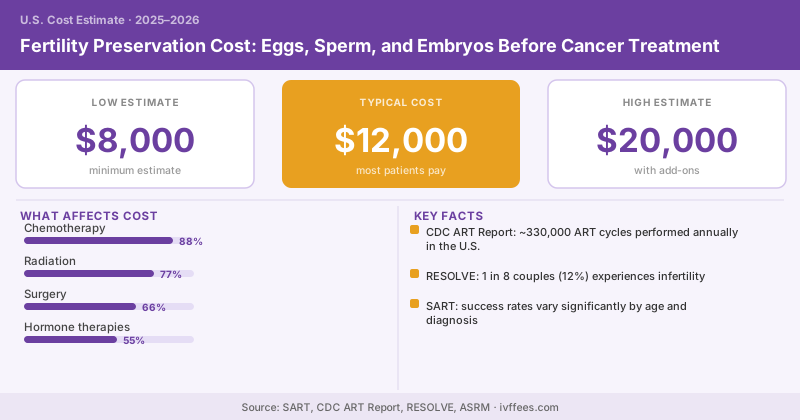
A cancer diagnosis at 31 is terrifying enough without also losing your chance to have children. Fertility preservation exists precisely for this — but the window between diagnosis and treatment is tight, and the costs are real.
Oncofertility is the subspecialty that sits at the intersection of cancer care and reproductive medicine. When cancer treatment threatens fertility — through chemotherapy’s effects on eggs or sperm, radiation to the reproductive organs, or surgeries — fertility preservation gives patients a chance to bank their reproductive potential before treatment starts.
This guide covers what each preservation option costs, how quickly it needs to happen, and what insurance is starting to cover.
Fertility Preservation Cost Overview
| Preservation Type | Upfront Procedure Cost | Annual Storage | Notes |
|---|---|---|---|
| Sperm banking (oncofertility) | $300–$900 | $150–$500 | Can be done in 1–3 days |
| Egg freezing (1 retrieval cycle) | $10,000–$17,000 | $500–$1,200 | Requires 2–4 weeks |
| Embryo freezing (with sperm source) | $12,000–$20,000 | $500–$1,500 | Requires partner/donor |
| Ovarian tissue freezing | $5,000–$10,000 | $300–$800 | Still experimental |
| Fertility consult with oncofertility specialist | $200–$500 | N/A | Often waived for cancer patients |
Who Needs Fertility Preservation?
According to the American Society of Reproductive Medicine (ASRM), the following cancer treatments carry significant risk to fertility:
Chemotherapy: Alkylating agents (cyclophosphamide, chlorambucil, busulfan) are highly gonadotoxic — they damage egg and sperm-producing cells. Platinum-based drugs carry moderate risk. Not all chemotherapy is equally damaging, and your oncologist can help assess your specific regimen’s risk level.
Radiation: Pelvic or abdominal radiation directly damages the ovaries and uterus. Total body irradiation (used before bone marrow transplants) is nearly always gonadotoxic.
Surgery: Removal of ovaries, testicles, or the uterus obviously eliminates those reproductive functions. Pelvic surgeries can also damage reproductive organs inadvertently.
Hormone therapies: Long-duration anti-estrogen therapy (tamoxifen for 5–10 years) for breast cancer delays pregnancy — fertility preservation before treatment allows options after therapy ends.
Timing Is Everything: The Treatment Window Problem
The biggest challenge in fertility preservation is time. Most oncologists want to start cancer treatment within 2–6 weeks of diagnosis. Egg freezing requires 10–14 days of stimulation injections, monitoring, and then a retrieval procedure — which fits within that window if started immediately.
Sperm banking can happen in 1–3 days — essentially no barrier.
The practical recommendation from ASRM: a fertility preservation consultation should happen within the first week of a cancer diagnosis, before a chemotherapy start date is set. Many cancer centers now have dedicated oncofertility teams or referral protocols for this reason.
Egg Freezing for Cancer Patients
The process is identical to elective egg freezing: hormone injections for 10–14 days, frequent monitoring, egg retrieval under light sedation. For cancer patients, some clinics use modified “random start” protocols that allow stimulation to begin at any point in the menstrual cycle rather than waiting for the next natural cycle start — saving 1–2 weeks.
Cost: typically $10,000–$16,000 per retrieval cycle, plus $500–$1,200/year for storage.
Some oncology hospitals and fertility clinics partner to offer reduced rates for cancer patients. Livestrong Fertility (livestrong.org/fertility) connects cancer patients with fertility clinics offering discounted treatment — frequently 40–70% below standard rates.
Livestrong Fertility partners with over 400 fertility clinics nationwide to offer free or deeply discounted fertility preservation for cancer patients. Eligibility: a cancer diagnosis before age 45. Application is online and takes 1–2 weeks to process. If time is short, call them directly — they can expedite for urgent cases. This resource alone can save $5,000–$12,000.
Embryo Freezing: The More Stable Option (When Available)
For patients with a partner or willing to use donor sperm, freezing embryos (fertilized eggs) rather than eggs alone offers a practical advantage: embryos survive the freeze-thaw process better than unfertilized eggs.
The success rate of a frozen embryo transfer is higher than a transfer using frozen-then-thawed eggs — though both have become highly effective with modern vitrification techniques.
Embryo freezing adds the step of fertilization before freezing, which doesn’t significantly change the cost or timeline. If you have a partner and time permits, embryo freezing is generally the preferred approach for women undergoing cancer treatment.
Ovarian Tissue Freezing: The Emerging Option
For patients who can’t wait 2 weeks for egg retrieval — particularly children with cancer, or adults facing immediate chemotherapy starts — ovarian tissue cryopreservation is an option.
A small laparoscopic surgery removes and freezes a portion of ovarian tissue. After cancer treatment, the tissue can be reimplanted. ASRM upgraded this from “experimental” to “established” in 2019, though it remains less available and less proven than egg or embryo freezing.
Cost: $5,000–$10,000 for the surgery and initial freezing, plus annual storage fees. Insurance coverage is inconsistent.
Insurance Coverage for Oncofertility
This is one area where coverage is genuinely improving. As of 2024, at least 12 states have enacted laws requiring insurance plans to cover fertility preservation for patients facing iatrogenic infertility (infertility caused by cancer treatment). These include California, Connecticut, Illinois, Maryland, New York, and others.
Federal law (the Family Building Act, introduced in Congress) would extend oncofertility coverage to all states — it hasn’t passed as of this writing, but the trend is clear.
Even without a state mandate, some large employers have added oncofertility coverage to their fertility benefits packages. Check your specific plan before assuming nothing is covered.
If your oncologist hasn’t mentioned fertility preservation, bring it up yourself. Studies consistently show that physicians are less likely to discuss fertility preservation with younger patients and women — despite these being exactly the patients most likely to value it. ASCO guidelines state that fertility preservation should be discussed with all patients of reproductive age facing gonadotoxic treatment, regardless of whether they’re asked about it.
Long-Term Cost Perspective
Banking costs are just the beginning. Using banked eggs, embryos, or sperm later requires additional procedures:
- Frozen embryo transfer: $3,000–$5,500 per attempt
- Egg thaw + fertilization + transfer: $4,000–$7,000
- Using frozen sperm in IUI or IVF: variable
The full fertility preservation cost — including eventual use — is $15,000–$50,000 depending on your situation, the number of cycles needed, and insurance coverage.
That’s a real cost. But for a 28-year-old cancer survivor who preserved her eggs before chemotherapy and later delivers a baby, every dollar of it is typically described as the best money they ever spent.
The Bottom Line
Fertility preservation is time-sensitive, emotionally complex, and financially significant. Start with the Livestrong Fertility program if you have a cancer diagnosis — the cost savings can be dramatic. Get a fertility consultation in the first week after diagnosis, before the oncology treatment schedule is finalized. And check your insurance and state mandate status before assuming you’re paying everything out of pocket.