What does a fertility workup actually cost — and is the $4,000 version four times better than the $1,000 version?
Not always. Fertility testing costs vary enormously based on where you get tested, whether insurance covers it, and whether you’re testing one partner or both. This guide breaks down every standard test, its typical cost, and what it actually tells you about your chances of conceiving.
The Standard Female Fertility Panel
Most reproductive endocrinologists order a baseline panel for women that covers three key areas: ovarian reserve, hormonal balance, and uterine structure. Here’s what that typically includes:
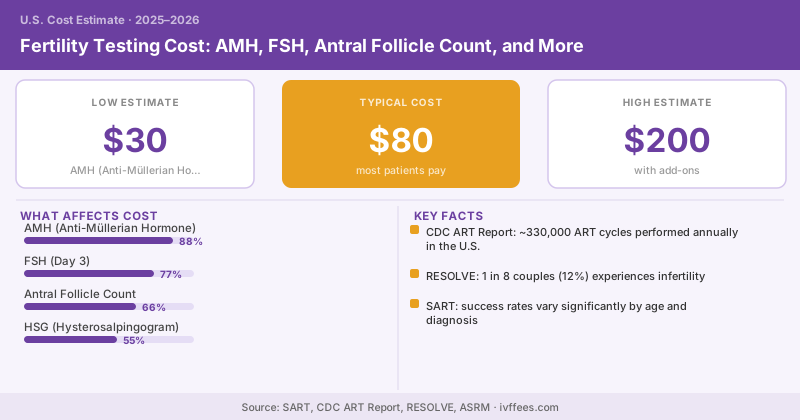
| Test | Low | Typical | High |
|---|---|---|---|
| AMH (Anti-Müllerian Hormone) | $30 | $80 | $200 |
| FSH + LH + Estradiol (Day 3 panel) | $100 | $200 | $500 |
| Antral Follicle Count (AFC) ultrasound | $150 | $350 | $700 |
| TSH (thyroid) | $25 | $60 | $150 |
| Prolactin | $25 | $60 | $150 |
| Saline sonogram (SHG) | $300 | $600 | $1,200 |
| HSG (tubal patency) | $500 | $1,000 | $2,500 |
| Full female panel (bundled) | $500 | $1,500 | $4,000 |
The Standard Male Fertility Panel
Male factor infertility contributes to roughly 40–50% of all infertility cases, according to ASRM. Despite that, men’s testing is often overlooked until the female workup comes back normal. The core test is a semen analysis, which typically costs $50–$200 on its own.
A more complete male workup includes:
- Basic semen analysis — count, motility, volume
- Strict morphology (Kruger) — evaluates sperm shape
- Hormonal panel — FSH, testosterone, LH, prolactin
- DNA fragmentation — measures sperm DNA damage
- Anti-sperm antibodies — less commonly ordered
The full male panel typically runs $300–$800 out of pocket.
What Each Test Actually Tells You
AMH (Anti-Müllerian Hormone): The single best marker of ovarian reserve. Low AMH suggests fewer eggs available; high AMH can indicate PCOS. It doesn’t change much throughout your cycle, so timing isn’t critical.
FSH (Day 3): High FSH on cycle day 3 suggests the brain is working harder to stimulate ovaries that aren’t responding well — a sign of diminished reserve. Used alongside AMH for a fuller picture.
Antral Follicle Count: Done via transvaginal ultrasound, this counts the small resting follicles in your ovaries. More follicles = more potential eggs. Combined with AMH, it’s the strongest predictor of IVF egg retrieval outcomes.
HSG (Hysterosalpingogram): An X-ray procedure that evaluates the shape of the uterus and the openness of the fallopian tubes. Blocked tubes prevent natural conception and affect IVF planning.
Saline Sonogram (SHG): Uses ultrasound + saline to look inside the uterus for polyps, fibroids, or abnormalities. Often done before IVF even if an HSG was normal.
If budget is limited, start with: AMH + FSH/E2 (Day 3) + AFC ultrasound for women, and a basic semen analysis for male partners. These four tests give you 80% of the diagnostic picture at 20–30% of the full workup cost. More tests can be added if results are abnormal or treatment isn’t working.
Insurance Coverage for Fertility Testing
This is where things get complicated. According to a 2023 analysis by RESOLVE: The National Infertility Association, diagnostic fertility testing is covered at least partially by most major insurance plans — because it’s classified as diagnostic, not treatment.
Practically, that means:
- Day 3 hormonal panels often covered under “diagnostic blood work”
- HSG often covered under gynecological imaging
- AMH less consistently covered — some plans code it as experimental
- Semen analysis usually covered as a basic diagnostic
Always check your EOB (Explanation of Benefits) after testing and appeal any denials. Many patients discover after the fact that tests that “seemed like they’d be covered” weren’t.
Getting Tested Without a Clinic
You don’t always need to go through a fertility clinic for initial testing. Options to consider:
Direct-to-consumer (DTC) labs: Companies like LetsGetChecked, Everlywell, and Base offer AMH testing via mail-order kits for $70–$150. These are useful for initial screening before seeing a specialist.
OB-GYN: Many OBs can order a Day 3 panel and AMH as part of a well-woman visit, often covered by insurance as preventive care.
Urologist: For male factor, a urologist can order the full male reproductive panel, sometimes more affordably than a fertility clinic.
The caveat: interpretation matters. A low AMH at a fertility clinic is interpreted in the context of your age, cycle data, and symptoms. The same number from a DTC kit can be misread without that context.
Some fertility clinics charge for consultations even before any testing. Ask upfront whether the initial consult is bundled with testing or billed separately. Some clinics include a basic panel in a “new patient fee”; others charge each component individually. Get this in writing before your first appointment.
Total Cost Scenarios
Scenario 1 — Covered patient: Both partners have good insurance with fertility diagnostic coverage. The full workup costs $200–$500 in copays and deductibles.
Scenario 2 — Partial coverage: Insurance covers the blood work but not imaging. Out-of-pocket runs $400–$800 for the HSG and AFC ultrasound.
Scenario 3 — No insurance coverage: Self-pay for the complete panel runs $800–$2,000 depending on clinic pricing and location.
Scenario 4 — Specialized testing: Adding DNA fragmentation, ERA testing, immune panels, or karyotyping can push the total to $3,000–$5,000 for thorough workups.
The Bottom Line
A basic fertility workup doesn’t have to break the bank. The AMH, Day 3 panel, AFC, and semen analysis together give you the most clinically meaningful information for under $1,000 if you shop around. Full workups at major fertility clinics cost more but include interpretation, care coordination, and the ability to move directly into treatment. Know what you’re getting before you pay.