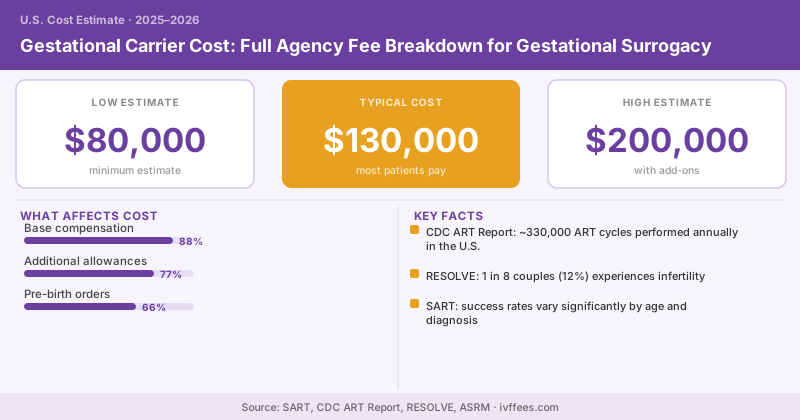
The total cost of gestational surrogacy in the United States is $80,000 to $200,000. That range isn’t vague — each extreme reflects a real scenario. The low end assumes a first-time surrogacy with a match found quickly, no complications, and a single IVF transfer. The high end includes multiple IVF cycles, a complex match process, high-cost-of-living carrier state, and extended medical complications.
Here’s where every dollar goes.
The Major Cost Categories
Gestational surrogacy costs divide into four main buckets: agency fees, carrier compensation, legal fees, and medical expenses.
| Cost Category | Low | Typical | High |
|---|---|---|---|
| Surrogacy agency fee | $15,000 | $25,000 | $45,000 |
| Gestational carrier base compensation | $35,000 | $50,000 | $80,000 |
| Carrier-side legal fees | $3,000 | $7,000 | $15,000 |
| Intended parent legal fees | $3,000 | $6,000 | $12,000 |
| IVF cycle (egg retrieval + embryo creation) | $15,000 | $22,000 | $35,000 |
| IVF embryo transfer for carrier | $3,000 | $5,000 | $8,000 |
| Carrier escrow management | $1,000 | $2,500 | $5,000 |
| Miscellaneous/contingency | $5,000 | $12,000 | $25,000 |
| TOTAL | $80,000 | $130,000 | $200,000 |
Breaking Down Carrier Compensation
Gestational carrier compensation is what you pay the woman who carries your pregnancy. It’s not a fee for her body — it’s compensation for her time, physical experience, and significant commitment.
Base compensation for a gestational carrier in the U.S. typically ranges from $35,000 to $70,000, with carriers in high-cost-of-living states (California, New York, Washington state) at the upper end. First-time gestational carriers are typically compensated at the lower end of the range; experienced carriers with proven healthy pregnancies command more.
Additional allowances on top of base compensation include:
- Monthly living allowance ($200–$500/month during pregnancy)
- Maternity clothing allowance ($500–$1,000)
- Lost wages for bed rest or medically required work absence
- Transfer fee ($500–$1,000)
- Invasive procedure fees (amnio, C-section: $500–$2,500 each)
- Multiple gestation supplement (twins carry higher compensation)
- Life insurance premium payment during pregnancy
Total carrier compensation including all allowances typically ranges from $40,000 to $90,000.
Agency Fees: What You’re Paying For
A surrogacy agency coordinates the match between intended parents and gestational carriers, manages the relationship throughout the process, provides case management, and handles many of the logistics that would otherwise fall to you.
What agency fees typically cover:
- Carrier recruitment, screening, and psychological evaluation
- Matching service and facilitation
- Background checks and home studies (carrier)
- Ongoing case management throughout the pregnancy
- Escrow management (sometimes)
- Post-birth support
What they don’t cover: medical expenses, legal fees, carrier compensation, or IVF costs — these are passed through to you directly.
Some intended parents work without an agency (independent matching) to save $15,000 to $45,000, but this requires significantly more personal coordination, legal expertise, and risk tolerance.
All carrier compensation and expense reimbursements should be held in a third-party escrow account managed by a surrogacy-experienced escrow company or law firm. This protects both you and your carrier. Never pay carrier compensation directly without escrow; never agree to be your own escrow manager.
Legal Costs: Two Separate Attorneys Required
Gestational surrogacy requires legal representation for both the intended parents AND the gestational carrier — and they must be separate attorneys (no conflict of interest allowed).
The surrogacy agreement defines: compensation structure, expectations during pregnancy (prenatal care, diet, lifestyle), selective reduction provisions, parental rights establishment, and what happens if things go wrong.
In states with clear gestational surrogacy laws (California, Nevada, Washington, Connecticut, Maine), the legal process is smoother and often less expensive. In restrictive or unclear states, legal costs and complexity increase.
Pre-birth orders (PBO) establish parental rights before the baby is born. Not all states allow them; the legal work to obtain one costs $2,000 to $5,000 and is essential for protecting your parental rights at delivery.
The Medical Cost Component
If you’re using your own eggs (or a donor), you’ll need a full IVF cycle to create embryos. Carrier-side medical expenses — the carrier’s pre-screening, monitoring during embryo transfer preparation, the transfer itself, and obstetrical care throughout pregnancy — are separate.
Most gestational carrier agencies require the carrier to have her own health insurance. Carriers without fertility-friendly health insurance (insurance that doesn’t explicitly exclude surrogate pregnancies) present a major cost risk — you may be responsible for her full obstetrical and delivery costs if her insurance excludes surrogacy.
Obstetrical and delivery costs through the carrier’s insurance: $3,000 to $30,000+ depending on coverage, complications, and whether a C-section is needed.
Carefully review the gestational carrier’s health insurance policy before matching. Some policies exclude “surrogate pregnancies” explicitly. If this clause exists, you’ll need to purchase a surrogate-friendly policy — adding $12,000 to $25,000 to your total cost. Always have a reproductive attorney review the insurance policy before signing the surrogacy agreement.
The RESOLVE Perspective on Gestational Surrogacy Costs
RESOLVE: The National Infertility Association identifies gestational surrogacy costs as one of the most significant barriers to family building — and notes that total costs in the U.S. have increased substantially over the past decade as carrier compensation has risen with demand and cost of living.
For intended parents facing medical necessity (absent uterus, repeated IVF failures due to uterine factors, same-sex male couples), gestational surrogacy may be the only path to a biological child. The financial planning for this path is distinct from IVF and requires its own budget framework.
Bottom Line
Gestational surrogacy costs $80,000 to $200,000 all-in. Carrier compensation, agency fees, legal costs, and medical expenses each represent meaningful portions of the total. Working without an agency can save $15,000 to $45,000 but requires more coordination. Careful escrow management, thorough insurance review, and state-specific legal planning are the three things most likely to prevent cost overruns.