Most clinics today grow your embryos for five or six days instead of three before transferring or freezing them. That extra time in the lab is called blastocyst culture, and depending on where you go, it might be free, bundled, or a separate $1,000 line item. Knowing which it is at your clinic matters.
Let’s walk through what blastocyst culture is, why it became standard, and what you’ll actually pay.
Day 3 vs Day 5: The Basic Difference
After egg retrieval and fertilization, your embryos start dividing. A day-3 embryo is a cleavage-stage embryo with about 6 to 8 cells. A day-5 embryo is a blastocyst — a more developed structure with around 100 to 200 cells, an inner cell mass, and a fluid-filled cavity.
Growing embryos to the blastocyst stage lets the lab see which ones keep developing. Many embryos that look fine on day 3 stop growing by day 5. Extended culture essentially lets the strongest embryos reveal themselves.
What It Costs
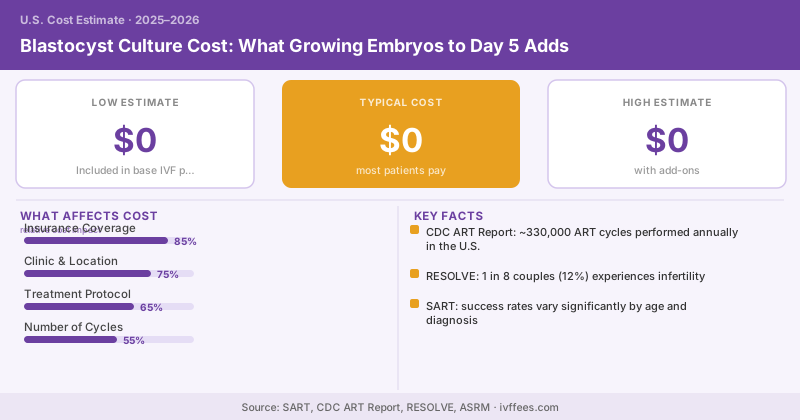
Pricing here is all over the map. Many clinics fold blastocyst culture into the base IVF fee. Others charge for the extended lab time and specialized media.
| Blastocyst Culture Scenario | Low | Typical | High |
|---|---|---|---|
| Included in base IVF package | $0 | $0 | $0 |
| Extended culture add-on (per cycle) | $300 | $750 | $1,500 |
| With time-lapse or premium media | $600 | $1,200 | $2,000 |
Blastocyst culture means growing embryos to day 5 or 6 instead of day 3. Many clinics include it in the base fee; others charge $300–$1,500 extra. It’s standard practice and well-supported, but it’s not right for every patient.
Why It Became the Norm
Blastocyst culture is one of the better-established practices in modern IVF — it’s not a fringe add-on. A Cochrane review on cleavage-stage versus blastocyst-stage transfer found higher live birth rates per fresh transfer with blastocyst transfer in good-prognosis patients. The selection advantage is real: transferring at day 5 lets the lab choose embryos that have already proven they can develop.
It’s also tied to single embryo transfer. The SART and ASRM have promoted elective single embryo transfer to reduce risky multiple pregnancies, and blastocyst culture makes that easier because you’re selecting one strong embryo rather than transferring several day-3 embryos hoping one takes.
When Day 3 Might Be Chosen Instead
Blastocyst culture isn’t automatically better for everyone. If you have only a few embryos, some clinics prefer a day-3 transfer because there’s concern that very few embryos might not survive to day 5 in the lab — the reasoning being that the uterus may be a better environment than the incubator for a struggling embryo.
So the decision depends on how many embryos you have and their quality. Your embryologist will guide the call.
Sorting Out Your Invoice
Because blastocyst culture is sometimes bundled and sometimes itemized, it’s a common source of billing confusion. When you review your estimate, check whether it’s a separate charge or already in your base IVF cost. Understanding what’s included in IVF cost helps you compare clinics fairly — one clinic’s “cheaper” package may simply have unbundled the lab fees.
Frequently Asked Questions
Is blastocyst culture better than a day-3 transfer? For good-prognosis patients, evidence supports higher live birth rates with blastocyst transfer because the lab can select the strongest embryos. But for patients with very few embryos, some doctors prefer a day-3 transfer. It depends on your embryo count and quality.
Why do some clinics charge extra for blastocyst culture? Extended culture requires more lab time, specialized growth media, and incubator space through day 5 or 6. Some clinics build that into the base IVF fee; others itemize it as a $300–$1,500 add-on.
Will all my embryos survive to day 5? No, and that’s part of the point. Many embryos that look healthy on day 3 stop developing by day 5. Extended culture reveals which embryos are strongest, so you transfer or freeze the ones most likely to succeed.
If you have only one or two embryos, ask your doctor whether extended culture is the right call. In rare cases, no embryos survive to day 5 in the lab, which can leave you with nothing to transfer.