What does a blocked fallopian tube actually cost to fix? That’s the wrong question to start with. The smarter question is whether you should fix it at all — because for many women, the cheapest path to pregnancy is to bypass the tubes completely rather than repair them.
Tubal factor accounts for a significant share of female infertility. The CDC estimates roughly 25–35% of female infertility involves the fallopian tubes. The treatment fork is stark: surgery to open the tubes, or IVF to make them irrelevant. The dollars look very different on each road.
First, You Have to Confirm the Blockage
Before any treatment, you need imaging. The standard test is an HSG (hysterosalpingogram) — dye injected into the uterus while X-rays watch whether it flows through the tubes. It’s part of nearly every fertility testing workup.
| Procedure | Low | Typical | High |
|---|---|---|---|
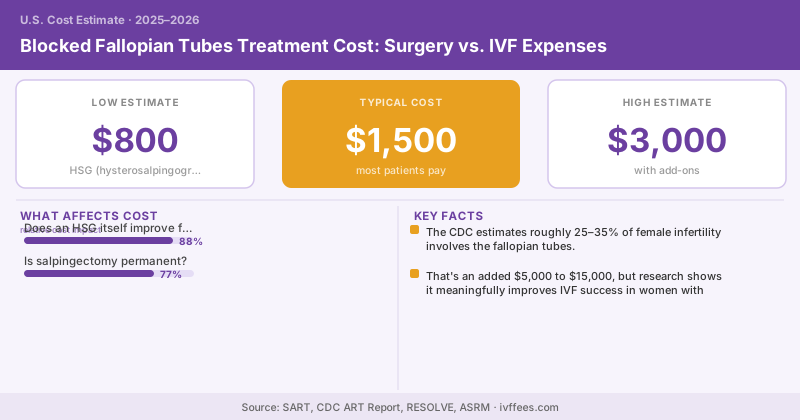
| HSG (hysterosalpingogram) | $800 | $1,500 | $3,000 |
| Sonohysterogram (saline ultrasound) | $400 | $800 | $1,500 |
| Laparoscopy with tubal evaluation | $5,000 | $9,000 | $15,000 |
| Tubal surgery (open the blockage) | $6,000 | $12,000 | $20,000 |
| Salpingectomy (tube removal before IVF) | $5,000 | $9,000 | $15,000 |
| IVF cycle (bypasses tubes) | $12,000 | $17,000 | $25,000 |
Option One: Tubal Surgery
If the blockage is mild and near the uterus, a relatively simple procedure (sometimes a tubal cannulation done during HSG) can clear it for a few thousand dollars. If the blockage is at the far end of the tube and the tube is dilated, surgery is more complex and less successful.
The honest numbers: tubal repair surgery has variable success, and even when a tube is opened, the delicate cilia inside may not work, raising ectopic pregnancy risk. ASRM notes that for many tubal-factor patients, IVF offers higher pregnancy rates than surgical repair.
Option Two: Skip the Tubes With IVF
IVF doesn’t care whether your tubes are open — it removes eggs directly from the ovary and places embryos directly in the uterus. For bilateral blockage or severely damaged tubes, IVF is often the recommended first-line treatment rather than attempting repair. A cycle runs $12,000 to $25,000 before fertility medications, but it sidesteps the tube problem entirely.
For one mildly blocked tube in a young woman, surgery may be worth trying because natural conception (or IUI) can follow cheaply. For two badly damaged tubes, most specialists recommend going straight to IVF — surgical repair often costs nearly as much as IVF while delivering lower pregnancy rates and higher ectopic risk.
The Hydrosalpinx Complication
A specific kind of tubal blockage — hydrosalpinx, a tube filled with fluid — actively lowers IVF success because the toxic fluid can wash back into the uterus and harm implantation. In this case, surgeons often recommend removing or clipping the affected tube (salpingectomy) before IVF. That’s an added $5,000 to $15,000, but research shows it meaningfully improves IVF success in women with hydrosalpinx.
Don’t pay for tubal repair surgery if your real goal is IVF anyway. If a damaged or fluid-filled tube will lower IVF success, the surgery you want is removal, not repair — and those are coded and priced differently. Make sure your surgeon understands whether you’re trying to conceive naturally or heading to IVF, because it completely changes the right procedure.
Insurance Considerations
Tubal surgery and salpingectomy are often covered under surgical/gynecological benefits, even on plans that exclude fertility treatment — especially when the procedure treats a disease state like hydrosalpinx or prevents complications. The IVF itself depends on your state mandate. If you’re in a non-mandate state and weighing your options, the surgery may be the only insurance-covered piece, which can tip the math. For the larger picture of paying for treatment, see IVF financing options.
Frequently Asked Questions
Can both tubes being blocked be fixed without IVF? Sometimes, with surgery — but success rates for repairing severely blocked tubes are modest, and ectopic risk rises. For bilateral severe blockage, ASRM and most REs favor IVF over surgical repair.
Does an HSG itself improve fertility? Possibly. Some studies suggest the dye flush during an HSG (especially oil-based contrast) may modestly increase pregnancy rates in the months afterward by clearing minor debris — a small bonus on top of the diagnostic value.
Is salpingectomy permanent? Yes. Removing a tube is irreversible, but if the tube is non-functional or filled with fluid, removing it removes a barrier to IVF success rather than sacrificing real fertility potential.
Bottom Line
Blocked fallopian tube treatment ranges from a $1,500 diagnostic HSG to $20,000 tubal surgery — or you bypass it all with a $12,000–$25,000 IVF cycle. For one mildly blocked tube, repair can be worth a shot. For severe bilateral blockage or hydrosalpinx, the money is usually better spent on IVF (plus tube removal when needed). Map out the surgery-versus-IVF math with your RE before committing to either.