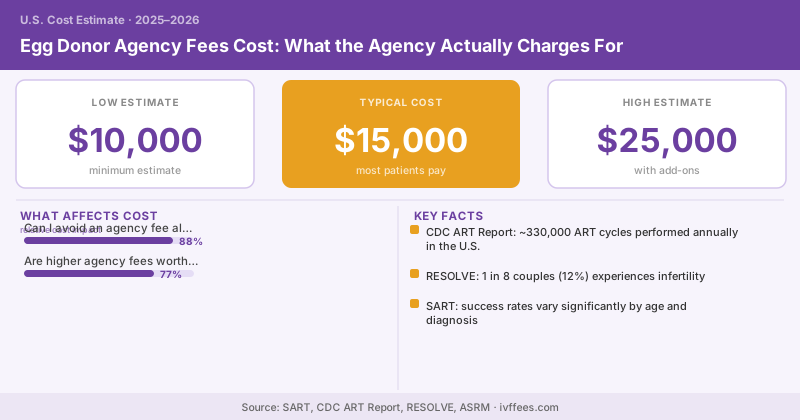
In 2010, you could match with an egg donor for an agency fee of around $4,000 to $6,000. Today that same service runs $8,000 to $20,000 — and that’s before you pay the donor a dime. Egg donor agency fees have roughly doubled in a decade as demand for screened, repeat-tested donors has outpaced supply.
So what does that money actually buy? Let’s pull the fee apart.
The Agency Fee Is Separate From Donor Compensation
First, clear up the biggest source of sticker shock. The agency fee and the donor’s compensation are two different things. The agency fee pays the matching company for its services. Donor compensation — typically $8,000 to $15,000, sometimes higher for proven or specialized donors — goes to the donor herself. You pay both.
Add in the medical cycle, and a fresh agency-matched donor egg IVF cycle commonly lands between $35,000 and $60,000 all-in.
What the Agency Fee Covers
| Agency Service | Included? | Typical Value |
|---|---|---|
| Donor recruitment & advertising | Yes | $2,000–$4,000 |
| Initial donor screening & vetting | Yes | $1,500–$3,000 |
| Donor database access & matching | Yes | $1,500–$3,500 |
| Case coordination & scheduling | Yes | $1,500–$4,000 |
| Travel coordination (if donor travels) | Sometimes | $1,000–$3,000 |
| Donor psychological screening | Sometimes | $500–$1,500 |
| Legal coordination | Sometimes | $1,000–$2,500 |
| Typical agency fee range | $8,000–$20,000 |
The biggest hidden value is recruitment. Agencies spend heavily to attract and pre-screen donors, then weed out the roughly 95% who don’t qualify. ASRM guidelines and FDA screening rules mean most applicants never make the cut. You’re paying for that filtering work.
Agency vs. Clinic-Based Donor Programs
You don’t always need an outside agency. Many fertility clinics run their own in-house donor programs, which can fold the matching service into the cycle cost and save you the standalone agency fee. The tradeoff is selection — clinic programs usually have smaller donor pools, while dedicated agencies offer broader databases with more detailed profiles, photos, and donor histories.
The egg donor agency fee ($8,000–$20,000) is a separate charge from donor compensation ($8,000–$15,000) and the medical cycle. If you want the widest selection and detailed profiles, an agency earns its fee. If you’re flexible on the donor and want to save, a clinic’s in-house program can eliminate the agency fee entirely.
Watch for Repeat-Match Guarantees
Some agencies charge the full fee per match attempt. If your first donor drops out or fails screening after you’ve paid, do you owe a second fee? This is where contracts vary enormously.
Read the cancellation and re-match policy before signing. A donor can withdraw at any point before retrieval, fail a medical screen, or produce too few eggs. Ask: if the cycle is canceled before retrieval, what’s refundable? If you need a new donor, is the agency fee waived or discounted? Agencies that charge a full fresh fee for every re-match can quietly double your costs.
Frozen Donor Eggs Skip the Agency Fee
If the agency fee is your sticking point, frozen donor egg banks are worth a hard look. Because the eggs are already retrieved and stored, there’s no live matching coordination — and the agency-style fee largely disappears. Frozen cohorts run $16,000 to $25,000 all-in, well under a fresh agency cycle. You give up egg volume and custom matching, but you keep a lot more money.
Negotiating and Reducing Agency Costs
A few practical moves to control the agency line:
- Ask about package pricing that bundles agency fee, screening, and legal coordination
- Choose a first-time donor over a proven donor to lower compensation (compensation, not agency fee)
- Compare three agencies — fees vary by thousands for nearly identical service
- Confirm what’s NOT included so medical and legal costs don’t ambush you later
And whatever the total, IVF financing options and multi-cycle packages can spread agency-matched donor costs over time.
Frequently Asked Questions
Why is the agency fee separate from what I pay the donor? The agency is a service business that recruits, screens, and matches donors. The donor is compensated separately for her time and the physical demands of a retrieval cycle. They’re two distinct transactions that just happen to land on the same invoice stack.
Can I avoid an agency fee altogether? Yes — use your clinic’s in-house donor program, choose frozen donor eggs from a bank, or work with a known egg donor. Each route trades some convenience or selection for savings.
Are higher agency fees worth it? Sometimes. A premium agency with a large, well-documented donor pool and strong re-match protections can save you a failed cycle, which costs far more than the fee difference. But many families match successfully through lower-cost programs. Compare the full all-in number against a standard IVF cost baseline before deciding.