What happens to fertility when a man can’t ejaculate, or ejaculates backward into the bladder, or has no fluid come out at all? It’s a real and treatable problem — and the cost depends entirely on which type of dysfunction you have.
Ejaculatory disorders are a less-discussed but genuine contributor to the 40–50% of infertility cases involving male factor, per the American Urological Association. They range from delayed and retrograde ejaculation to complete anejaculation, often tied to diabetes, spinal cord injury, surgery, or medications. Here’s what treatment costs.
Treatment Costs by Type
| Treatment | Used for | Low | Typical | High |
|---|---|---|---|---|
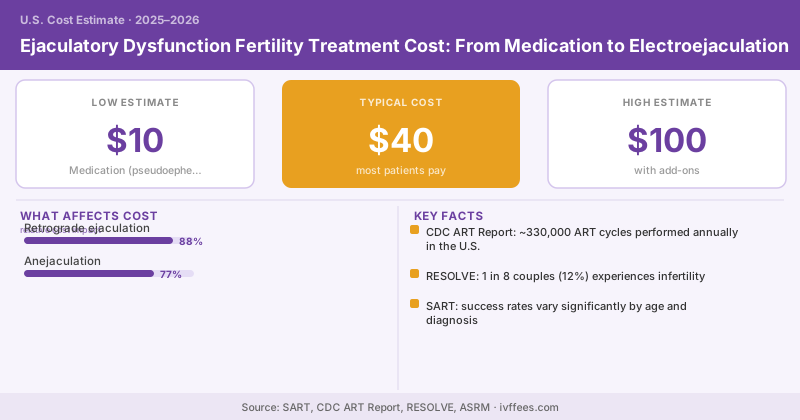
| Medication (pseudoephedrine, etc.) | Retrograde ejaculation | $10 | $40 | $100/mo |
| Adjusting/stopping causative meds | Drug-induced cases | $0 | $50 | $200 |
| Bladder sperm retrieval + wash | Retrograde ejaculation | $300 | $800 | $2,000 |
| Penile vibratory stimulation | Anejaculation (some) | $300 | $700 | $1,500 |
| Electroejaculation (EEJ) | Anejaculation/spinal injury | $1,500 | $3,000 | $5,000 |
| Surgical sperm retrieval (TESE) | When above fail | $3,000 | $5,000 | $8,000 |
Ejaculatory dysfunction treatment ranges from $30/month medication for retrograde ejaculation to $5,000+ for electroejaculation. The good news: even men who can’t ejaculate at all can usually have sperm retrieved for IVF. The key is matching the treatment to the exact type of dysfunction.
Matching Treatment to the Problem
Retrograde ejaculation. Semen goes backward into the bladder instead of out — common in diabetics and after prostate surgery. Often treatable with medications like pseudoephedrine that tighten the bladder neck. If medication fails, sperm can be recovered from the bladder, washed, and used for IUI or IVF for a few hundred to a couple thousand dollars.
Anejaculation. No ejaculation occurs, frequently from spinal cord injury or nerve damage. Penile vibratory stimulation is tried first; if that fails, electroejaculation (EEJ) uses a probe to stimulate ejaculation under sedation. EEJ is highly effective at producing a sperm sample.
Delayed ejaculation and medication-induced cases. Sometimes the culprit is a drug (certain antidepressants, alpha-blockers). Adjusting or switching medications with your doctor can resolve it cheaply.
A full male fertility evaluation pinpoints which type you have, which determines the cost path. Don’t skip the diagnosis.
When Sperm Retrieval Is Needed
If medications and stimulation techniques don’t yield usable sperm, surgical retrieval like TESE pulls sperm directly from the testicle for use with IVF and ICSI. This is the fallback for the most resistant cases — for example, severe spinal cord injury where even EEJ doesn’t work. Whatever sperm is recovered, very little is needed for ICSI.
If you’re on a medication that may be causing the problem (some antidepressants, blood pressure drugs, or alpha-blockers used for prostate or BPH), never stop it on your own. Work with the prescribing doctor to adjust it — abruptly stopping certain medications is dangerous, and a coordinated switch is the safe, cheap first step.
The Cost-Smart Sequence
Start cheap and escalate only as needed: identify the type, try medication or med adjustment, then bladder retrieval or vibratory stimulation, then EEJ, and finally surgical retrieval. Many men resolve retrograde ejaculation for under $100 a month. Even when IVF becomes necessary, getting a viable sperm sample is almost always achievable.
Frequently Asked Questions
Can a man who can’t ejaculate at all still have biological children? Yes. Penile vibratory stimulation, electroejaculation, or surgical sperm retrieval can obtain sperm even from men with complete anejaculation or spinal cord injury. That sperm is then used with IUI or IVF with ICSI. Inability to ejaculate is not the same as inability to produce sperm.
Is retrograde ejaculation treatment covered by insurance? Medications like pseudoephedrine are cheap regardless. Diagnostic testing and treatment of an underlying medical cause (diabetes, post-surgical) may be covered. The assisted reproduction steps — IUI or IVF — follow your plan’s fertility coverage rules.
How do I know if I have retrograde ejaculation? A telltale sign is little or no ejaculate during orgasm, sometimes with cloudy urine afterward. A post-orgasm urinalysis checking for sperm in the bladder confirms it. A semen analysis showing very low volume also raises the suspicion.