42% of IVF cycles in the US produce more embryos than the patient ever uses. Those surplus embryos can be donated — and for intended parents priced out of donor egg IVF at $35,000–$55,000, donated embryos offer a genuinely lower-cost path to parenthood. The catch is understanding what you’re actually getting.
Here’s the full picture.
Embryo Donation vs. Embryo Adoption: What’s the Difference?
These terms get used interchangeably, but they describe meaningfully different processes.
Embryo donation is a medical and legal transaction. Fertility clinics match embryo donors (typically patients with surplus frozen embryos) with recipients. You sign a legal agreement, pay a matching or administrative fee, and undergo a frozen embryo transfer (FET) cycle. No home study. No agency. The process stays within the medical system.
Embryo adoption treats the transfer of embryos more like an adoption proceeding. It typically involves a third-party agency (often faith-based, such as Nightlight Christian Adoptions’ Snowflakes program), a home study by a licensed social worker, background checks, and sometimes an interview process to evaluate the recipients. The agency then facilitates matching with donor families who may want some say in where their embryos go.
Legally, “embryo adoption” isn’t adoption in any US state. Courts have consistently ruled that frozen embryos are property, not persons, and the transfer is governed by reproductive law and contract — not family or adoption law. But the process functionally mimics adoption in its thoroughness and timeline.
The Cost Breakdown
| Pathway | Matching/Acquisition Fee | FET Cycle | Total Estimate |
|---|---|---|---|
| Clinic-based donation (open match) | $2,000–$5,000 | $3,000–$6,000 | $5,000–$11,000 |
| Clinic-based donation (anonymous) | $1,000–$3,000 | $3,000–$6,000 | $4,000–$9,000 |
| Agency-based adoption (e.g., Snowflakes) | $5,000–$10,000 | $3,000–$6,000 | $8,000–$16,000 |
| Legal fees (all pathways) | $500–$2,000 | — | $500–$2,000 |
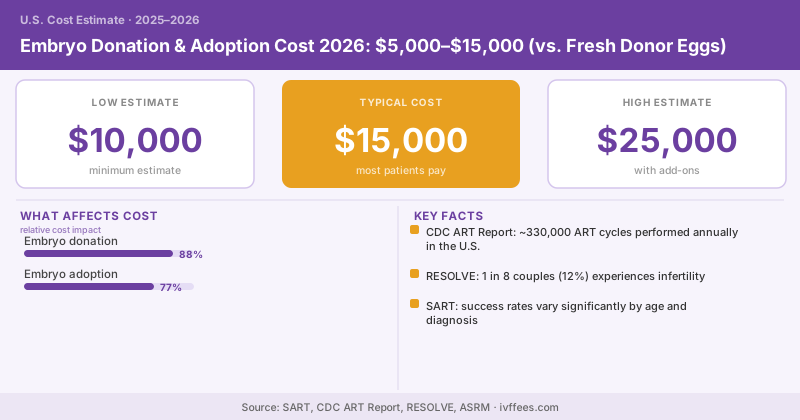
| All-in typical range | — | — | $5,000–$15,000 |
Compare that to fresh donor egg IVF ($35,000–$55,000) or even frozen donor egg IVF ($16,000–$34,000). For patients who don’t have a genetic connection requirement, donated embryos represent the lowest-cost third-party option.
What the Home Study Involves (Adoption Pathway)
If you go through an agency-based adoption program, you’ll typically need:
- A home study conducted by a licensed social worker ($1,000–$2,500 on its own)
- Criminal background checks for both partners
- Medical and psychological evaluations
- References and sometimes a home visit
- An application essay or interview with the agency
The home study process adds 2 to 4 months to the timeline. Some donors specifically choose the adoption pathway because they want reassurance about where their embryos are going — and the home study provides that. Others find the intrusion uncomfortable given that no home study is required for people who conceive naturally.
If you’re primarily motivated by cost and timeline, clinic-based embryo donation is almost always faster (weeks, not months) and $3,000–$7,000 cheaper than agency-based adoption programs. The trade-off is less contact with donor families and less ability to share background information with the donors. Both pathways produce the same medical procedure at the end — a frozen embryo transfer.
Legal Fees Are Non-Negotiable in Either Path
Even through a clinic-based program, you need a legal agreement executed before the transfer. This agreement:
- Terminates the donors’ parental rights to the embryos
- Establishes the recipients as the legal intended parents
- Covers disclosure terms (what, if anything, the child can know about their genetic origins)
A reproductive attorney typically charges $500–$2,000 to draft and execute this agreement. Some clinics include a template agreement in their program fee; others require you to retain separate counsel. Either way, don’t skip the legal step — without a signed agreement before the transfer, the donors may retain some legal claim depending on your state.
Success Rates: What You’re Actually Getting
This is the hardest part of the cost equation. Unlike donor egg IVF, where the donor’s age and medical history are known, donated embryos come from a range of prior IVF patients — some with multiple failed cycles, some with surplus blastocysts from highly successful retrievals.
The CDC’s 2022 Assisted Reproductive Technology national data report shows that frozen embryo transfers using donor embryos achieve a live birth rate of approximately 35–38% per transfer nationally. That’s lower than fresh donor egg IVF (~47%) but comparable to FET cycles using a patient’s own frozen embryos in good-prognosis cases.
What really drives success is the embryo’s grade and whether it’s been chromosomally tested. PGT-A-screened embryos donated from successful cycles can perform similarly to fresh donor eggs. Un-tested embryos from patients with prior failures carry more uncertainty.
Ask any clinic or agency program: are the embryos PGT-A tested? What grade are they (day-5 blastocyst vs. day-3 cleavage)? That information changes the expected success rate significantly.
Embryo Donation vs. Fresh Donor Eggs: The Trade-Off
| Factor | Donated Embryos | Fresh Donor Egg IVF |
|---|---|---|
| Typical all-in cost | $5,000–$15,000 | $35,000–$55,000 |
| Genetic connection | None (to either partner) | One partner (egg recipient) |
| Live birth rate per transfer | ~35–38% | ~47% |
| Wait time | Days to 3 months | 4–8 weeks (matching + cycle) |
| Number of embryos | Variable (often 1–5) | Typically more embryos per retrieval |
The financial savings are real. The trade-off is a meaningful reduction in per-transfer success probability, no genetic connection for either intended parent, and less certainty about embryo quality and history.
Some clinic-based embryo donation programs have very limited inventories — waiting lists of 6 to 18 months are not unusual at programs with strong demand. Factor timeline into your decision, especially if age-related urgency matters for your situation.
The Bottom Line
Embryo donation (clinic-based) runs $5,000–$11,000 all-in. Embryo adoption through an agency runs $8,000–$16,000. Both are dramatically cheaper than fresh donor egg IVF. Success rates are real but lower than fresh donor cycles — and the gap narrows considerably when you receive PGT-A-tested, high-grade blastocysts. For patients who’ve exhausted their own eggs or who don’t require a genetic connection, donated embryos are among the most cost-effective paths available.
Cost estimates based on published program fees from Nightlight Christian Adoptions Snowflakes, National Embryo Donation Center, and major US fertility clinics. CDC 2022 ART Surveillance data used for success rate comparisons.