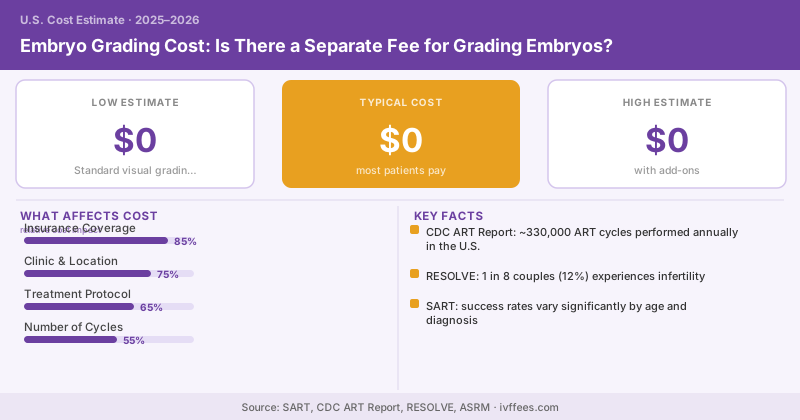
Here’s a number that surprises people: $0. That’s what most clinics charge specifically for grading your embryos. Yet patients regularly ask about “embryo grading cost,” because the term sounds like a service you’d pay for. The reality is more nuanced, and a few situations do carry real charges.
Let’s untangle what embryo grading is, why it’s usually free, and where actual costs hide.
What Embryo Grading Is
After fertilization, embryologists evaluate your embryos under a microscope and assign each one a grade based on its appearance. For a day-5 blastocyst, grading typically covers three things: how expanded the blastocyst is (a number), the quality of the inner cell mass that becomes the baby (a letter), and the quality of the trophectoderm that becomes the placenta (a letter). A grade like “4AA” means a fully expanded blastocyst with top-quality cell masses.
This visual assessment helps the lab decide which embryo to transfer first and which to freeze.
Why It’s Usually Free
Grading is part of the embryologist’s routine work. It’s baked into your lab fee, just like checking fertilization or monitoring development. No reputable clinic charges a standalone “grading fee” — it’s like a restaurant charging extra for the chef to look at your food.
| Embryo Grading Scenario | Low | Typical | High |
|---|---|---|---|
| Standard visual grading (per cycle) | $0 | $0 | $0 |
| Time-lapse imaging for selection | $300 | $600 | $1,000 |
| AI embryo-scoring software | $200 | $500 | $1,200 |
| PGT-A (genetic, not visual, grading) | $3,000 | $4,500 | $6,000 |
Standard embryo grading — the visual assessment that produces grades like 4AA — is included in your IVF lab fee at no separate charge. Real costs only appear when grading is enhanced with time-lapse imaging, AI scoring, or genetic testing.
Where the Real Costs Hide
If you see a charge connected to embryo evaluation, it’s almost always one of these:
- Time-lapse imaging. Some labs add a camera-based incubator to assist selection, charging $300–$1,000. See our time-lapse imaging guide — though note the evidence for it is mixed.
- AI embryo scoring. Software that ranks embryos using machine learning is a newer add-on, typically $200–$1,200.
- Genetic testing. PGT genetic testing and the embryo biopsy it requires are sometimes confused with grading, but they test chromosomes, not appearance, and cost thousands.
Visual grading and genetic testing are different things. A 4AA embryo can still be chromosomally abnormal, and a lower-graded embryo can be euploid. That’s why some patients do both.
What the Evidence Says
Morphological grading is the long-standing standard, but it’s imperfect. Studies have shown that visual grade correlates with success but doesn’t predict it precisely — appearance and chromosomal health don’t always match. The ASRM has noted that newer selection technologies like AI scoring and time-lapse are promising but not yet proven to outperform traditional grading in live birth rates. The HFEA rates several of these enhanced-selection add-ons at amber, meaning the evidence is still developing.
CDC ART data underscores why selection matters at all: success rates vary widely by patient age and embryo quality, so picking the best embryo is genuinely important — it’s just not something you should be billed extra for in its basic form.
Bottom Line for Your Budget
Don’t budget separately for embryo grading. Do budget for the optional technologies that sometimes get bundled with “advanced grading” language. When you compare clinics, fold these into your view of the full IVF cost so you’re not fooled by a low headline price that quietly unbundled the lab work.
Frequently Asked Questions
Do clinics charge a fee just for grading embryos? No. Standard visual grading is part of the embryologist’s routine work and is included in your lab fee. If you see a separate charge, it’s for an enhancement like time-lapse imaging, AI scoring, or genetic testing — not basic grading.
Does a higher embryo grade guarantee success? No. Grade correlates with success but doesn’t predict it. A top-graded 4AA embryo can still be chromosomally abnormal, and a lower-graded embryo can be genetically normal. That’s why some patients add genetic testing on top of visual grading.
Is AI embryo grading worth paying for? The evidence is still developing. The ASRM considers AI selection promising but not yet proven to beat traditional grading on live birth rates, and the HFEA rates it amber. If your clinic offers it as a paid add-on, ask what data supports it for patients like you.
Watch for clinics that rebrand standard grading as “advanced embryo assessment” and attach a fee. Basic morphological grading should never cost extra — ask exactly what any “grading” charge is actually paying for.