Your embryo survived the retrieval. The fertilization. The biopsy. The freeze. Now it’s time to thaw it — and yes, there’s a fee for that too.
The embryo thawing fee is one of the smaller costs in a frozen embryo transfer cycle, but it’s also one of the most frequently overlooked when patients first hear the FET price. Here’s exactly what you’re paying for and what to expect from the process.
What the Thaw Fee Actually Covers
Embryo thawing — more precisely called “warming” in the clinical literature — is a carefully controlled laboratory process. The embryologist removes the embryo from liquid nitrogen storage (where it’s kept at -196°C), places it into a series of warming solutions at precisely controlled temperatures, and gradually restores it to physiological conditions over roughly 15–30 minutes.
It’s not just “take it out of the freezer.” The warming solution protocol, the timing, the temperature transitions — all of it requires specialized training and equipment. The fee covers:
- Embryologist time and expertise
- Warming solutions and materials
- Microscopy assessment of embryo survival and quality post-thaw
- Documentation and quality control records
- Lab preparation and post-thaw monitoring
| Thaw Fee Component | Low End | Typical | High End |
|---|---|---|---|
| Embryo warming lab fee | $300 | $650 | $1,200 |
| Post-thaw assessment | Usually included | Included | Included |
| Hatching assist (if applied) | $250 | $400 | $750 |
| Additional embryo thaw (if first fails) | $0–$300 | $300–$600 | $600–$1,000 |
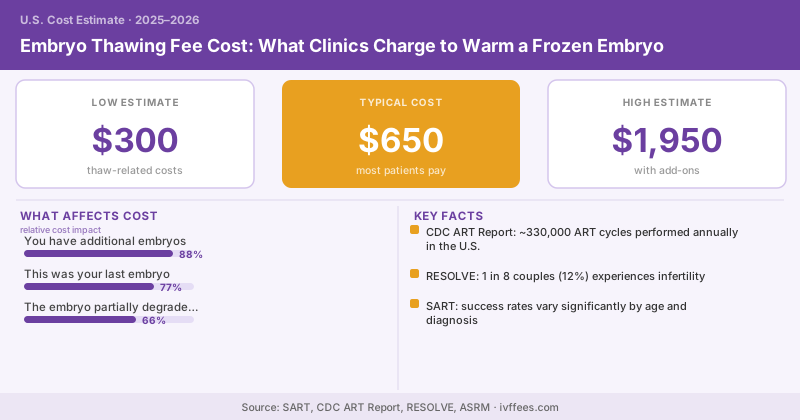
| Total thaw-related costs | $300 | $650–$1,050 | $1,950 |
Blastocyst vs. Day-3 Embryo Thaws
Most clinics today freeze embryos at the blastocyst stage — around Day 5 or 6 after fertilization — rather than Day 3. Blastocysts are more developed, have undergone more cellular division, and have demonstrated their ability to survive to a more advanced stage. They’re also more accurately assessable by the embryologist post-thaw.
Day-3 embryos are less commonly frozen now except in specific circumstances (early-stage embryo transfer protocols, some PGT scenarios). The thaw process is similar, but survival rates at blastocyst stage are slightly higher — typically 97–99% for vitrified blastocysts vs. 90–95% for Day-3 embryos at experienced labs.
The fee structure is usually the same regardless of stage.
Survival Rates: What to Expect
Modern vitrification — the flash-freezing technology that replaced slower “slow-freeze” methods in most U.S. clinics — delivers consistently high embryo survival rates. According to published data in Fertility and Sterility and SART outcome reports, vitrified blastocyst survival rates at experienced centers exceed 95%, with many programs reporting 97–99%.
This is a significant improvement over slow-freeze methods, which had survival rates of 75–90%. If your embryos were frozen before roughly 2010–2012, they may have been slow-frozen, and survival odds upon thaw are lower.
A “surviving” embryo means it remained intact through the thaw process. It doesn’t guarantee the embryo will be suitable for transfer — the embryologist assesses post-thaw quality and may determine that even a surviving embryo has deteriorated too much for optimal chances. This is uncommon but it happens, particularly with lower-grade embryos.
What Happens If the Embryo Doesn’t Survive
If an embryo is lost during thawing, your clinic should notify you immediately — usually a same-day call before you come in for transfer. What happens next depends on how many frozen embryos you have stored:
You have additional embryos: The clinic will typically thaw another embryo. Policies vary on whether a second thaw attempt is billed at full fee or reduced/waived. Ask your clinic specifically what their policy is before your transfer cycle begins.
This was your last embryo: If the embryo doesn’t survive and there are no others, the FET cycle is cancelled. You’d face the option of doing another full IVF retrieval cycle — a significant emotional and financial reset.
The embryo partially degrades: In some cases, an embryo survives the thaw but with some cellular damage. The embryologist assesses whether the damage affects viability. Some patients choose to transfer a partially degenerated embryo; others cancel and try again.
Batch Thawing: Thawing Multiple Embryos at Once
Some patients, particularly those doing PGT-tested transfers where embryo quality is already confirmed, choose to thaw one embryo at a time (sequential). Others with several untested frozen embryos may ask about thawing two or more to select the best-looking one for transfer.
Most clinics don’t routinely recommend thawing extras just to select, because:
- Embryos not transferred can’t be re-frozen with comparable survival rates
- Each thaw carries a small attrition risk
- Policies around “excess” thawed embryos vary by clinic and state
If you have a specific reason for wanting to compare embryos (e.g., you have several Day-5 blastocysts of varying grades), discuss this with your reproductive endocrinologist before transfer day.
Do not assume embryos can be re-frozen after thawing. Re-vitrification of a thawed embryo is technically possible but significantly reduces subsequent survival rates. Once thawed, the embryo is either transferred, discarded, or donated — re-freezing is rarely recommended and many clinics don’t offer it.
How Clinics Bill the Thaw Fee
There’s no standardization across clinics. Three common billing structures:
- Bundled FET price — the thaw is included in a flat $3,500–$6,000 FET fee. Most large clinics do this.
- Itemized add-on — the FET procedure fee is quoted separately from the embryo warming fee ($500–$1,500 added on top).
- Included in annual storage fee — rare, but some clinics bundle the first thaw into storage pricing.
When comparing FET costs across clinics, always confirm whether the quoted price includes embryo warming. A clinic quoting $3,200 with the thaw included may be cheaper than one quoting $2,800 with a $900 thaw fee added.
The Bottom Line
The embryo thaw fee runs $500–$1,500 at most clinics, and modern vitrification means embryo survival exceeds 95% in experienced hands. It’s not the largest line item in your FET cycle, but it’s real money worth budgeting for — and worth understanding before your transfer day arrives.
Ask your clinic for an itemized estimate that explicitly includes or excludes the warming fee. And confirm their policy on additional thaws if the first embryo doesn’t make it.
Data sourced from published outcomes in Fertility and Sterility, SART 2022 Clinic Summary Report, and ASRM Laboratory Practice Guidelines for embryo cryopreservation.