Imagine paying an extra $1,200 and waiting a full extra month, all to fine-tune the timing of your embryo transfer by a few hours. That’s the ERA test. For some patients it sounds like exactly the precision they’ve been missing. For others it’s an expensive detour with shaky evidence. The truth depends on your history — and on a 2022 trial that surprised a lot of people.
Let’s compare the ERA route against a standard transfer, cost and evidence side by side.
What the ERA Test Is
ERA stands for Endometrial Receptivity Analysis. It’s a genetic test of your uterine lining designed to pinpoint your personal “window of implantation” — the specific time your endometrium is most receptive to an embryo.
To do it, you go through a mock cycle (taking the same hormones as a real transfer cycle), then have a biopsy of your uterine lining. The sample is analyzed to see whether your window is normal, early (pre-receptive), or late (post-receptive). The result is used to adjust the timing of your real frozen embryo transfer.
Cost Comparison: ERA vs Standard
| Transfer Approach | Low | Typical | High |
|---|---|---|---|
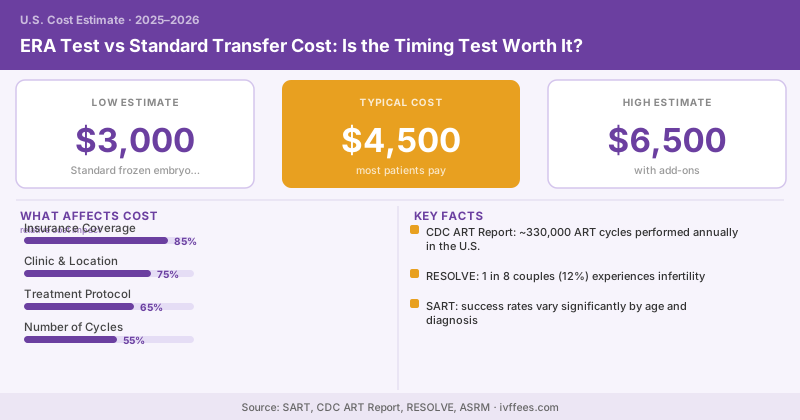
| Standard frozen embryo transfer | $3,000 | $4,500 | $6,500 |
| ERA test (analysis fee) | $700 | $1,000 | $1,500 |
| ERA mock cycle (meds + monitoring + biopsy) | $500 | $1,200 | $2,500 |
| Total added cost of the ERA route | $1,200 | $2,200 | $4,000 |
So the ERA approach isn’t just the test fee — it’s the test plus a whole extra mock cycle with its own medication and monitoring costs.
A standard frozen embryo transfer runs $3,000–$6,500. Adding an ERA test layers on $1,200–$4,000 (test plus mock cycle) and delays your transfer by a cycle. A large 2022 trial found ERA didn’t improve live birth rates for most patients.
What the Big Trial Found
This is the part that reshaped the debate. A 2022 randomized controlled trial published in Fertility and Sterility compared personalized embryo transfer guided by ERA against standard-timing transfer. It found no significant improvement in live birth rates from using the ERA test for the general IVF population.
That result aligned with the broader skepticism the ASRM has expressed about IVF add-ons being marketed ahead of solid evidence. The HFEA’s add-on rating system also places endometrial receptivity testing at a cautious rating, noting the evidence doesn’t yet support routine use to improve birth rates.
In short: for most patients undergoing their first or second transfer, the data doesn’t support adding the ERA.
When Might It Still Be Considered?
Some clinics still offer ERA for patients with recurrent implantation failure — multiple good embryos transferred without success. The reasoning is that timing might be the missing variable in a minority of cases. But even here, the evidence is debated, and you should treat it as a discussion, not a default.
If you’ve had a single failed transfer, jumping straight to ERA is probably premature given the cost and the trial results.
Making the Call
Before adding an ERA, weigh it against where else that $1,200–$4,000 could go — another transfer attempt, PGT genetic testing, or simply your savings. Ask your clinic to justify it for your specific case, not as a routine step. Understanding what’s included in your IVF cost helps you see whether ERA is being offered as evidence-based care or as an upsell.
Frequently Asked Questions
Does the ERA test improve IVF success rates? For most patients, the strongest evidence says no. A 2022 randomized trial in Fertility and Sterility found ERA-guided transfer didn’t significantly improve live birth rates versus standard-timing transfer. Some clinics still consider it for recurrent implantation failure, but even that’s debated.
How much does the ERA test add to a transfer cycle? Expect $1,200–$4,000 total. That includes the analysis fee ($700–$1,500) plus a full mock cycle with medications, monitoring, and a biopsy ($500–$2,500). It also delays your real transfer by at least one cycle.
Should I get an ERA before my first transfer? Most experts would say no. The 2022 trial found no benefit for the general population, so adding ERA before you’ve even attempted a standard transfer is hard to justify on the evidence and adds significant cost and delay.
The ERA isn’t just a test fee — it requires a separate mock cycle with its own medication and monitoring costs, plus a one-cycle delay. Make sure any quote you’re given includes the full cost of the mock cycle, not just the lab analysis.