Illinois mandated IVF coverage in 1991. Most states still have nothing.
That one-sentence summary captures why fertility treatment costs vary so dramatically across the United States — and why two patients with identical diagnoses, identical treatment plans, and identical employers can face bills that differ by $30,000 or more based solely on their ZIP code.
Here’s a clear-eyed breakdown of which states have mandates, what those mandates actually cover, and — critically — who falls through the exemption gaps.
The Two Types of State Mandates
Before looking at specific states, understand the crucial distinction between mandate types:
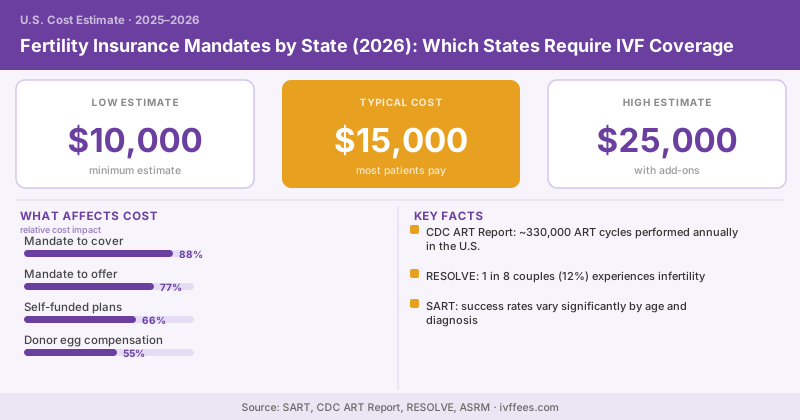
Mandate to cover: Insurers selling plans in the state must include fertility benefits in their policies. These are the strong mandates. Patients in these states with qualifying fully-insured plans typically have IVF covered.
Mandate to offer: Insurers must make a fertility benefit available as an option — but employers can decline to purchase it. These are largely symbolic for most workers.
According to RESOLVE: The National Infertility Association, which tracks state legislation, approximately 21 states had some form of fertility insurance law as of 2026. The number with meaningful IVF coverage mandates is smaller.
States With IVF Coverage Mandates (2026)
| State | IVF Mandate Type | Cycles Covered | Key Limits |
|---|---|---|---|
| Illinois | Mandate to cover | 4 retrievals lifetime | Married only under original law; newer expansions broader |
| Massachusetts | Mandate to cover | Unlimited (medically necessary) | Age and diagnosis criteria apply |
| Connecticut | Mandate to cover | 3 IVF cycles | Employer size exemptions apply |
| New Jersey | Mandate to cover | 4 cycles per lifetime | Diagnosis of infertility required |
| Maryland | Mandate to cover | 3 IVF cycles | Some employer exemptions |
| New York | Mandate to cover | 3 cycles | 2020 expansion; large group plans |
| Rhode Island | Mandate to cover | 3 IVF cycles | Defined infertility diagnosis required |
| Hawaii | Mandate to cover | 1 IVF cycle | One attempt only |
| Arkansas | Mandate to cover | Limited | Excludes donor eggs |
| Montana | Mandate to cover | Limited | Small employer exemptions |
| New Hampshire | Mandate to cover | Varies by plan | Recent legislation; scope evolving |
Several more states — including California, Colorado, and others — have passed expanded fertility coverage laws in recent years that cover some but not all IVF-related expenses. State laws evolve; check RESOLVE’s current mandate tracker at resolve.org for up-to-date status.
States With Infertility Coverage But Not IVF
A number of states require coverage for infertility diagnosis and treatment without specifically requiring IVF. These typically cover diagnostic tests (bloodwork, ultrasounds, semen analysis, HSG tubes assessment) and lower-tech treatments like intrauterine insemination (IUI), but not IVF itself:
- California (expanded in 2023 to include some IVF, phased in)
- Ohio
- West Virginia
- Various others with partial mandates
“Infertility coverage” sounds promising but can mean only $1,000–$5,000 in diagnostic tests if IVF isn’t explicitly required.
States With No Fertility Insurance Mandates
The majority of U.S. states have no fertility insurance mandate at all. In these states, IVF is an out-of-pocket expense regardless of which insurer you have:
- Texas, Florida, Georgia, North Carolina, Virginia, Pennsylvania, Michigan, Wisconsin, Minnesota (no mandate), Arizona, Nevada, and most other states
Patients in non-mandate states are entirely dependent on voluntary employer fertility benefits, which some large employers provide but most do not.
Fertility insurance legislation moves quickly. Several states have passed or expanded mandates since 2022. RESOLVE: The National Infertility Association maintains a current state-by-state mandate tracker at resolve.org/what-are-my-options/insurance-coverage/infertility-coverage-in-your-state/. Check this before assuming your state’s status.
The Self-Funded Plan Exemption — The Biggest Gap
This is the part that blindsides most patients in mandate states.
State fertility mandates apply only to fully insured plans — policies where the employer pays an insurance company to assume risk. These plans are regulated by state insurance law, so state mandates bind them.
Self-funded plans — where the employer directly pays employee medical claims and just hires an insurer to administer paperwork — are governed by federal ERISA law. ERISA doesn’t require any fertility coverage. State mandates don’t touch them.
Per KFF’s 2023 Employer Health Benefits Survey, 65% of covered workers are in self-funded plans. That includes most employees of mid-size and large companies, regardless of state.
This means: if you work for a company with 500+ employees in Massachusetts — one of the strongest mandate states — there’s a good chance your plan is self-funded and your IVF coverage is whatever your employer chose to include, not what state law requires.
Ask HR directly: “Is our health plan fully insured or self-funded?” A self-funded plan means state mandates don’t apply to you. If the answer is self-funded, ask what voluntary fertility benefits the plan includes — many large employers have added fertility coverage voluntarily through programs like Progyny or Carrot Fertility, even without a legal mandate.
What Mandates Typically Don’t Cover
Even strong state mandates tend to exclude:
Donor egg compensation. Donor egg IVF involves paying a separate egg donor — typically $8,000–$30,000 in compensation and agency fees. State mandates that cover IVF usually cover the recipient’s transfer cycle but not donor egg procurement costs.
Embryo storage. Annual embryo storage fees ($500–$1,200/year) are rarely covered by mandate or insurance.
Surrogacy. Gestational carrier arrangements are excluded from fertility mandates in virtually every state.
Age limits. Many mandates include upper age cutoffs — often 40–44 — that exclude patients using own eggs above that age. Patients over 45 are almost universally uncovered even in strong mandate states.
Experimental protocols. Newer add-ons like ERA testing, some immunological treatments, or research-phase protocols are typically excluded.
How to Actually Verify Your Coverage
Don’t rely on your state’s mandate status alone. The only way to know what you’re covered for:
- Call your insurer’s fertility case management line (the number is usually on your insurance card)
- Ask for your Summary Plan Description (SPD) — specifically the fertility benefits section
- Confirm: Is your plan fully insured or self-funded?
- If covered: How many IVF cycles? Is there a lifetime maximum dollar amount? What diagnoses qualify?
Many patients discover their coverage only after the bill arrives. A 20-minute call before starting treatment can save you from a $20,000 surprise.
Bottom Line
As of 2026, roughly 11–15 states have meaningful IVF coverage mandates — but the self-funded plan exemption means most American workers don’t benefit from them even when they live in mandate states. RESOLVE’s data suggests fewer than 30% of fertility patients have any meaningful insurance coverage for IVF.
If you’re in a mandate state and have a fully-insured employer plan, your IVF costs may be substantially covered. For everyone else, understanding what you owe before you start is the first step in building a financial plan around treatment.
Data sourced from RESOLVE: The National Infertility Association state mandate tracker (2026), KFF 2023 Employer Health Benefits Survey, and NCSL fertility coverage state law database.