Before starting testosterone, Alex had one question for his doctor: how much would it cost to freeze his eggs first, and could he do it before his first injection?
That’s an increasingly common conversation as awareness grows about how gender-affirming hormone therapy can affect future fertility. Here’s what preservation actually costs and why the timing question matters so much.
What Fertility Preservation Costs by Method
| Preservation Option | Low End | Typical | High End |
|---|---|---|---|
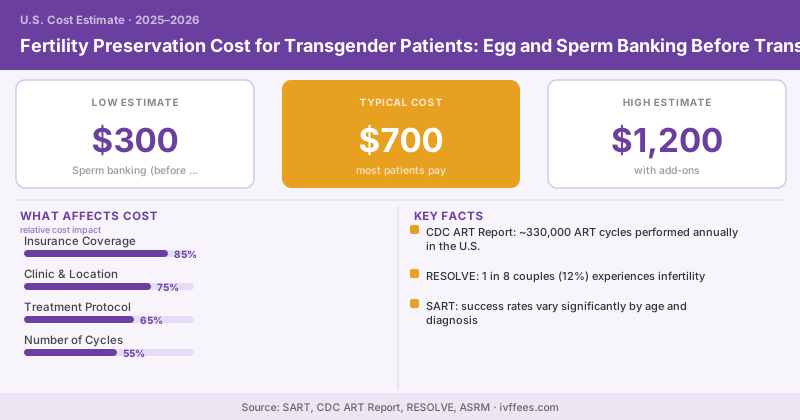
| Sperm banking (before estrogen) | $300 | $700 | $1,200 |
| Egg freezing (before testosterone) | $7,000 | $10,500 | $15,000 |
| Embryo freezing (with partner, before testosterone) | $8,000 | $12,000 | $17,000 |
| Annual storage (either method) | $150 | $400 | $700 |
The cost structure mirrors standard fertility preservation generally — sperm banking is comparatively fast and affordable, while egg or embryo freezing involves a full ovarian stimulation cycle and retrieval procedure, driving significantly higher cost.
Why Timing Matters Before Starting Hormones
Major medical organizations, including the Endocrine Society’s clinical practice guidelines for gender-affirming care, recommend discussing fertility preservation with patients before starting hormone therapy, since testosterone and estrogen can both affect fertility in ways that aren’t reliably or fully reversible for every patient even after stopping treatment. This is why the conversation ideally happens as early as possible in a patient’s transition planning — not as an afterthought once hormone therapy is already underway.
If preserving the option for biological children is important to you, raise fertility preservation with your provider at your very first gender-affirming care consultation, before any hormone prescription is written. Some patients choose to proceed with a short preservation process first and begin hormones immediately afterward, which is generally easier to coordinate than pausing hormone therapy later to preserve fertility.
Insurance Coverage Has Improved, But Isn’t Uniform
A meaningful number of states have passed laws requiring insurance coverage for fertility preservation when it’s tied to a medically necessary treatment expected to cause infertility — laws originally aimed largely at cancer patients but which advocates argue should logically extend to gender-affirming hormone therapy given the similar fertility impact. Whether a specific insurer applies this coverage to transgender patients varies significantly, and it’s worth having your provider document the fertility-related rationale clearly when submitting for prior authorization or coverage review.
Finding an Affirming Clinic Matters as Much as Cost
Beyond the financial question, transgender patients considering fertility preservation benefit significantly from working with a fertility clinic experienced in gender-affirming care specifically — comfortable with a patient’s correct name and pronouns, familiar with how hormone therapy history affects protocol planning, and generally practiced in creating a comfortable clinical environment for transgender patients. Organizations like RESOLVE and various LGBTQ+ family-building advocacy groups maintain referral lists for clinics with specific experience in this area, which is worth researching alongside cost comparisons.
If you’ve already started hormone therapy, don’t assume fertility preservation is no longer an option — many patients still successfully bank eggs or sperm after some time on hormones, sometimes after a temporary pause under medical guidance, though results and timelines vary by individual. Talk to a fertility specialist directly about your specific situation rather than assuming the door has closed.
The Bottom Line
Budget $300–$1,200 for sperm banking or $7,000–$17,000 for egg or embryo freezing before starting gender-affirming hormone therapy, plus modest annual storage after that. Raise the fertility preservation conversation with your provider as early as possible — ideally before your first hormone prescription — since timing significantly affects both your options and your peace of mind going forward.