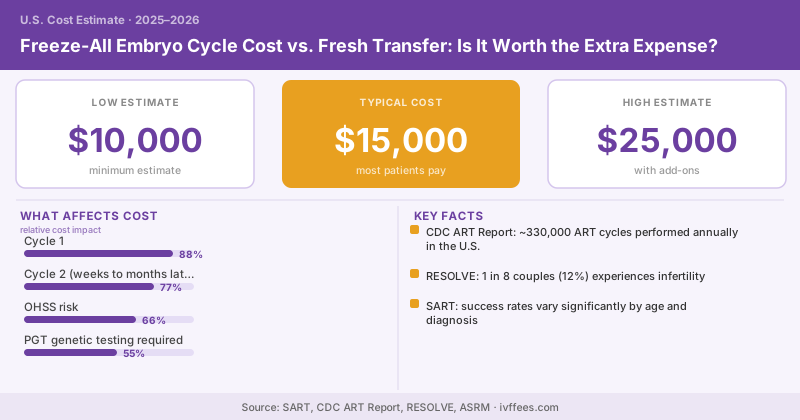
The freeze-all protocol costs more upfront. But it often costs less overall — and for the right patient, it dramatically improves the odds of success.
That’s the core trade-off. During a freeze-all cycle, your clinic retrieves and fertilizes your eggs, then freezes every resulting embryo rather than transferring one immediately. The transfer happens in a separate cycle weeks or months later, once your body has recovered and your uterine environment is optimized.
It’s a two-step process that costs more in total. Here’s when it’s worth it — and when it isn’t.
What Exactly Is a Freeze-All Protocol?
Standard IVF involves stimulation, egg retrieval, fertilization, and then a fresh embryo transfer 3–5 days later in the same cycle. The freeze-all (or “segmentation”) approach splits that into two separate cycles:
Cycle 1: Stimulation → retrieval → fertilization → freeze ALL embryos (no transfer) Cycle 2 (weeks to months later): Prepare uterus → thaw embryo → frozen embryo transfer
The extra steps — embryo cryopreservation plus a full FET cycle — are what drive up the cost.
The Cost Difference
| Cost Component | Fresh Transfer Cycle | Freeze-All + FET Cycle |
|---|---|---|
| Stimulation, retrieval, fertilization | $8,000–$15,000 | $8,000–$15,000 |
| Fresh embryo transfer | $1,500–$3,000 | Not applicable |
| Embryo vitrification (freezing all) | Not applicable | $1,000–$2,500 |
| FET cycle (separate cycle) | Not applicable | $3,000–$6,500 |
| Medications for FET | Not applicable | $200–$800 |
| Total | $9,500–$18,000 | $12,200–$24,800 |
The difference typically runs $3,000–$5,000 — though it can be higher if the FET cycle requires ERA testing or additional monitoring. Some clinics bundle embryo freezing into their base IVF package, so always ask specifically what’s included.
When Doctors Recommend Freeze-All
Your reproductive endocrinologist isn’t recommending a freeze-all to run up your bill. There are clear clinical indications:
OHSS risk. Ovarian hyperstimulation syndrome is a potentially serious complication where the ovaries overreact to stimulation medications. If your estrogen levels are very high on trigger day or you have polycystic ovarian syndrome (PCOS), a fresh transfer increases OHSS risk. Freezing all embryos lets the body recover before any pregnancy hormone exposure.
PGT genetic testing required. If you’re doing PGT-A or PGT-M, embryos must be biopsied and sent to a genetics lab — a process that takes 1–2 weeks. That’s too long for a fresh transfer. Freeze-all is mandatory when PGT is planned.
Uterine lining concerns. High progesterone levels on the day of egg retrieval — which can happen with some stimulation protocols — can make the uterine lining temporarily less receptive. A freeze-all gives the lining time to normalize.
ERA testing. The Endometrial Receptivity Array (ERA) test identifies a personalized “window of implantation” — the exact timing when your uterus is most receptive. This requires a mock transfer cycle before the real one, which means freezing all embryos and transferring in a later cycle when your ERA-determined window is used.
ERA testing costs $800–$1,500 and requires its own preparatory cycle with a biopsy. If your doctor recommends ERA, budget an extra $2,000–$3,000 beyond the standard freeze-all cost — plus another month of delay. ERA is most often recommended after unexplained repeated implantation failure, not for first-time IVF patients.
The Outcome Data
SART (Society for Assisted Reproductive Technology) published data through 2022 showing that FET live birth rates have converged with or exceeded fresh transfer rates for many patient groups. For women under 35 with chromosomally tested embryos, FET success rates often run 50–58% per transfer — comparable to or better than fresh transfer rates in the same group.
The CDC’s ART Surveillance report similarly shows that frozen embryo transfers now account for approximately 65% of all transfers in the U.S., up from roughly 40% a decade ago. This shift reflects both the growth of embryo freezing technology and the accumulating evidence that FETs often outperform fresh transfers when the uterine environment is deliberately optimized.
When Freeze-All May Not Be Necessary
For patients with a small number of embryos, no OHSS risk, normal progesterone levels, and no PGT planned, a fresh transfer can be just as effective — and saves $3,000–$5,000. Your doctor should explain the clinical rationale if they’re recommending freeze-all when none of the above risk factors apply.
If your clinic routinely recommends freeze-all for every patient regardless of clinical indicators, ask why. While freeze-all is genuinely beneficial in the right circumstances, it has also become an add-on that some clinics push without strong evidence of benefit for low-risk patients. Request the clinical reason specific to your case.
Does Insurance Cover the Extra Costs?
In states with IVF mandates — Illinois, Massachusetts, New Jersey, New York, and others — the additional FET cycle is often covered under the same mandate that covers the initial IVF cycle. But embryo cryopreservation fees and storage costs may be billed separately and may or may not be covered.
Always get an itemized estimate before your cycle starts and confirm specifically whether embryo vitrification and subsequent FET cycles are included in your coverage.
The Bottom Line
A freeze-all protocol adds $3,000–$5,000 to your IVF spending compared to a fresh transfer cycle. For patients with OHSS risk, PGT testing planned, suboptimal uterine lining, or elevated progesterone — it’s money well spent and may significantly improve your odds. For lower-risk patients with no such indicators, a fresh transfer is a reasonable, more affordable choice.
The conversation with your doctor should be specific: ask them which clinical factors in your case make freeze-all the better option, and ask for the data that supports it.
Data sourced from SART 2022 Clinic Summary Report, CDC ART National Summary Report 2022, and ASRM Practice Guidance on FET protocols.