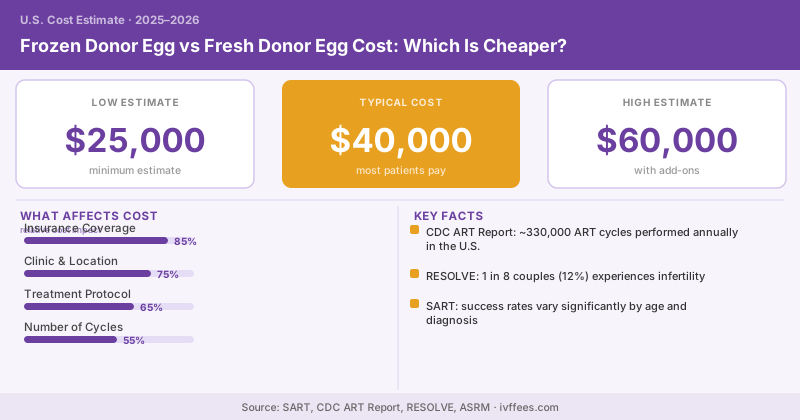
A frozen donor egg cycle can cost less than half of a fresh one. You’re looking at roughly $16,000 to $25,000 for frozen versus $35,000 to $60,000 for fresh. That’s a real gap, and it’s the first thing most people notice when they start pricing donor egg IVF. But cheaper isn’t automatically better, and the math gets more interesting once you factor in how many eggs you actually get.
Let’s break down where the money goes and what you’re trading off.
Why Frozen Costs Less
With frozen donor eggs, you buy a pre-made batch — usually a cohort of 6 to 8 vitrified eggs from an egg bank. The donor already went through retrieval months or years ago. You’re not paying for her stimulation medications, her monitoring visits, or her retrieval procedure as a one-off. Those costs were spread across multiple recipients who split her egg yield.
Fresh cycles are different. You get the donor’s entire retrieval — often 15 to 25 eggs — but you cover the full cost of her cycle alone. More eggs, more potential embryos, and frequently a higher live birth rate per cycle. You’re paying a premium for volume and, in many cases, better odds.
| Cost Component | Frozen Donor Egg | Fresh Donor Egg |
|---|---|---|
| Egg acquisition / donor fee | $14,000–$20,000 | $8,000–$15,000 |
| Donor stimulation meds | Included | $4,000–$7,000 |
| Donor screening & monitoring | Included | $3,000–$6,000 |
| Recipient fertilization & culture | $3,000–$5,000 | $4,000–$6,000 |
| Embryo transfer | $3,000–$5,000 | $3,000–$5,000 |
| Agency / coordination fees | $0–$3,000 | $8,000–$20,000 |
| Estimated total | $16,000–$25,000 | $35,000–$60,000 |
The Egg Count Difference
Here’s the catch with frozen. You typically get 6 to 8 eggs. Not all survive the thaw — survival rates run about 85% to 95% with modern vitrification, per SART data published in 2023. So your usable count might drop to 5 or 6. From there, fertilization and blastocyst development whittle the number down again. You might end up with 1 to 3 viable embryos.
A fresh cycle with 18 retrieved eggs gives you far more room. More embryos mean more transfer attempts and a better shot at extras to freeze for a sibling later. If you want more than one child, the per-baby cost of fresh can actually come out lower.
Frozen donor eggs win on upfront price. Fresh donor eggs win on egg volume and often on cumulative live birth rate. If you’re building a one-and-done budget, frozen is usually the smarter spend. If you want multiple children or maximum odds per cycle, fresh frequently delivers better value per baby.
Success Rates Compared
The American Society for Reproductive Medicine (ASRM) and SART have tracked this closely. Historically, fresh donor egg cycles posted slightly higher live birth rates per transfer than frozen, but the gap has narrowed dramatically as vitrification technology improved. SART’s 2022 national data showed frozen donor egg outcomes approaching fresh in many clinics, though fresh still edges ahead at top programs.
What this means for your wallet: if a frozen cycle fails, you buy another batch and pay again. Two failed frozen cycles can erase the savings versus one successful fresh cycle. Always ask your clinic for their own frozen-versus-fresh live birth numbers, not just the national average.
Hidden Costs to Watch
Neither path is truly all-inclusive. Watch for these add-ons:
- Genetic testing (PGT-A): $3,000–$6,000 if you screen embryos
- Frozen embryo storage: $500–$1,000/year
- Repeat transfer fees if the first embryo doesn’t implant
- Medications for the recipient to prep the uterine lining: $1,500–$3,500
Some egg banks advertise low “per egg” prices but require you to buy a minimum lot, and guarantees vary wildly. Read the warranty: does it promise a certain number of surviving eggs after thaw, or a certain number of blastocysts? A bank that guarantees mature thawed eggs is very different from one that guarantees a live birth. Get the guarantee terms in writing before you pay.
Which Should You Choose?
Pick frozen if your priority is the lowest possible entry cost, you want a faster timeline (no waiting to sync cycles with a donor), and you’re planning for one child. Pick fresh if you want the highest odds per cycle, plan to bank embryos for siblings, or your clinic’s fresh outcomes are notably stronger.
Many families also explore embryo adoption as an even lower-cost alternative, since donated embryos are already created. And if cost is the main barrier, look into IVF financing options — both fresh and frozen donor programs frequently qualify for multi-cycle packages.
Frequently Asked Questions
Is a frozen donor egg cycle as safe as a fresh one? Yes. Vitrification is a well-established technique, and babies born from frozen donor eggs show no increased health risks compared to fresh, according to ASRM. The main practical difference is egg quantity, not safety.
How many frozen donor eggs should I buy? Most banks sell cohorts of 6 to 8. Given thaw survival and attrition, 6 to 8 eggs typically yields 1 to 3 usable embryos. If you want a strong chance at a sibling, consider buying two cohorts or choosing a fresh cycle.
Can I switch from frozen to fresh if frozen fails? Absolutely, and many people do. Just budget for it. Two failed frozen attempts plus a fresh cycle can exceed $70,000, so weigh that scenario up front when you compare the two paths to standard IVF cost.