Sit down with your IVF coordinator and the price starts at $15,000. Stand up and it’s $22,000. What happened? Add-ons. ERA, IMSI, assisted hatching, time-lapse imaging, PRP infusions — each one arrives with a cost and a pitch. Stack four or five together and your base cycle has quietly grown by 50%.
Some of these add-ons have real evidence. Many don’t. Here’s the breakdown on the four patients ask about most: ERA, IMSI, assisted hatching, and time-lapse imaging.
The Full Add-On Cost Summary
| IVF Add-On | Low | Typical | High | HFEA Rating |
|---|---|---|---|---|
| ERA (Endometrial Receptivity Array) | $800 | $1,200 | $1,500 | Amber |
| IMSI (high-mag sperm selection) | $500 | $750 | $1,000 | Amber |
| Assisted hatching (laser AHA) | $300 | $600 | $800 | Amber |
| Time-lapse embryo imaging | $500 | $800 | $1,200 | Amber |
| PRP endometrial infusion | $500 | $1,000 | $2,000 | Red/experimental |
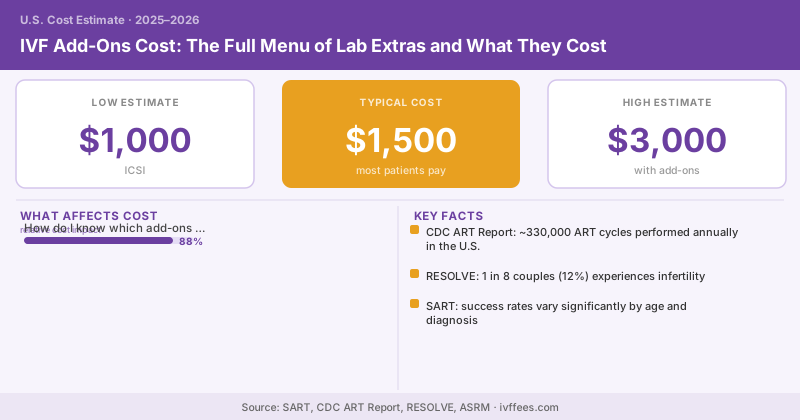
| ICSI (sperm injection) | $1,000 | $1,500 | $2,500 | Green (for male factor) |
| PGT-A (embryo chromosomal testing) | $3,000 | $4,500 | $6,000 | Green (for specific indications) |
The UK’s Human Fertilisation and Embryology Authority (HFEA) traffic-light system rates add-ons based on the strength of evidence that they improve live birth rates. As of 2025, nearly every commonly offered add-on lands at amber — meaning the evidence is uncertain or contradictory — not green.
ERA: Endometrial Receptivity Array ($800–$1,500)
The ERA is a genetic test of a small endometrial biopsy taken during a mock cycle. It analyzes the expression of 248 genes to determine your “window of implantation” — the narrow timeframe when your uterus is most receptive to embryo transfer. The claim: if you’re “displaced” from the standard window, a personalized transfer time improves success.
Sounds compelling. The clinical data is less so.
A 2021 landmark randomized controlled trial published in the New England Journal of Medicine enrolled 767 patients with prior implantation failure and found no statistically significant difference in live birth rates between ERA-guided transfers and standard timing (38.8% vs. 37.0%). ASRM’s current guidance does not recommend ERA for routine use, and the HFEA rates it amber.
The possible exception: patients with two or more unexplained failed transfers of good-quality embryos. Some observational studies show modest benefit in this subgroup, though no high-quality RCT has confirmed it specifically for repeated implantation failure (RIF).
The ERA also requires a mock cycle — typically $800–$1,500 for the biopsy and analysis — before you do the actual transfer cycle. That’s an extra month and an extra expense before a transfer even happens.
If you’ve had two or more failed frozen embryo transfers with good-quality, PGT-A normal blastocysts and no anatomical explanation found, ERA is a reasonable conversation to have with your RE. The evidence doesn’t strongly support it, but in true repeated implantation failure with no other cause identified, the argument for it is stronger than it is for a first-time transfer.
IMSI: High-Magnification Sperm Selection ($500–$1,000)
Standard ICSI uses 200–400x magnification to select sperm for injection. IMSI (intracytoplasmic morphologically selected sperm injection) uses 6,000x magnification — roughly 15–30 times more powerful — allowing embryologists to identify subtle nuclear defects in sperm heads that aren’t visible under standard magnification.
The hypothesis: selecting sperm with better nuclear morphology improves fertilization, embryo quality, and ultimately live birth rates.
A 2019 Cochrane systematic review of 9 randomized trials found no statistically significant improvement in live birth rates with IMSI compared to conventional ICSI (risk ratio 1.04, 95% CI 0.82–1.33). The HFEA rates IMSI amber. ASRM does not recommend it for routine use.
Where IMSI might have a role: severe teratozoospermia (very high proportion of abnormal sperm morphology) or repeated IVF failure with a clear male factor component. In those cases, some specialists argue the additional selection step is worth the $500–$1,000 add-on, even without strong RCT evidence.
Assisted Hatching ($300–$800)
Before implantation, a developing embryo must break out of its outer shell (the zona pellucida). Assisted hatching uses a laser to create a small opening in that shell before the embryo is transferred, theoretically making hatching easier.
The evidence is mixed and has been reviewed repeatedly. A 2018 Cochrane review found that assisted hatching “may” improve clinical pregnancy rates slightly, but the evidence was rated as low quality and any effect on live birth rates was uncertain. ASRM’s guidance: AHA is not recommended for routine use in all patients; it may be considered for older patients, frozen embryos, or prior failed cycles.
One important nuance: if you’re doing a blastocyst (day-5) transfer, the embryo is already expanding and in the process of natural hatching. Assisted hatching is largely unnecessary at day 5 — it was designed for day-3 transfers, which are less common in modern IVF practice.
The cost ($300–$800) is modest compared to other add-ons. But modest cost doesn’t equal proven benefit.
Time-Lapse Embryo Imaging ($500–$1,200)
Time-lapse systems (brand names include EmbryoScope and MIRI TL) photograph embryos every few minutes and create a continuous video of development. The idea: algorithms can detect subtle developmental abnormalities or “deselect” embryos that show concerning division patterns, improving the selection of the best embryo for transfer.
A 2020 Cochrane review of 8 randomized trials found no statistically significant improvement in live birth rates with time-lapse imaging compared to standard incubation (risk ratio 1.04, 95% CI 0.97–1.11). The HFEA rates it amber. A secondary claimed benefit — that continuous incubation (embryos don’t need to be removed from the incubator for assessment) provides a more stable environment — has more biological plausibility but hasn’t been proven to change outcomes.
ASRM guidance: time-lapse imaging may be offered but is not recommended as a standard add-on.
PRP Endometrial Infusion (Experimental, ~$500–$2,000)
Platelet-rich plasma (PRP) infusion involves placing a small amount of the patient’s own PRP into the uterine cavity before an embryo transfer. Some data suggests PRP may improve endometrial receptivity in patients with thin lining or prior failed cycles.
This is currently experimental. No large RCTs have established it as effective. The HFEA rates it red (no convincing evidence of benefit). It’s worth knowing about for patients with recurrent thin endometrium that hasn’t responded to standard treatments — but it shouldn’t be offered or accepted as a routine add-on.
The Add-Ons That DO Have Evidence
Two add-ons have strong evidence for specific indications:
ICSI (intracytoplasmic sperm injection, $1,000–$2,500) is genuinely necessary for male factor infertility — low sperm count, poor motility, or azoospermia requiring surgical sperm extraction. ASRM and HFEA both rate ICSI green for male factor. According to the CDC’s 2022 ART Surveillance report, ICSI was used in 78% of all IVF cycles nationally — though many of those cycles had no male factor indication, suggesting overuse.
PGT-A (preimplantation genetic testing for aneuploidy, $3,000–$6,000) has solid evidence for patients 37 and older, recurrent pregnancy loss, and patients with prior aneuploid pregnancies. It reduces the risk of transferring a chromosomally abnormal embryo, lowering miscarriage rates. ASRM supports it for those specific indications. For patients under 35 with no history of chromosomal issues or losses, the evidence is weaker and cost-benefit is less clear.
Clinics that offer every patient the same add-on package — ERA + IMSI + AHA + time-lapse + PRP as a bundle — are adding revenue without individualizing care. Each add-on should be recommended with a specific clinical reason tied to your history, diagnosis, and cycle results. If your RE can’t articulate why you specifically need an add-on, ask them to leave it off the invoice.
The Bottom Line
ERA runs $800–$1,500. IMSI costs $500–$1,000. Assisted hatching is $300–$800. Time-lapse imaging adds $500–$1,200. Stack all four and you’ve added $2,100–$4,500 to your cycle for add-ons that all carry amber HFEA ratings and limited RCT evidence. Accept the ones with a specific clinical reason tied to your case. Push back on the rest.
Evidence ratings based on HFEA Add-Ons Traffic Light system (2024), ASRM Practice Committee opinions, and cited Cochrane reviews. CDC 2022 ART Surveillance data cited for ICSI usage statistics.