$40,000. That’s what many women over 45 realistically spend on a path to parenthood through fertility treatment — and it’s often not their first try.
Age 45 is a clinical inflection point. The biology is blunt: egg quality and quantity decline sharply with each year after 40, and by 45, the odds of a live birth using your own eggs have fallen to the floor. But that doesn’t mean parenthood is impossible. It means you need accurate data to make smart decisions — especially financial ones.
The Hard Numbers on Own-Egg IVF at 45+
CDC’s 2022 Assisted Reproductive Technology Surveillance report — the largest annual dataset on IVF outcomes in the United States — puts live birth rates per egg retrieval at age 45 and older using autologous (own) eggs at approximately 2–5%. Per transfer, it’s similar or lower.
That’s not 2–5% success on the first try. That’s 2–5% total, per cycle. Do the math: if you attempt three own-egg IVF cycles at $15,000 each, you’ve spent $45,000 and still face roughly a 90%+ chance of not taking a baby home.
SART (Society for Assisted Reproductive Technology) data from 2022 corroborates this. Among patients 45 and older using their own eggs, fewer than 3% of initiated cycles resulted in a live birth. Among those who made it to embryo transfer, the cumulative numbers only improve modestly.
| Approach | Cost Per Attempt | Approx. Live Birth Rate |
|---|---|---|
| Own-egg IVF, age 45+ | $12,000–$20,000 | 2–5% per cycle |
| Fresh donor egg IVF | $35,000–$55,000 | 40–50% per transfer |
| Frozen donor egg bank | $16,000–$34,000 | 35–50% per transfer |
| Donor embryo transfer | $5,000–$12,000 | 35–45% per transfer |
The Cumulative Cost of Own-Egg Attempts
Here’s the financial reality most patients don’t calculate upfront: if your per-cycle success rate is 3%, you’d statistically need roughly 20 cycles to have a 50% chance of success. At $15,000 per cycle, that’s $300,000 — and most patients don’t have unlimited attempts before ovarian reserve runs out entirely.
Even conservative scenarios are sobering. Three own-egg IVF cycles at 45+ costs $36,000–$60,000 total. PGT genetic testing adds $3,000–$6,000 per cycle and is often recommended at this age to identify chromosomally normal embryos — which become increasingly rare. Many patients undergo two or three retrievals and never produce a transferable euploid embryo at all.
Going straight to donor eggs after age 45 is often the more economical path when you factor in total expected spend per successful outcome.
One own-egg IVF cycle at 45+ costs $12,000–$22,000 with a 2–5% chance of live birth. One frozen donor egg cycle costs $16,000–$34,000 with a 35–50% chance of live birth. The donor cycle costs more per attempt but far less per successful pregnancy. Most reproductive endocrinologists will give you this exact framing when you ask directly.
Donor Eggs: Costs and What’s Included
Donor egg IVF works because the embryo’s chromosomal quality is determined by the donor’s age — not yours. Donors are typically 21–32 years old, with high ovarian reserve and extensive screening. Your success rate at 45 or 55 using a 26-year-old donor’s eggs is approximately the same as a 26-year-old using her own eggs.
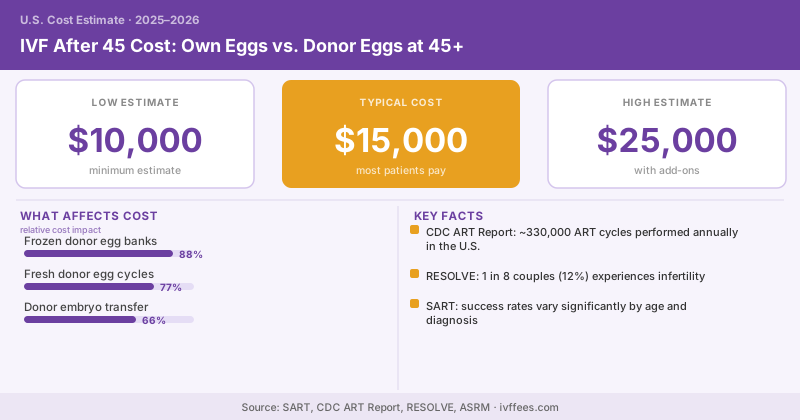
Frozen donor egg banks are often the smartest starting point. You purchase a cohort of 6–8 mature eggs from a bank like California Cryobank, Fairfax EggBank, or similar. The typical all-in cost: $16,000–$34,000, including the egg cohort purchase, your clinic’s preparation and transfer fee, and medications.
Fresh donor egg cycles involve a specific matched donor who goes through stimulation synchronized with your cycle. You get more eggs (often 15–25), which means more embryos to test and freeze. But cost jumps to $35,000–$55,000, and it takes 4–6 weeks to coordinate.
Donor embryo transfer (using embryos donated by another family) is the lowest-cost option — $5,000–$12,000 per transfer — but inventory is limited and wait lists can stretch 1–2+ years.
Insurance Coverage After 45
Most state fertility insurance mandates have age restrictions that effectively exclude patients 45 and older. Illinois, which has one of the country’s strongest mandates, covers IVF for patients meeting medical criteria — but many insurers apply upper age caps. Massachusetts, New Jersey, and New York mandates similarly tend to limit covered cycles to patients under 40–43.
Even if you’re in a mandate state, confirm your specific plan’s age limit before assuming coverage. The mandate creates a floor for what insurers must offer, but the specific policy terms — including age limits — matter enormously. Ask HR for your Summary Plan Description and call the fertility case management line directly.
Donor compensation and egg bank fees are almost never covered by insurance, even when the recipient’s IVF transfer is covered.
What to Ask Your Reproductive Endocrinologist
Before committing to own-egg IVF at 45+, ask for:
- Your current AMH (anti-Müllerian hormone) level and antral follicle count — these predict how many eggs you’re likely to retrieve
- Whether PGT-A testing would be recommended, and the expected euploid embryo rate at your age
- The clinic’s specific live birth rate for patients 45+ using own eggs
- A written estimate that includes ALL costs: retrieval, lab, freeze, future FET, medications, and PGT
SART publishes clinic-specific success rates by age at sartcorsonline.com. It’s worth looking up your clinic’s numbers for patients 45+ before deciding.
The Bottom Line
Own-egg IVF at 45+ is medically possible but statistically difficult — live birth rates hover around 2–5% per cycle per CDC data, and costs of $12,000–$22,000 per attempt add up fast. Donor egg IVF at $16,000–$55,000 depending on type offers success rates ten to twenty times higher.
Most reproductive endocrinologists will recommend a direct conversation about donor eggs as the primary path at 45+. That doesn’t make it an easy conversation. But it does make it the most financially and medically rational one.
Data sourced from CDC 2022 ART National Summary Report, SART 2022 Clinic Summary Report, and ASRM Practice Guidelines 2024.