Most people assume IVF costs roughly the same everywhere. Wrong. Where you live can swing your bill by ten thousand dollars or more, and Atlanta sits on the friendlier end of that range. Compared to San Francisco, New York, or Boston, Atlanta IVF is a relative bargain — not because clinics here cut corners, but because the cost of running a fertility lab in Georgia is simply lower.
That doesn’t mean it’s cheap. It means your dollar goes further. Here’s what to expect.
What IVF Actually Costs in Atlanta
Base IVF procedure fees across the Atlanta metro run $11,000 to $16,000. Add medications, monitoring, and optional genetic testing, and an uninsured first cycle typically totals $15,000 to $24,000.
| Cost Component | Low End | Typical | High End |
|---|---|---|---|
| Base IVF procedure (Atlanta) | $11,000 | $13,500 | $16,000 |
| Fertility medications | $3,500 | $5,000 | $7,000 |
| Monitoring & labs | $1,000 | $1,500 | $2,500 |
| Anesthesia | $600 | $900 | $1,300 |
| PGT-A genetic testing (optional) | $3,500 | $5,000 | $7,500 |
| Frozen embryo transfer (if needed) | $3,000 | $4,500 | $6,500 |
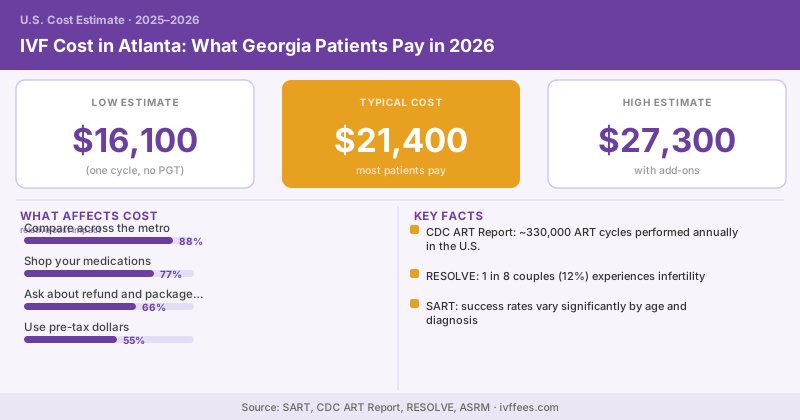
| Total (one cycle, no PGT) | $16,100 | $21,400 | $27,300 |
Atlanta’s lower cost of living relative to coastal metros is the main reason base prices come in below cities like Seattle or Boston. The same $5,500 medication bill is roughly fixed nationally, but the clinic’s own overhead — staff, lab, rent — is cheaper in Georgia, and that shows up in the procedure fee.
Georgia Has No IVF Insurance Mandate
Georgia does not require insurers to cover IVF. There’s no statewide fertility mandate, so the large majority of Georgia patients pay out of pocket. This puts Georgia in the same category as Texas, Arizona, and Florida — states where coverage depends entirely on your employer’s voluntary benefits.
If you want the full picture of which states require coverage and which don’t, the IVF insurance mandate by state breakdown is worth a read. The short version: Georgia isn’t one of them.
Atlanta’s strong corporate base helps a bit here. Major employers headquartered in the metro — including several Fortune 500 companies — have added voluntary fertility benefits in recent years, part of a national trend RESOLVE has documented as employers compete for talent. If you work for a large Atlanta-based firm, check before you assume nothing’s covered.
Georgia has no IVF mandate, so coverage hinges on your employer. Atlanta’s large corporate headquarters scene means many big employers now offer voluntary fertility benefits — ask HR specifically about ‘infertility treatment’ coverage before paying full price.
Atlanta’s Clinic Market
Atlanta has a deep fertility market and is widely considered a regional hub for the Southeast. Patients travel here from across Georgia, Alabama, Tennessee, South Carolina, and beyond because Atlanta concentrates more clinics, more reproductive endocrinologists, and more lab capacity than smaller Southern cities.
That regional pull also makes Atlanta one of the busier IVF markets in the country by volume. According to CDC ART surveillance data, Georgia clinics perform thousands of cycles annually, and Atlanta accounts for the bulk of them. High volume tends to keep clinics efficient and pricing competitive — a benefit for patients comparing options across the metro.
How to Keep Atlanta IVF Costs Down
Compare across the metro. Prices vary by several thousand dollars between Atlanta clinics. Get itemized quotes from at least two or three before committing.
Shop your medications. Drugs are $3,500–$7,000 here. National specialty pharmacies frequently beat local retail, and shopping fertility medication costs is one of the easiest ways to trim the bill.
Ask about refund and package programs. Several Atlanta clinics offer multi-cycle and refund-guarantee programs that can lower your per-cycle exposure if you’re likely to need more than one round.
Use pre-tax dollars. Georgia has a state income tax, so HSA and FSA contributions save you both federal and state tax. Funding an HSA before your cycle stretches every dollar further.
For patients facing a gap even after these steps, IVF financing options through clinic-partnered lenders are widely available in Atlanta.
Per SART national data, the live birth rate per egg retrieval for women under 35 is around 49% and declines with age. A single-cycle quote is not a guarantee of a single-cycle baby. Ask your Atlanta clinic for success rates specific to your age and diagnosis, and budget for the chance of a second cycle.
Frequently Asked Questions
Is IVF cheaper in Atlanta than other big cities? Generally yes. Atlanta’s lower cost of living keeps clinic overhead — and base procedure fees — below coastal metros like Seattle, Boston, or San Francisco. You’ll typically pay a few thousand dollars less per cycle.
Does Georgia require insurance to cover IVF? No. Georgia has no IVF mandate. Coverage depends entirely on your employer’s voluntary benefits, so check with HR and confirm whether your insurance covers IVF in 2025.
Do patients travel to Atlanta for IVF? Yes. Atlanta is the Southeast’s fertility hub, drawing patients from across Georgia and neighboring states thanks to its concentration of clinics and reproductive specialists.
Cost data based on Atlanta-area clinic fee schedules, CDC ART surveillance data, SART national data, RESOLVE analysis, and Georgia insurance mandate status. Individual costs vary by clinic, protocol, and employer coverage.