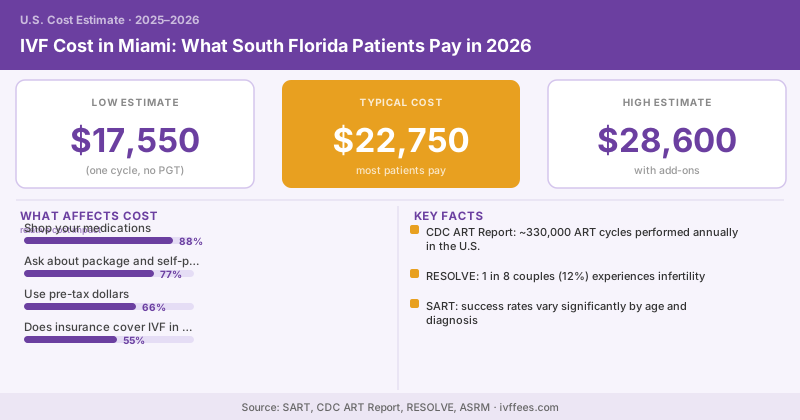
Q: Is IVF expensive in Miami? A: Yes, but probably less than you’d guess for a city this glamorous. Base IVF in the Miami metro runs $12,000 to $17,000 before medications — pricier than Atlanta or Houston, but a clear notch below New York or San Francisco. Miami’s twist isn’t the sticker price. It’s the city’s role as an international fertility destination and a Florida insurance landscape that leaves almost everyone paying out of pocket.
What IVF Actually Costs in Miami
Base IVF procedure fees across the Miami metro — Miami-Dade, Broward, and the surrounding South Florida area — run $12,000 to $17,000. Add medications, monitoring, and optional genetic testing, and an uninsured first cycle typically totals $17,000 to $25,000.
| Cost Component | Low End | Typical | High End |
|---|---|---|---|
| Base IVF procedure (Miami) | $12,000 | $14,500 | $17,000 |
| Fertility medications | $3,800 | $5,200 | $7,200 |
| Monitoring & labs | $1,100 | $1,600 | $2,600 |
| Anesthesia | $650 | $950 | $1,400 |
| PGT-A genetic testing (optional) | $3,800 | $5,200 | $7,800 |
| Frozen embryo transfer (if needed) | $3,200 | $4,800 | $6,800 |
| Total (one cycle, no PGT) | $17,550 | $22,750 | $28,600 |
Miami’s cost of living has climbed sharply in recent years, pushing clinic overhead — and base fees — above the rest of Florida and most of the South. It still trails the priciest coastal metros, but the gap has narrowed.
Florida Has No IVF Insurance Mandate
Florida does not require insurers to cover IVF. There’s no statewide fertility mandate, so the vast majority of Florida patients — Miami included — pay out of pocket. That lines Florida up with Texas, Georgia, and Arizona, and stands in sharp contrast to mandate states like New York and New Jersey. For the full state-by-state comparison, see the IVF insurance mandate by state breakdown.
Because there’s no mandate, your only realistic coverage path in Miami is a voluntary employer benefit. Larger South Florida employers in healthcare, finance, hospitality, and the growing tech and finance migration into the region have begun adding fertility benefits, in line with the national trend RESOLVE has tracked. But coverage is far from universal here, so don’t assume it.
Florida has no IVF mandate, so almost all Miami patients pay out of pocket. Your only likely route to coverage is a voluntary employer fertility benefit — increasingly offered by larger South Florida employers, but not guaranteed. Ask HR specifically about ‘infertility treatment’ before budgeting for the full cost.
Miami’s Clinic Market and Destination Role
Miami is unusual among U.S. fertility markets because it functions as an international destination. The metro draws patients from across Latin America and the Caribbean, as well as domestic patients, thanks to its bilingual clinics, international connectivity, and concentration of experienced reproductive endocrinologists.
That destination dynamic gives Miami a deep, competitive clinic market spanning Miami-Dade and Broward counties, with both independent practices and national network locations. For international and out-of-area patients, clinics here are well practiced at coordinating remote monitoring and travel-based treatment cycles. The competition for a diverse, partly self-pay patient base helps keep pricing in check despite Miami’s rising cost of living.
How to Keep Miami IVF Costs Down
Confirm whether you have any employer coverage. With no state mandate, this is the difference between a covered cycle and a $20,000 out-of-pocket bill.
Shop your medications. At $3,800–$7,200, drugs are a major cost. National specialty pharmacies frequently undercut local retail — comparing fertility medication costs is one of the easiest savings.
Ask about package and self-pay rates. Miami’s high share of self-pay patients means many clinics offer transparent package pricing and multi-cycle discounts — ask directly.
Use pre-tax dollars. Florida has no state income tax, so the HSA/FSA benefit is federal-only — still worth maxing an HSA before your cycle.
If a gap remains, Miami clinics widely offer IVF financing options.
According to SART national data, the live birth rate per egg retrieval for women under 35 is roughly 49% and declines with age. One cycle is not a guarantee. Ask your Miami clinic for age- and diagnosis-specific success rates, and budget for the chance of a second round.
Frequently Asked Questions
Does insurance cover IVF in Miami? Rarely. Florida has no IVF mandate, so coverage exists only through a voluntary employer benefit. Most Miami patients pay out of pocket — confirm your IVF coverage for 2025 with HR.
Why do international patients come to Miami for IVF? Miami’s bilingual clinics, international flight connectivity, and experienced reproductive specialists make it a fertility destination for patients from Latin America and the Caribbean, as well as domestic travelers.
How can I lower my Miami IVF costs? Confirm any employer coverage, shop medications, ask about self-pay package rates, and use HSA dollars. See how to reduce IVF cost.
Cost data based on Miami-area clinic fee schedules, SART national data, RESOLVE analysis, and Florida insurance mandate status. Individual costs vary by clinic, protocol, and employer coverage.