Minnesota has one of the highest concentrations of Fortune 500 headquarters per capita in the country — and that single fact does more to shape Twin Cities IVF coverage than any state law. Because while the base price in Minneapolis runs a moderate $12,500 to $17,500, whether your insurance helps comes down almost entirely to which of those big employers you work for.
Let’s break down both the cost and the coverage.
What IVF Actually Costs in Minneapolis
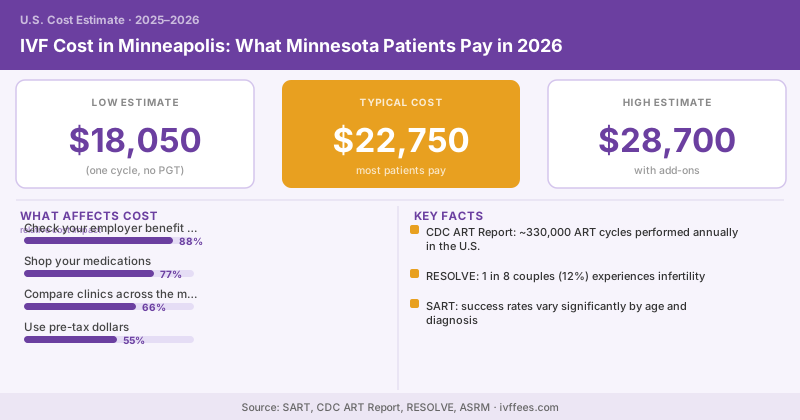
Base IVF procedure fees across the Minneapolis-St. Paul metro run $12,500 to $17,500. Add medications, monitoring, and optional genetic testing, and an uninsured first cycle typically totals $17,000 to $25,000.
| Cost Component | Low End | Typical | High End |
|---|---|---|---|
| Base IVF procedure (Minneapolis) | $12,500 | $15,000 | $17,500 |
| Fertility medications | $3,800 | $5,200 | $7,200 |
| Monitoring & labs | $1,100 | $1,600 | $2,600 |
| Anesthesia | $650 | $950 | $1,400 |
| PGT-A genetic testing (optional) | $3,800 | $5,200 | $7,800 |
| Frozen embryo transfer (if needed) | $3,200 | $4,800 | $6,800 |
| Total (one cycle, no PGT) | $18,050 | $22,750 | $28,700 |
The Twin Cities cost of living sits near or slightly above the national average — higher than much of the Midwest but well below the coasts. IVF base fees track that, landing in the moderate middle of the national range.
Minnesota Has No IVF Mandate — But Big Employers Often Cover It
Minnesota does not require insurers to cover IVF. There’s no statewide fertility mandate, so on paper most Minnesotans pay out of pocket. That places Minnesota with no-mandate states like Wisconsin and Iowa, in contrast to mandate states such as New York and New Jersey. The IVF insurance mandate by state breakdown shows exactly where each state falls.
In practice, the Twin Cities punch well above their no-mandate weight on coverage. Minnesota’s unusually dense roster of major corporate headquarters — in retail, healthcare, food, and finance — means a large share of working residents have access to voluntary employer fertility benefits. RESOLVE has tracked the steady expansion of these voluntary benefits nationally, and Minnesota’s big-employer economy makes the Twin Cities one of the better Midwest markets for coverage despite the lack of a mandate.
Minnesota has no IVF mandate, but the Twin Cities’ high concentration of Fortune 500 employers means many residents have voluntary fertility benefits anyway. Your employer matters far more than state law here — ask HR specifically about ‘infertility treatment’ coverage before assuming you’ll pay out of pocket.
The Twin Cities Clinic Market
Minneapolis-St. Paul anchors fertility care for a wide region, drawing patients from across Minnesota, the Dakotas, and western Wisconsin who have limited options closer to home. The metro supports a strong cluster of established clinics, including academic-affiliated programs through its major health systems that handle complex cases.
That regional pull gives Twin Cities clinics enough volume to stay competitive and experienced. The Mayo Clinic’s broader Minnesota presence also adds to the state’s reputation for high-quality medicine, even though most routine IVF in the metro happens at dedicated fertility centers in the Minneapolis-St. Paul area. The result is a market with solid choice and a regional reach that benefits patients traveling in from the upper Midwest.
How to Keep Minneapolis IVF Costs Down
Check your employer benefit first. In the Twin Cities, this is the highest-leverage move by far — many big local employers cover a meaningful chunk of treatment and medication.
Shop your medications. At $3,800–$7,200, drugs are a major cost. National specialty pharmacies often beat local retail — comparing fertility medication costs is an easy win.
Compare clinics across the metro. Even with a moderate-sized market, itemized quotes from each Twin Cities clinic reveal differences worth thousands.
Use pre-tax dollars. Minnesota has a state income tax, so HSA and FSA contributions cut both federal and state tax. Fund an HSA before your cycle.
If a gap remains, Twin Cities clinics widely offer IVF financing options.
Per SART national data, the live birth rate per egg retrieval for women under 35 is around 49% and declines with age. One cycle is not a guarantee. Ask your Minneapolis clinic for age- and diagnosis-specific success rates and budget for the possibility of a second round.
Frequently Asked Questions
Does Minnesota require insurance to cover IVF? No. Minnesota has no IVF mandate. However, the Twin Cities’ many large employers frequently offer voluntary fertility benefits, so check your plan and confirm your IVF coverage for 2025 with HR.
Is Minneapolis a regional fertility hub? Yes. The Twin Cities draw patients from across Minnesota, the Dakotas, and western Wisconsin who have few options closer to home, supporting a strong cluster of experienced clinics.
How can I lower my Minneapolis IVF costs? Check your employer benefit, shop medications, compare clinics, and use HSA dollars. See how to reduce IVF cost.
Cost data based on Twin Cities clinic fee schedules, SART national data, RESOLVE analysis, and Minnesota insurance mandate status. Individual costs vary by clinic, protocol, and employer coverage.