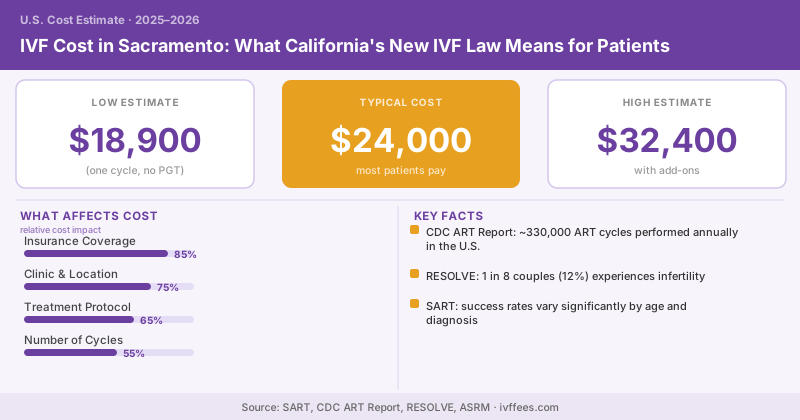
42% of Americans have never heard that their state’s insurance rules for fertility treatment can change overnight — and Sacramento patients are living through exactly that kind of change right now, thanks to California’s newly effective IVF coverage law.
What IVF Costs in Sacramento
| Cost Component | Low End | Typical | High End |
|---|---|---|---|
| Base IVF procedure fee | $14,000 | $17,500 | $21,000 |
| Fertility medications | $3,300 | $5,000 | $7,200 |
| Monitoring & labs | $1,000 | $1,600 | $2,500 |
| Anesthesia | $600 | $900 | $1,400 |
| PGT-A genetic testing (optional) | $3,300 | $5,000 | $7,500 |
| Frozen embryo transfer (if needed) | $3,000 | $4,400 | $6,300 |
| Total (one cycle, no PGT) | $18,900 | $24,000 | $32,400 |
Sacramento pricing runs below the Bay Area and Los Angeles, but above many Midwestern and Southern metros — a middle-tier California market.
California’s SB 729: What Actually Changed
California’s SB 729, signed into law and phasing in starting mid-2025, requires many large-group health insurance plans to cover infertility diagnosis and treatment, including IVF, for the first time as a statewide requirement. This is a significant shift for California patients who previously had no state mandate to rely on, similar to the majority of U.S. states.
The mandate isn’t universal, though. It generally applies to large-group plans (typically employers with more than 100 employees) regulated by the state, and phases in over specific effective dates by plan renewal. Self-funded employer plans, which are federally regulated under ERISA rather than state insurance law, are not required to comply with SB 729 even if the employer is large — a distinction that surprises many Sacramento patients who assume “large employer” automatically means covered.
Ask your HR department directly whether your health plan is “fully insured” (subject to California state mandates like SB 729) or “self-funded” (regulated federally, generally exempt from state mandates). Many large employers, including some in the Sacramento area’s substantial state government and healthcare workforce, use self-funded plans, which means SB 729 may not automatically apply even though the employer is large.
Sacramento as a State-Government Employment Hub
Sacramento’s economy is heavily shaped by its role as California’s state capital, with a large share of the local workforce employed by state government agencies (CalPERS-administered health plans), the University of California Davis system, and Sutter Health and other regional healthcare employers. CalPERS has separately been evaluating fertility benefit expansions for state employees, adding another layer to the coverage landscape distinct from SB 729 itself.
Sacramento-Area Fertility Clinics
- Sacramento Fertility Clinic — established local independent practice
- UC Davis Health Reproductive Endocrinology and Infertility — academic program with research infrastructure
- Kaiser Permanente Sacramento fertility services — relevant for Kaiser members given the plan’s distinct HMO structure
Kaiser Permanente’s significant presence in the Sacramento area means many local patients access fertility care through Kaiser’s integrated system rather than an independent clinic — worth noting since Kaiser’s specific coverage and network rules differ from standard fee-for-service insurance.
Reducing IVF Costs in Sacramento
Given SB 729’s recent rollout, the single highest-value action for insured Sacramento patients is confirming with certainty whether their specific plan is fully insured (likely covered) or self-funded (likely exempt). Beyond that, standard strategies apply: compare specialty pharmacy pricing, check IVF grants, and get itemized quotes from both UC Davis’s academic program and independent local clinics.
SB 729’s phase-in means coverage timing can vary even among plans that will eventually be subject to the mandate — some large-group plans update at their next renewal date, which may be months away. Don’t assume the law applies to your specific plan immediately; confirm your plan’s actual effective date directly with your insurer or HR department.
The Bottom Line
Sacramento IVF runs roughly $18,900–$32,400 all-in for uninsured patients, but California’s SB 729 is actively changing the coverage picture for many large-group plan holders. Confirm whether your specific plan is fully insured or self-funded before assuming either full coverage or full self-pay — the distinction has real financial consequences right now.