Would you believe IVF in Salt Lake City can run several thousand dollars less than the same treatment in Denver, just a few hundred miles away? Utah’s fertility clinic market is smaller than many people expect, but it’s also one of the more affordable options in the Mountain West.
What IVF Costs in Salt Lake City
| Cost Component | Low End | Typical | High End |
|---|---|---|---|
| Base IVF procedure fee | $10,500 | $13,500 | $16,500 |
| Fertility medications | $2,800 | $4,200 | $6,000 |
| Monitoring & labs | $800 | $1,300 | $2,000 |
| Anesthesia | $500 | $750 | $1,200 |
| PGT-A genetic testing (optional) | $3,000 | $4,500 | $6,500 |
| Frozen embryo transfer (if needed) | $2,700 | $4,000 | $5,800 |
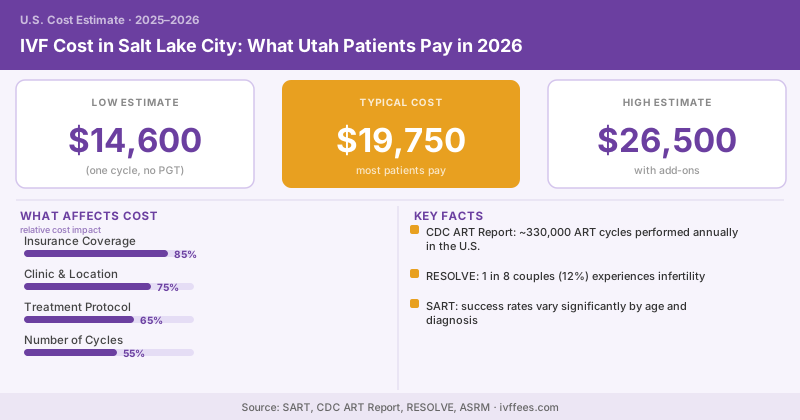
| Total (one cycle, no PGT) | $14,600 | $19,750 | $26,500 |
That base fee is meaningfully below what many patients pay in Denver, Phoenix, or coastal cities for a comparable procedure, driven partly by lower regional overhead and a competitive local clinic environment.
Utah’s Insurance and Cultural Landscape
Utah does not have a comprehensive state mandate requiring insurers to cover IVF itself, though the state does have some requirements around covering infertility diagnostic testing. Most Salt Lake City patients pay for the procedure out-of-pocket, similar to the majority of U.S. states without a full mandate.
What’s distinctive about the Salt Lake City market is the surrounding culture: Utah has one of the highest average family sizes in the country and a strong cultural emphasis on family-building, tied significantly to the state’s large Church of Jesus Christ of Latter-day Saints population. This has shaped a local fertility clinic market that’s more accustomed than many regions to serving patients pursuing larger families and multiple rounds of treatment, and some clinics have developed multi-cycle package pricing partly in response to that demand pattern.
Because a meaningful share of Utah fertility patients plan for multiple children via IVF or frozen embryo transfer over several years, some Salt Lake City clinics offer package pricing for banking embryos across a single stimulated cycle intended to be used for more than one pregnancy. Ask specifically about multi-child or multi-transfer packages if you’re planning a larger family.
Salt Lake City-Area Fertility Clinics
- University of Utah Health Fertility Center — academic program with research ties and typically competitive pricing
- Utah Fertility Center — one of the more established independent practices in the region
- Reproductive Care Center — multiple Utah locations, longstanding presence in the local market
Utah’s smaller population means fewer total fertility clinics than a metro like Denver or Phoenix, so ask about appointment availability and typical wait times for a new patient consultation — a smaller market can mean a longer wait for the most established programs.
Why Some Mountain West Patients Choose Salt Lake City
Salt Lake City draws patients from Idaho, western Wyoming, and parts of Nevada who don’t have a local fertility clinic of comparable size. The city’s central location and major airport hub (Delta’s second-largest hub) make it logistically manageable for regional patients coordinating travel around retrieval and transfer dates.
Reducing IVF Costs in Salt Lake City
Because Salt Lake City already runs below the national average, additional savings mostly come from typical national levers: shopping specialty pharmacies for medications, checking fertility grants (RESOLVE’s assistance directory includes several Mountain West-specific options), and asking each clinic about a multi-cycle discount before committing to package pricing.
According to SART’s most recent national data, live birth rates per retrieval vary meaningfully by clinic even within the same regional market. Don’t assume Salt Lake City’s lower average price reflects lower quality care, or that all local clinics perform similarly — check each program’s specific, age-matched SART outcomes before choosing.
The Bottom Line
Salt Lake City IVF runs roughly $14,600–$26,500 all-in for most uninsured patients, below many comparable regional markets, without a state insurance mandate to lean on. Ask about multi-cycle and multi-child packages given the local market’s family-planning orientation, and confirm SART data before assuming lower average pricing means uniform quality across every local clinic.