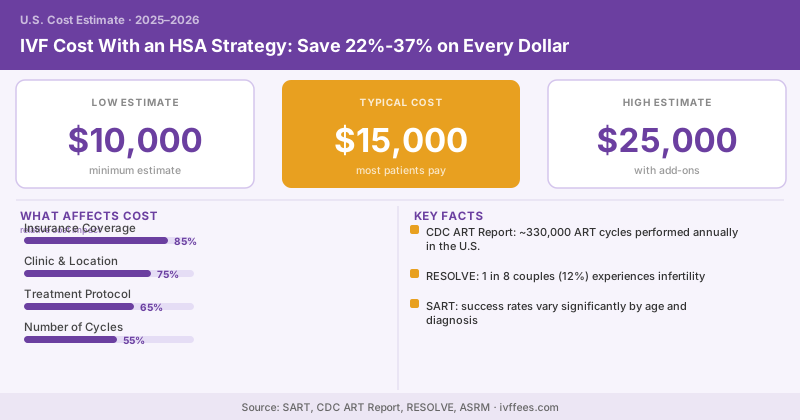
Every dollar you run through a Health Savings Account for IVF is a dollar you never paid tax on. For a $20,000 cycle, that quietly saves $4,400 to $7,400 depending on your tax bracket — money most patients leave on the table because they pay with after-tax cash instead.
An HSA won’t cover the whole bill for most people. But used strategically, it’s the single most tax-efficient way to pay for fertility treatment. Here’s the playbook.
Why an HSA beats a regular bank account
IVF and its medications are qualified medical expenses, so HSA withdrawals for them are tax-free. And contributions go in pre-tax. So you avoid tax on the way in and the way out — a true triple advantage when you count tax-free growth. Pay the same $20,000 with a normal checking account and you’ve already paid income tax on every dollar.
The catch: you need an HSA-eligible high-deductible health plan (HDHP) to contribute. For 2025, IRS limits were $4,300 for individuals and $8,550 for families. So you can’t fund a full cycle in one year — but you can plan ahead.
| Tax bracket | Tax saved on $20K | Effective IVF cost |
|---|---|---|
| 22% (+ FICA) | ~$4,400–$5,900 | ~$14,100–$15,600 |
| 24% (+ FICA) | ~$4,800–$6,300 | ~$13,700–$15,200 |
| 32% (+ FICA) | ~$6,400–$7,400 | ~$12,600–$13,600 |
Exact savings depend on your state and whether contributions dodge FICA via payroll. The point: HSA money is 20%-37% “cheaper” than cash.
The multi-year contribution strategy
Since you can’t bank $20,000 in one year, plan two to three years ahead if your timeline allows. Max your family contribution annually, let it sit (you don’t have to spend it the year you contribute), and build a war chest before your cycle. Couples sometimes coordinate two HSAs.
You can only contribute to an HSA while enrolled in an HSA-eligible HDHP. If you switch to a richer plan to get better fertility coverage, your contributions stop — though you can still spend what’s already in the account. Weigh the trade-off: a fertility-coverage plan may save more than the HSA tax break.
The reimbursement loophole
Here’s the move most people miss: you don’t have to pay an IVF bill from your HSA immediately. You can pay out of pocket now, save the receipts, and reimburse yourself from the HSA years later — tax-free — after the account has grown. There’s no deadline to reimburse a qualified expense, as long as it was incurred after you opened the HSA. Keep meticulous records.
Paying for IVF with HSA dollars saves 22%-37% versus after-tax cash — $4,400 to $7,400 on a typical cycle. You can’t fund it all in one year, so contribute the max annually (and consider the reimburse-yourself-later move), but only while you’re on an HSA-eligible high-deductible plan.
HSA vs FSA for fertility
An FSA is use-it-or-lose-it within the plan year and capped lower, but it doesn’t require an HDHP and the full annual amount is available January 1 — handy for a cycle early in the year. An HSA rolls over forever and invests, but caps contributions and needs the right plan. Many patients use an FSA the year they cycle and an HSA to build long-term funds. Read more in our HSA/FSA fertility guide.
Layer it with everything else
The HSA tax break stacks with employer fertility benefits, grants, and the tactics in how to reduce IVF cost. Confirm what your insurance covers first, then use HSA dollars for the out-of-pocket remainder. For anything beyond your HSA balance, compare financing options.
Frequently Asked Questions
Are IVF medications HSA-eligible? Yes. Prescription fertility medications are qualified medical expenses, so you can pay for them tax-free from your HSA. Since meds add $3,000–$7,000 per cycle, this is one of the easiest, highest-value uses of HSA funds.
Can I reimburse myself for IVF I already paid for in cash? Yes, as long as the expense was incurred after you opened the HSA and you have receipts. There’s no deadline — you can pay now and reimburse yourself years later after your balance grows tax-free. This is a powerful, underused strategy.
What if I need more than my HSA contribution limit allows? Plan across multiple years, coordinate two spouses’ HSAs, or pair the HSA with an FSA the year you cycle. For the balance, use a grant, employer benefit, or financing. The HSA rarely covers a full cycle alone, but it makes every dollar it does cover cheaper.