In 2022, Greek clinics treated patients from 47 different countries. That’s not a coincidence — it’s a destination that’s been building international fertility infrastructure for two decades, and the prices reflect a cost structure that Americans find genuinely shocking compared to what they’ve been quoted at home.
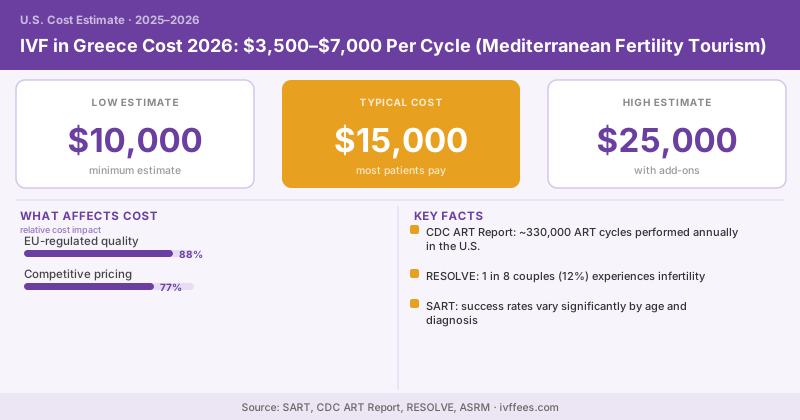
IVF with your own eggs in Athens: €2,800–€5,500. Donor egg IVF: €4,500–€9,000. Round-trip flights from New York: $650–$950. The numbers make Greece one of the most compelling European destinations for American fertility patients, particularly for donor egg cycles where U.S. prices have become almost prohibitive.
Here’s the complete picture.
Full Cost Breakdown: IVF in Greece for U.S. Patients
| Cost Component | Greece (EUR) | USD Approx. | U.S. Equivalent |
|---|---|---|---|
| Own-egg IVF (monitoring, retrieval, transfer) | €2,800–€5,500 | $3,100–$6,100 | $12,000–$18,000 |
| Fertility medications (own-egg cycle) | €1,000–€2,200 | $1,100–$2,400 | $4,000–$8,000 |
| Donor egg IVF (complete package) | €4,500–€9,000 | $4,950–$9,900 | $35,000–$55,000 |
| PGT-A genetic testing (per embryo) | €280–€450/embryo | $310–$495 | $800–$1,200/embryo |
| Frozen embryo transfer (FET) | €900–€1,800 | $990–$1,980 | $3,000–$5,000 |
| Round-trip flights (NYC to Athens) | — | $650–$950 | — |
| Round-trip flights (LA to Athens) | — | $850–$1,300 | — |
| Accommodation (Athens, per week) | — | $600–$1,400 | — |
| All-in: own-egg cycle | — | $6,000–$12,000 | $18,000–$30,000 |
| All-in: donor egg cycle | — | $8,000–$15,000 | $38,000–$60,000 |
Why Greece Attracts International Fertility Patients
Greece’s appeal goes beyond price. Three factors combine to make it a serious destination:
EU-regulated quality. Greek fertility clinics operate under EU Directive 2004/23/EC, the same tissue and cell quality framework governing clinics in Germany, France, and the Netherlands. Lab standards, donor screening, and documentation requirements are identical across EU member states. Operating within this framework provides meaningful quality assurance that patients traveling to some non-EU destinations don’t have.
Legal egg donation with a large donor pool. Greek Law 3305/2005 permits egg donation, establishes an anonymous donor framework, and has created a regulated market that attracts donors from across Southern Europe. Some top Athens clinics maintain donor databases of 1,000+ active profiles — comparable to larger Spanish programs. The diversity of available donors makes matching accessible for American patients of varied ethnic backgrounds.
Competitive pricing. Greece’s cost of living and medical sector wage structure produce clinic operating costs below Spain’s while maintaining similar EU-standard quality. The result: prices 10–20% lower than comparable Spanish clinics, with similar success rates.
According to ESHRE’s European IVF monitoring data, Greek clinics report live birth rates per egg transfer of approximately 28–35% for own-egg cycles across all ages, and 40–50% for donor egg cycles — consistent with top European clinics.
Top Clinics in Athens and Thessaloniki
Embryolab Fertility Clinic (Thessaloniki) is one of Greece’s most internationally recognized fertility centers. It publishes outcome data submitted to ESHRE monitoring and has an established international patient program with English-speaking coordinators. Its location in Thessaloniki (northern Greece) makes it a slightly less convenient transit point for Americans — most fly into Athens and travel 5 hours by train or 1 hour by domestic flight — but the clinic’s reputation draws patients willing to make that journey.
Genesis Athens Clinic (Athens) combines a full fertility program with obstetric care, making it useful for patients who want to begin prenatal care with the same provider before transitioning to a U.S. OB-GYN. The Athens location has the advantage of being directly accessible from the international airport.
Pelargos IVF Medical Group (Athens) is known for competitive pricing on donor egg packages, a rapid donor matching process, and a large international patient base. Strong English-language support for U.S. patients, with telemedicine consultations available for initial screening.
The dramatic savings on donor egg IVF in Greece (versus the U.S.) come almost entirely from the donor compensation structure. Greek law caps donor compensation at approximately €900 per donation — compared to U.S. practice where donors may receive $10,000–$30,000 and agencies charge recipients an additional $5,000–$15,000. A Greek clinic doesn’t need to pass $25,000–$40,000 in donor-side costs to the recipient. The eggs are screened to the same EU standards. The embryology is the same. The saving is structural, not a quality tradeoff.
Egg Donation Laws in Greece: What Americans Must Understand
Greek Law 3305/2005 is one of Europe’s most permissive frameworks for assisted reproduction — permitting egg donation, sperm donation, embryo donation, and surrogacy (for Greek residents under specific conditions). For international patients, the relevant rules are:
Anonymous donation only. Unlike the U.S., where open-ID and known-donor programs are available, Greek law mandates complete anonymity. Your donor-conceived child has no legal right to access donor identity.
Donor screening requirements. All donors undergo: complete medical history, infectious disease panel (HIV, HBV, HCV, syphilis, HTLV), karyotype (chromosomal analysis), and psychological evaluation. Some clinics add expanded carrier screening voluntarily; ask specifically.
Recipient requirements. Greek clinics treat international patients who are in heterosexual partnerships or single women (the law was updated to include single women in 2021). Same-sex female couples have varying access depending on the clinic; ask your clinic directly. Greek law does not permit surrogacy arrangements for non-Greek-resident foreigners.
Age limits. Donors must be between 18 and 35 years old. Recipients using donor eggs typically must be under 50 (some clinics set the limit at 45).
Greek law prohibits the export of frozen embryos created from anonymous Greek donors outside of Greece in some interpretations. Confirm with your clinic and a reproductive attorney familiar with Greek law whether embryos created in Greece can be transferred to your U.S. doctor for storage or future transfer. This is important if you plan to bank multiple embryos for future cycles in the United States.
Travel Logistics from the United States
Athens (ATH) is the main gateway. United, Delta, and American don’t operate direct flights from the U.S., but connections via Amsterdam (KLM), Frankfurt (Lufthansa), or London (British Airways) are readily available from any major U.S. hub. Total travel time: 12–15 hours from the east coast, 15–18 hours from the west coast.
Direct flights on Aegean Airlines or other carriers via European hubs are often the best-priced option. Peak summer fares (July–August) to Athens run higher; shoulder season travel (April–June, September–October) offers better rates and more bearable temperatures for patients undergoing treatment.
Trip structure:
- Trip 1 (optional to skip): Initial consultation. Athens clinics increasingly accommodate U.S. patients who send bloodwork, AMH, FSH, antral follicle count results, and medical history electronically. If your U.S. RE can provide this documentation, you may be able to skip the first trip entirely.
- Trip 2 (required): 9–14 days for own-egg stimulation and retrieval; 3–5 days for frozen donor egg transfer.
- Trip 3 (optional): Return for FET from banked embryos. 3–5 days.
Accommodation in Athens ranges from €70–€150/night for a comfortable apartment near the clinics, which are clustered in the Marousi and Glyfada districts. Budget €400–€900 for a 7-night stay.
Greece vs. Czech Republic vs. Spain: Which Is Right for You?
If your primary goal is lowest possible cost: Czech Republic is usually cheapest, especially for own-egg cycles. The euro exchange rate and lower Czech cost base produce prices that Greece and Spain typically can’t match.
If your goal is largest donor database and best matching for diverse ethnicity: Spain leads, with donor databases cultivated from across Southern and Eastern Europe.
If you want a balance of cost, EU quality, and Mediterranean travel experience: Greece sits squarely in the middle — less expensive than Spain, warmer weather and better tourism infrastructure than Czech Republic, with fully comparable EU-regulated clinical standards.
The Bottom Line
For American patients facing $35,000–$55,000 donor egg IVF quotes at home, Greece offers a credible path to the same procedure at $8,000–$15,000 all-in — including flights and a week in Athens. The EU regulatory framework provides meaningful quality assurance. The clinics serving international patients have years of experience supporting American patients through the logistics.
The anonymous-only donor policy is the one area that requires serious thought before committing. Understand it, discuss it with your partner, and decide whether it aligns with your family’s values. If it does, Greece is a genuinely excellent fertility destination.
Cost estimates based on ESHRE European IVF Monitoring data, clinic published pricing, and USD/EUR exchange rates as of 2026. ESHRE’s Cross-Border Reproductive Care data cited for international patient statistics. Individual costs vary by clinic, protocol, and travel origin. Consult a reproductive attorney for legal guidance on international fertility agreements.