Can you use your HSA for IVF? Yes — and the tax savings are larger than most people realize.
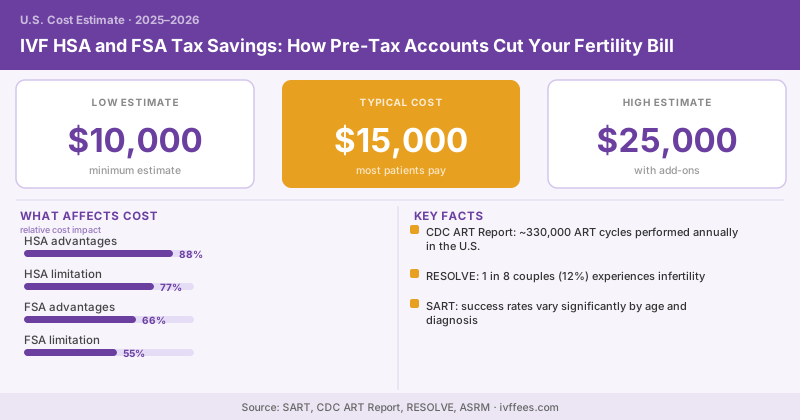
Every dollar you pay for IVF from a Health Savings Account (HSA) or Flexible Spending Account (FSA) is a dollar you never paid income tax on. On a typical $15,000–$20,000 cycle, that’s $1,650–$7,400 in real money saved — depending on your tax bracket and how strategically you fund the accounts.
Most fertility patients don’t maximize this. Here’s how to actually use it.
What’s Covered: The Full List
The IRS defines qualified medical expenses broadly for HSA and FSA purposes. Fertility treatment falls squarely within that definition. Covered expenses include:
- IVF procedures — stimulation, egg retrieval, fertilization, embryo transfer
- Egg freezing — oocyte cryopreservation for fertility preservation
- Embryo freezing and storage — annual cryostorage fees
- Fertility medications — gonadotropins, GnRH agonists/antagonists, trigger shots, progesterone
- Diagnostic tests — AMH, FSH, AFC ultrasound, semen analysis, HSG
- PGT genetic testing — PGT-A and PGT-M
- Sperm cryopreservation
- IUI (intrauterine insemination)
- Acupuncture — if a licensed practitioner performs it for a medical condition
This is a notably generous list. The fertility medications alone ($3,000–$7,000 per IVF cycle) represent substantial tax-free spending.
Surrogacy fees are not qualified medical expenses for the intended parent’s HSA/FSA — they’re expenses incurred by a third party, not the account holder. Donor compensation paid to an egg donor typically isn’t covered either. The egg bank purchase fee may be partially covered (the medical screening portion) but donor compensation isn’t. When in doubt, call your HSA administrator before paying.
The 2026 Contribution Limits
| Account Type | 2026 Contribution Limit | Rollover Rule | Requires HDHP? |
|---|---|---|---|
| HSA — Individual Coverage | $4,300 | Unlimited rollover | Yes |
| HSA — Family Coverage | $8,550 | Unlimited rollover | Yes |
| HSA — Catch-up (55+) | +$1,000 extra | Unlimited rollover | Yes |
| FSA (Health FSA) | $3,050 | $640 rollover or 2.5-month grace | No |
Note: HSA limits are set by the IRS annually. The numbers above reflect 2026 IRS guidance. FSA limits are also IRS-set but typically adjusted annually for inflation.
The Tax Savings Math
Here’s where the numbers get motivating. Let’s say you have $5,000 in IVF-related expenses this year.
If you pay from after-tax money in your checking account, you’ve already paid income tax on every dollar — meaning you effectively spent more than $5,000 to have $5,000 available to spend.
If you pay from an FSA or HSA:
| Tax Bracket | Tax Saved on $5,000 | Effective Cost After Tax Savings |
|---|---|---|
| 22% federal + 7.65% FICA | ~$1,483 | ~$3,517 |
| 24% federal + 7.65% FICA | ~$1,583 | ~$3,417 |
| 32% federal (no FICA on HSA payroll) | ~$1,600–$1,970 | ~$3,030–$3,400 |
| 37% federal (no FICA on HSA payroll) | ~$2,000–$2,235 | ~$2,765–$3,000 |
On a full $15,000 IVF cycle paid through pre-tax accounts at the 22% bracket with FICA savings, you’d save roughly $4,450 in taxes. At the 32% bracket, the savings approach $6,000.
The numbers are even better when HSA contributions are made through payroll — because payroll-contributed HSA dollars also avoid FICA (Social Security + Medicare) taxes, which after-tax FSA contributions don’t always dodge.
HSA vs. FSA: Key Differences for Fertility Patients
Both accounts let you pay for IVF with pre-tax dollars. But they work differently in ways that matter for large expenses like fertility treatment.
HSA advantages:
- Funds roll over indefinitely — no deadline to spend them
- The account is yours, not tied to your employer
- You can invest the balance and let it grow tax-free
- You can contribute right up to the annual limit even mid-year
- No spending deadline — pay an IVF bill now and reimburse yourself from the HSA years later
HSA limitation: You must be enrolled in an HSA-eligible High-Deductible Health Plan (HDHP). If your employer offers better fertility coverage through a richer PPO plan, you’d have to give up the HSA to use it.
FSA advantages:
- Available to most employed workers, not limited to HDHP enrollees
- The full year’s contribution is available January 1 — useful if your cycle is early in the year
- Some employers add contributions to your FSA
FSA limitation: Use-it-or-lose-it. Most FSA plans require you to spend the balance by year-end (with a possible $640 rollover or 2.5-month grace period). For multi-year IVF spending, you can’t bank FSA dollars the way you can with an HSA.
The biggest FSA mistake: contributing $3,050 for IVF in January, then switching jobs in July before using it all. FSA balances are generally forfeited when you leave an employer (outside the plan year). If there’s any job uncertainty, be conservative with FSA contributions and use an HSA for longer-term savings if you’re on an HDHP.
Strategic Timing for IVF Cycles
Most open enrollment periods run October–November for a January 1 effective date. If you know an IVF cycle is coming in the next 12 months, here’s the playbook:
Using an FSA: Elect the maximum ($3,050) during open enrollment. Starting January 1, the full $3,050 is available immediately — even though you’ll contribute it throughout the year. Pay your cycle start costs, monitoring, medications, and egg retrieval fees from the FSA. Follow up with any remaining available balance for additional costs.
Using an HSA: If you’re on an HDHP, maximize your family contribution ($8,550) through payroll deductions. Build the balance over 1–2 years if your timeline allows — HSA funds carry forward indefinitely. If your cycle is within months, you can also make a lump-sum contribution up to the annual limit.
Stacking both: If you’re switching from an HDHP (with HSA) to a richer plan for fertility coverage, you can spend your existing HSA balance on out-of-pocket IVF costs even though you can’t make new HSA contributions while on the richer plan. The balance doesn’t disappear; it just stops growing.
The Reimbursement Loophole (HSA Only)
One underused HSA strategy: pay IVF bills out of pocket today, save the receipts, and reimburse yourself from the HSA later — tax-free — after the account has grown.
There’s no deadline to claim HSA reimbursements, as long as:
- The expense was incurred after you opened the HSA
- You have documentation (receipts, Explanation of Benefits)
- The expense was a qualified medical expense at the time
This means you can invest your HSA balance for years, let it compound tax-free, and then pull out tax-free dollars that cover the fertility treatment you already paid for. It’s a genuine wealth-building move for people who can float the costs short-term.
Combining HSA/FSA With Other Savings
Pre-tax accounts stack on top of other cost-reduction strategies. They don’t conflict with employer fertility benefits, grant programs, or even insurance coverage — you’d use HSA/FSA for remaining out-of-pocket costs after insurance pays.
If you’re also looking at financing for the portion above your pre-tax balance, using HSA/FSA first reduces the amount you need to finance — which compounds the savings.
The Bottom Line
HSA and FSA accounts are one of the most underused tools in fertility financial planning. IVF, egg freezing, medications, genetic testing, and storage fees are all eligible. The 2026 limits ($8,550 family HSA, $3,050 FSA) won’t cover a full cycle alone — but they can save $1,100–$3,200 or more on the portion they do cover. For patients planning 12+ months out, a multi-year HSA strategy can meaningfully reduce total out-of-pocket spending on treatment.
The first step: confirm whether your current health plan is HSA-eligible, or whether your employer’s FSA covers fertility costs. A 10-minute conversation with HR can clarify both.
Contribution limits based on 2026 IRS Rev. Proc. guidance. Tax savings calculations are illustrative and depend on individual federal, state, and FICA tax situations. Consult a tax advisor for personalized guidance.