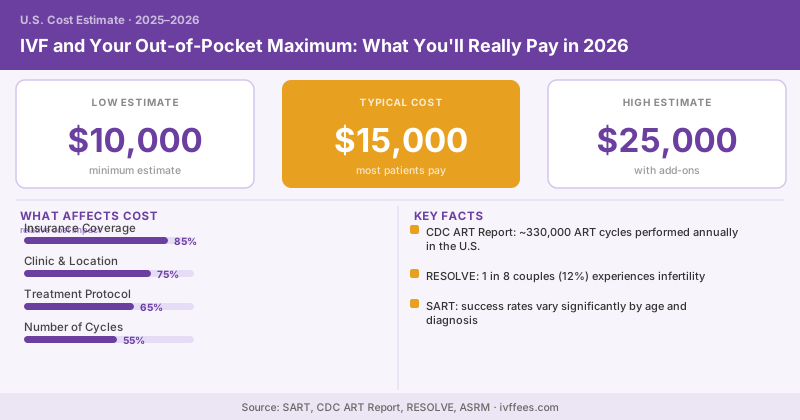
“My insurance covers IVF” doesn’t mean it’s free. Even with solid fertility benefits, you’ll likely owe your deductible, your coinsurance, and your copays until you hit your out-of-pocket maximum — which for 2025 ACA plans topped out at $9,200 for an individual and $18,400 for a family. Understanding that number tells you the real ceiling on your cost.
Most patients fixate on whether IVF is “covered.” The smarter question is: how much will I pay before the plan covers everything?
The three numbers that decide your bill
Your out-of-pocket maximum is the most you’ll pay in a plan year for covered care. Once you hit it, the insurer pays 100% of covered services for the rest of the year. Three things fill it up:
- Deductible — what you pay before insurance pays anything (often $1,500–$6,000)
- Coinsurance — your percentage share after the deductible (commonly 20%–40%)
- Copays — flat fees for visits and some services
IVF blows through deductibles fast because a single cycle costs $15,000–$20,000. So if your plan covers IVF, you’ll often hit your full out-of-pocket max in the same year you cycle.
| Plan element | 2025 typical range | How IVF affects it |
|---|---|---|
| Deductible | $1,500–$6,000 | Usually met in one cycle |
| Coinsurance | 20%–40% | Applies until OOP max |
| Out-of-pocket max (individual) | up to $9,200 | Your realistic ceiling |
| Out-of-pocket max (family) | up to $18,400 | Ceiling for family plans |
Why timing your cycle matters
Because the out-of-pocket max resets every plan year, when you cycle changes what you pay. If you’ll hit your max anyway, packing related care (egg retrieval, transfer, even unrelated procedures) into the same year means the insurer covers more of it at 100% once you’re maxed out. Cycle across two calendar years and you reset the deductible — paying it twice.
“Covered” doesn’t always count toward your out-of-pocket maximum. Some fertility benefits have a separate IVF dollar cap (e.g. $25,000 lifetime) that runs OUTSIDE your medical out-of-pocket max. Confirm whether your IVF coverage feeds the same OOP max as the rest of your plan, or sits in its own bucket.
Coverage cap vs out-of-pocket max — don’t confuse them
A lot of fertility plans have a lifetime or annual IVF dollar limit. That’s different from your out-of-pocket maximum. The IVF cap is the most the insurer will pay for fertility. The OOP max is the most you’ll pay overall. If your IVF cap is small, you can exhaust it and still owe full price beyond it — without ever hitting your medical OOP max. Read what insurance actually covers to untangle this.
Even with IVF coverage, plan to pay up to your out-of-pocket maximum — as high as $9,200 (individual) or $18,400 (family) in 2025. Confirm whether your IVF benefit feeds that same max or sits in a separate capped bucket, and time your cycle within one plan year to avoid paying your deductible twice.
How to use this to your advantage
- Call your insurer and ask: does IVF count toward my out-of-pocket maximum?
- If yes, front-load care into one plan year
- Track your accumulator (the running total toward your max) every statement
- Use an HSA or FSA for the portion you owe — see our HSA strategy guide
Even maxed-out coverage leaves real costs. Combine it with employer benefits, explore a grant, and apply the savings tactics in how to reduce IVF cost. If a denial is what’s driving your costs up, our appeal guide may help. For the remainder, weigh financing options.
Frequently Asked Questions
Does IVF always count toward my out-of-pocket maximum? Not always. If IVF is a covered medical benefit, it usually does. But some plans put fertility under a separate dollar cap that doesn’t feed your OOP max at all. Call your insurer and ask specifically — the answer changes your total cost significantly.
Do IVF medications count toward the out-of-pocket maximum? Often, yes, if they’re covered prescriptions processed through your plan. But some plans run pharmacy through a separate accumulator. Confirm whether your fertility meds apply to the same out-of-pocket max as your medical claims.
Should I time my IVF cycle around the plan year? If you expect to hit your out-of-pocket max, concentrating care into a single plan year maximizes what the insurer covers at 100%. Splitting a cycle across two calendar years usually means paying your deductible twice. Plan the calendar deliberately.