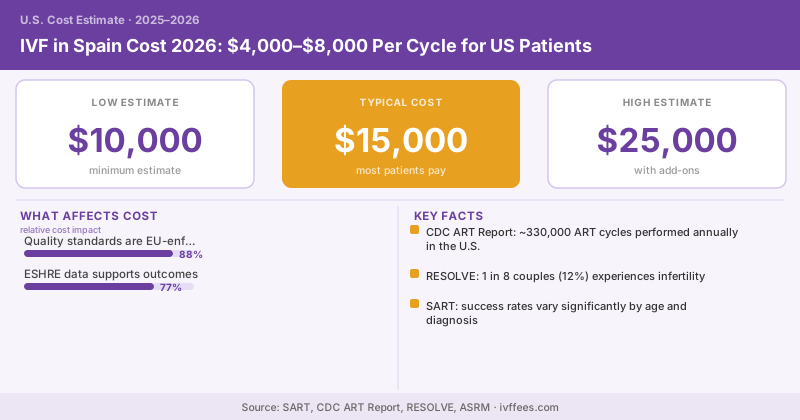
The U.S. clinic quoted $42,000 for donor egg IVF. The Barcelona clinic quoted €7,200. Same procedure. EU-regulated lab. The plane tickets cost $900 roundtrip.
That price gap is why Spain has become one of the top international destinations for fertility treatment — and specifically why American patients pursuing donor egg IVF increasingly fly across the Atlantic instead of paying domestic prices. The European Society of Human Reproduction and Embryology (ESHRE) estimates that Spain performs more cross-border fertility treatments than any other country in Europe, serving tens of thousands of international patients annually.
The math is hard to ignore. Let’s break it down properly.
What IVF in Spain Actually Costs
Spain has two main tracks for international patients: IVF with your own eggs (autologous) and donor egg IVF. The latter is far more common among American visitors, because Spain’s legal framework for egg donation is uniquely favorable compared to U.S. costs.
| Cost Component | Spain (EUR) | Spain (USD approx.) | U.S. Equivalent |
|---|---|---|---|
| IVF with own eggs (base cycle) | €3,500–€6,500 | $3,800–$7,200 | $12,000–$18,000 |
| Fertility medications (own egg cycle) | €1,200–€2,500 | $1,300–$2,750 | $4,000–$8,000 |
| Donor egg IVF (base cycle) | €5,000–€10,000 | $5,500–$11,000 | $35,000–$55,000 |
| PGT-A (genetic testing of embryos) | €1,500–€3,000 | $1,650–$3,300 | $3,000–$6,000 |
| Frozen embryo transfer (FET) | €1,200–€2,500 | $1,300–$2,750 | $3,000–$5,000 |
| Round-trip flights (east coast US) | — | $700–$1,200 | — |
| Round-trip flights (west coast US) | — | $900–$1,600 | — |
| Accommodation (2-week stay) | — | $1,000–$2,500 | — |
| All-in: own egg cycle | — | $7,000–$14,000 | $18,000–$30,000 |
| All-in: donor egg cycle | — | $9,000–$17,000 | $38,000–$60,000 |
Why Spain? The Regulatory Advantage
Spain’s fertility sector operates under Law 14/2006, which created one of Europe’s most permissive and simultaneously well-regulated frameworks for assisted reproduction. Key features that attract international patients:
Anonymous egg donation is legal and common. Unlike the U.S., where donors often receive $10,000–$30,000 in compensation and may require open-ID agreements, Spanish law caps donor compensation at €1,000 and mandates anonymity. This dramatically reduces the cost of a donor cycle. Spanish egg banks maintain large, diverse databases of screened donors precisely because demand from international patients is high.
Quality standards are EU-enforced. Spanish clinics must comply with EU Directive 2004/23/EC governing tissue and cell donation — the same standards governing any EU member state. Independent quality audits and published success rates are required by national health authorities. You’re not in regulatory no-man’s-land.
ESHRE data supports outcomes. According to ESHRE’s cross-border reproductive care studies, Spain’s top clinics report live birth rates in donor egg cycles of 45–55% per transfer — comparable to the best U.S. clinics.
Top Clinics and Cities
Barcelona is the primary hub. Institut Marquès is among Europe’s most recognized fertility clinics, with a large international patient program and live birth rates published annually. FIVMadrid also operates a Barcelona-affiliated network.
Madrid offers more clinics in a larger city with a major international airport (Adolfo Suárez Madrid–Barajas, one of Europe’s busiest). Clinics including Ginefiv and IVI Madrid serve international patients extensively.
Alicante is the third major destination — a smaller city on the Mediterranean coast with direct charter flights from the U.S. in summer. IVI (Instituto Valenciano de Infertilidad), which operates a major clinic in Alicante and Valencia, is one of Europe’s largest IVF chains with outcome data going back to the 1990s. Its scale means large egg donor databases and fast matching times.
All three cities operate with English-speaking international patient coordinators who handle scheduling, translation, and telemedicine consultations for overseas patients doing pre-travel workup remotely.
What’s Typically Included in the Quoted Price
Spain’s clinics compete heavily for international patients, so quoted prices are usually more comprehensive than U.S. clinic quotes. Most donor egg packages include:
- Donor matching and screening
- Uterine preparation medications for the recipient
- Embryo transfer procedure
- One embryo (additional embryos from the same cohort often available at reduced cost)
- Basic follow-up monitoring to confirm implantation
Not usually included:
- Initial diagnostic testing at home before traveling
- International travel and accommodation
- PGT-A genetic testing (quoted separately, usually €1,500–€3,000)
- Additional frozen embryo transfers from banked embryos
Fertility medications in Spain cost roughly 30–50% less than in the U.S. — a €1,500 medication protocol in Spain might cost $4,000–$6,000 in the U.S. Most patients doing own-egg cycles in Spain purchase medications on arrival at local pharmacies with a prescription from their Spanish clinic. For donor egg recipients, the recipient’s uterine-preparation medications (estrogen, progesterone) are modest in cost — €300–€600 — and easily purchased in Spain. Check with your clinic about what to bring vs. purchase locally.
The Travel Logistics Reality
Most American patients fly into Barcelona (BCN) or Madrid (MAD), both of which have direct flights from major U.S. hubs including New York, Miami, and Los Angeles. Flight time is 8–9 hours from the east coast, 11–12 hours from the west coast.
Trip 1 (initial consultation): 3–5 days. Many clinics now allow this to be done virtually or delegated to your local reproductive endocrinologist — ask whether you can skip this trip by sending blood work results and ultrasound reports electronically.
Trip 2 (stimulation monitoring and retrieval): For own-egg cycles, this is 9–14 days and can’t be shortened significantly. Stimulation monitoring requires near-daily ultrasounds during the last 4–5 days. For donor egg recipients, this trip is just for the embryo transfer — typically 3–5 days.
Optional Trip 3 (frozen embryo transfer): If additional embryos are banked and you return for a subsequent cycle, plan a 3–5 day trip.
Budget $1,700–$3,700 for travel and accommodation depending on origin city, season, and accommodation preference.
The Donor Anonymity Question — Don’t Skip This
Spain’s anonymous donation system means your donor-conceived child will have no legal right to access donor identity. This is the same policy that governed U.S. sperm and egg donation for decades — but U.S. practices have shifted significantly toward open-ID and known-donor arrangements.
Before committing to a Spanish donor cycle, consider:
- Your child’s future questions about genetic identity
- The growing availability of direct-to-consumer DNA testing (23andMe, AncestryDNA) that can identify genetic relatives regardless of legal anonymity
- Whether your family’s values align with an anonymous donation model
Many families proceed with Spanish donor cycles with full awareness of these considerations. The point is to make it an active, informed choice — not an afterthought.
Spain’s legal framework requires that donor-conceived individuals be informed of their status — Spanish clinics won’t help you conceal the donation from your child. However, there is no mechanism for donor identity disclosure. If you later decide your child should have access to donor identity, the legal path is limited. This is a permanent decision with permanent consequences. Consult with a reproductive attorney familiar with international fertility law before proceeding.
Comparing Spain to Other European Destinations
Spain isn’t the cheapest option in Europe — that distinction belongs to Czech Republic and some Balkan destinations. But Spain offers the largest egg donor databases, the widest variety of phenotypes (important for matching to diverse American patients), and the most developed international patient infrastructure.
For a straightforward own-egg IVF cycle on a tight budget, Czech Republic often makes more financial sense. For donor egg IVF with extensive donor selection and a well-regulated environment, Spain is the top-tier choice.
Is It Worth It?
For donor egg IVF specifically, the economics are almost impossible to argue with. A complete donor egg cycle in Spain — flights, accommodation, clinic costs, medications, and all — typically runs $9,000–$17,000 all-in. The same cycle in the U.S. runs $35,000–$60,000. The savings fund 2–4 Spanish cycles for the price of one domestic attempt.
For own-egg IVF, the math is less extreme but still compelling — especially if you anticipate multiple cycles or are paying entirely out of pocket. Even accounting for travel costs, two Spanish cycles often cost less than one U.S. cycle.
The success rates are real. The regulation is real. The savings are real. Do the research, choose a clinic with audited outcome data, and plan your travel logistics carefully.
Cost estimates based on ESHRE Cross-Border Reproductive Care published data, clinic public pricing, and USD/EUR exchange rates as of 2026. Individual costs vary by clinic, protocol, and travel origin. Consult a U.S.-licensed reproductive attorney for legal guidance on international donor agreements.