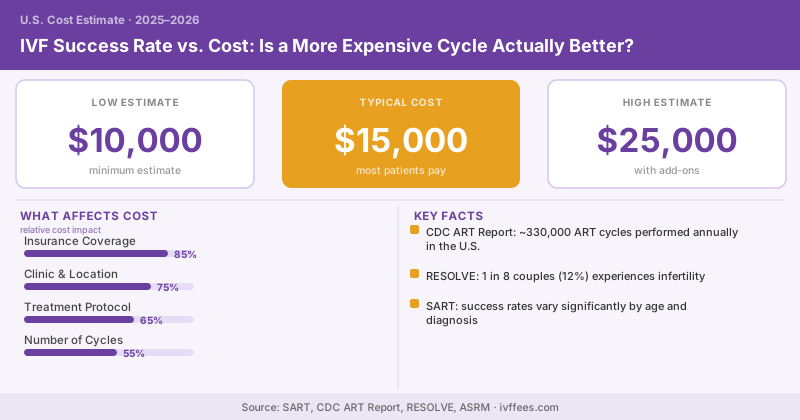
A $25,000 cycle isn’t automatically better than a $13,000 one — and that single sentence saves patients thousands of dollars in bad assumptions every year. Price and success rate are related, but not nearly as tightly as most people assume when they’re shopping for a fertility clinic.
The Real Math: Cost Per Live Birth, Not Cost Per Cycle
The number that actually matters isn’t the sticker price of one cycle — it’s your expected total spend to reach a live birth, given a clinic’s realistic success rate for your age and diagnosis.
| Scenario | Cycle Cost | Live Birth Rate | Expected Cycles to Live Birth | Est. Total Spend |
|---|---|---|---|---|
| Clinic A (lower price, lower rate) | $13,000 | 32% | ~3.1 | ~$40,300 |
| Clinic B (mid price, mid rate) | $18,000 | 45% | ~2.2 | ~$39,600 |
| Clinic C (higher price, higher rate) | $24,000 | 55% | ~1.8 | ~$43,200 |
(Illustrative model based on SART national benchmark ranges; individual results vary widely by age, diagnosis, and clinic.)
Notice how Clinic B, the mid-priced option, comes out ahead in this illustration — not the cheapest, not the most expensive. That’s the point: run your own version of this math before assuming the lowest quote is the best deal, or that the priciest clinic guarantees the best odds.
Where SART Data Comes In
The Society for Assisted Reproductive Technology publishes clinic-level, age-stratified outcome data at sart.org for nearly every U.S. fertility clinic. According to SART’s most recent national summary, live birth rate per egg retrieval for women under 35 nationally averages around 46–50%, dropping to roughly 30–35% for women 38–40, and considerably lower above 42. Individual clinics vary substantially around these averages — which is exactly why checking clinic-specific, age-matched numbers matters more than the national average or a clinic’s marketing claims.
Take the clinic’s quoted cycle cost, divide 1 by the clinic’s SART live birth rate for your specific age bracket (e.g., 1 ÷ 0.45 = 2.2 expected cycles), then multiply that by the cycle cost. Compare this number across every clinic you’re considering — it’s a far better apples-to-apples comparison than the sticker price alone.
Why Price and Quality Aren’t Tightly Linked
Fertility clinic pricing reflects a mix of factors that have little to do with lab quality: real estate costs in expensive metro areas, brand reputation built over decades, physician compensation structures, and whether the clinic is part of a large national network with overhead to cover. A well-run academic or independent clinic in a lower-cost city can post SART numbers that match or beat a premium urban brand — for a fraction of the price.
That said, some premium clinics genuinely do have exceptional embryology labs, more experienced physicians for complex cases, and outcomes data that justifies the higher price for patients with difficult diagnoses. The only way to know which category a given clinic falls into is to check its actual numbers.
When Paying More Actually Makes Sense
Higher-cost clinics can be worth it when you have a complex diagnosis — recurrent implantation failure, severe male factor infertility, or advanced age with diminished reserve — where a program’s specific expertise and case volume genuinely move the needle on outcomes. For straightforward cases in patients under 35 with no major risk factors, the outcome gap between clinics often narrows considerably, making price a more reasonable tiebreaker.
Be skeptical of any clinic, cheap or expensive, that won’t provide its SART-reported live birth rate for your specific age group in writing. A refusal to share this data, or reliance only on vague marketing language like “above-average success,” is a signal to look elsewhere before committing thousands of dollars.
The Bottom Line
Don’t assume cost tracks success rate in either direction. Pull the clinic’s actual SART data for your age bracket, run a simple cost-per-expected-live-birth calculation, and use that number — not the sticker price — to make your decision. It often points to a different, and cheaper, answer than instinct alone.