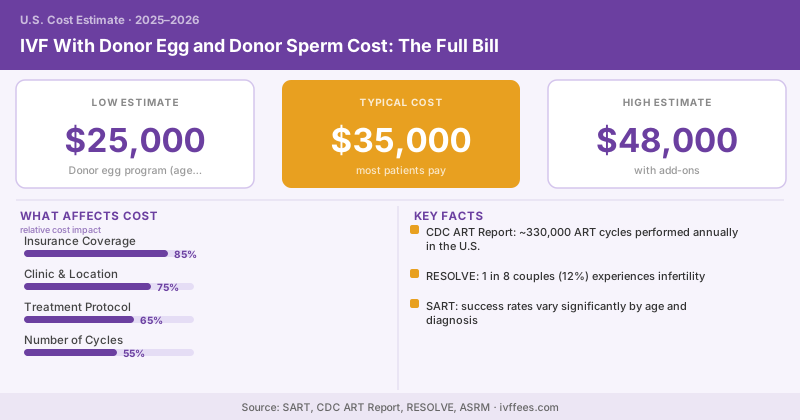
People assume using both a donor egg and donor sperm roughly doubles your IVF bill. It doesn’t — the donor egg program dominates the total so heavily that donor sperm barely moves the needle by comparison.
What the Combined Total Actually Looks Like
| Cost Component | Low End | Typical | High End |
|---|---|---|---|
| Donor egg program (agency + compensation + cycle) | $25,000 | $35,000 | $48,000 |
| Donor sperm (vial, shipping, handling) | $1,150 | $1,700 | $2,400 |
| Recipient transfer cycle (medications + procedure) | $4,000 | $6,000 | $9,000 |
| Total | $30,150 | $42,700 | $59,400 |
The donor egg program alone — covering the egg donor’s compensation, agency coordination fees, her medical screening and stimulation cycle, and the embryology lab fees to fertilize and culture the resulting embryos — represents the vast majority of the total cost, regardless of whose sperm is used to fertilize the eggs.
Why the Egg Donor Piece Costs So Much More
An egg donor undergoes her own full ovarian stimulation cycle and retrieval procedure, essentially the same medical process as a patient going through IVF herself, plus psychological and genetic screening, agency matching and coordination, legal contracts, and compensation for her time and medical risk. Donor sperm, by contrast, is a pre-screened, pre-frozen product purchased from inventory — no live donor cycle, screening coordination, or agency matching is required at the time of your purchase, which is why the cost difference between the two is so dramatic.
If you have a known or directed egg donor — a friend, family member, or someone you’ve found independently rather than through an agency database — you may be able to skip some agency matching fees, though psychological screening, medical screening, and legal contracts are still essential and shouldn’t be skipped to save money. Ask your clinic and a reproductive attorney what’s still required even with a known donor.
Who Actually Needs This Combination
This path is most common for same-sex male couples and single men pursuing parenthood, who by definition need both an egg donor and a gestational carrier (and by extension, often work with an agency managing both simultaneously), as well as heterosexual couples facing both significantly diminished ovarian reserve and severe male factor infertility at the same time. Each of these situations typically layers additional legal costs — parentage orders, surrogacy contracts if a gestational carrier is also involved — on top of the core donor egg and sperm costs discussed here.
Don’t Forget the Recipient’s Own Cycle Costs
Even though you’re not paying for an egg retrieval on the recipient’s side, whoever carries the pregnancy (whether the intended mother or a gestational surrogate) still requires a full frozen embryo transfer cycle — monitoring, endometrial preparation medications, and the transfer procedure itself — typically adding $4,000 to $9,000 to the total that’s sometimes overlooked when patients focus only on the donor costs.
If your situation also involves a gestational surrogate in addition to donor egg and sperm, don’t underestimate the added complexity and cost of coordinating three separate parties’ legal, medical, and screening timelines simultaneously. Work with a reproductive attorney and an agency experienced specifically in multi-donor, multi-party arrangements — this is not a situation to coordinate independently without experienced legal guidance.
The Bottom Line
Budget $30,000 to $60,000 for IVF combining a donor egg program and donor sperm, understanding that the donor egg piece drives nearly all of that cost while donor sperm adds only a small fraction. If a gestational surrogate is also part of your plan, budget separately and substantially more for surrogacy-specific costs, which aren’t included in the figures above.