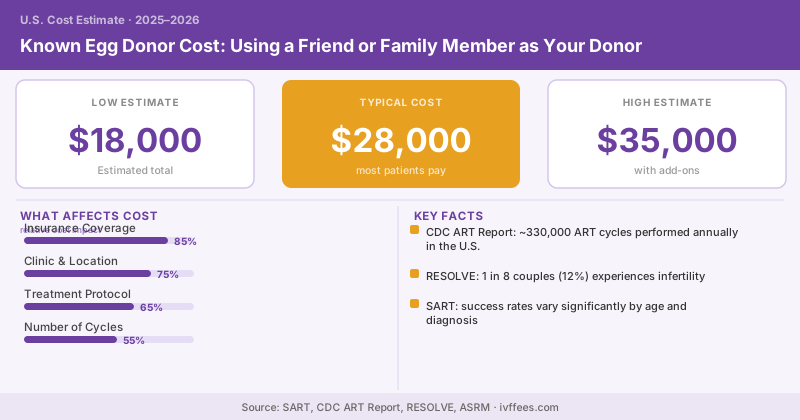
Most people assume a known egg donor — your sister, your cousin, a close friend — means free eggs. Wrong. Even when she charges you nothing for her time, a known donor cycle still runs $18,000 to $35,000. The donor’s generosity removes one line item, not the whole bill.
Here’s what you’re actually paying for and where the surprises hide.
What “Known Donor” Really Means
A known egg donor is someone you already have a relationship with who agrees to provide eggs. Unlike anonymous donation through a bank, you skip the donor-matching fee and often the compensation. But the medical, legal, and screening costs don’t disappear. They’re identical to any other fresh egg donation cycle — your clinic treats your sister’s body the same way it treats a paid stranger’s.
That’s the part that catches families off guard. The eggs are free; the cycle is not.
Cost Breakdown for a Known Donor Cycle
| Cost Component | Low | Typical | High |
|---|---|---|---|
| Donor medical screening | $2,000 | $3,500 | $5,000 |
| Psychological evaluation (donor) | $500 | $800 | $1,500 |
| Genetic carrier screening | $300 | $600 | $1,200 |
| Donor stimulation medications | $3,000 | $5,000 | $7,000 |
| Monitoring & egg retrieval | $6,000 | $8,500 | $12,000 |
| Fertilization, culture, transfer | $6,000 | $8,000 | $11,000 |
| Legal agreement (donor + recipient) | $1,000 | $2,500 | $4,500 |
| Estimated total | $18,000 | $28,000 | $35,000 |
Notice there’s no $8,000–$15,000 donor compensation line and no agency fee. That’s where you save versus a typical anonymous fresh cycle — often $15,000 to $30,000 in avoided costs.
The Screening Can’t Be Skipped
This is the most common point of friction. Your aunt may be perfectly healthy, but FDA regulations and ASRM guidelines require every egg donor — known or not — to complete infectious disease testing, genetic carrier screening, and a psychological evaluation. The FDA mandates screening for communicable diseases under its tissue donor rules, and there’s no family exemption.
ASRM also recommends a separate psychological consultation for known donors specifically, because the emotional dynamics of donating to a relative are more complicated than anonymous donation. That counseling protects everyone, and it’s worth every dollar.
A known egg donor typically saves you $15,000 to $30,000 by removing compensation and agency fees, but you still pay full medical, screening, and legal costs of $18,000 to $35,000. The eggs are a gift; the cycle is a medical procedure with a real price tag.
Legal Agreements Are Non-Negotiable
Just because you trust the person doesn’t mean you skip the lawyers. A known donor agreement spells out who has parental rights (you, not the donor), what happens to leftover embryos, future contact expectations, and financial responsibilities. Reproductive attorneys typically charge $1,000 to $4,500 to draft and review this contract, with both parties ideally having separate counsel.
Skipping this is the single most expensive mistake families make. A handshake deal with your sister can turn into a custody dispute or an estate complication years later.
Family pressure is real and can cloud judgment on both sides. A donor who feels obligated to say yes, or a recipient who feels they can’t ask hard medical questions, sets up emotional risk. Insist on independent psychological counseling and separate legal representation even when everyone is enthusiastic. The relationship you’re protecting is worth more than the legal fees.
Age and Health Factors
Known donors are often chosen for genetic similarity rather than optimal fertility. If your donor is over 32, ask your clinic how her age affects expected egg yield and live birth odds. A 38-year-old sister may produce fewer viable eggs than a 24-year-old anonymous donor, which can mean a second cycle — and that doubles the medical cost.
Run the numbers honestly. Sometimes the emotional value of a family donor is worth a lower yield; sometimes the math points back toward a younger anonymous donor egg IVF cycle.
Comparing Your Options
If a known donor doesn’t work out, compare against anonymous fresh and frozen banks, and don’t forget embryo adoption as a lower-cost alternative. Whatever path you choose, layering in IVF financing options can spread the medical costs that a known donor can’t eliminate.
Frequently Asked Questions
If my donor isn’t charging me, why is it still so expensive? Because the medical procedure — stimulation, monitoring, retrieval, lab work, and transfer — costs the same regardless of who the eggs come from. You’re paying the clinic and the lab, not the donor.
Does my known donor need her own lawyer? Ideally yes. Separate counsel for the donor and recipient prevents conflicts of interest and ensures the agreement holds up legally. Expect to pay for both, though some couples cover the donor’s legal fee as a courtesy.
Can a relative donate without affecting parental rights? Yes, when a proper legal agreement is in place establishing you as the legal parent. Without that contract, parental rights can become legally murky, which is exactly why the agreement is mandatory. This mirrors the legal protections required in surrogacy legal fees.