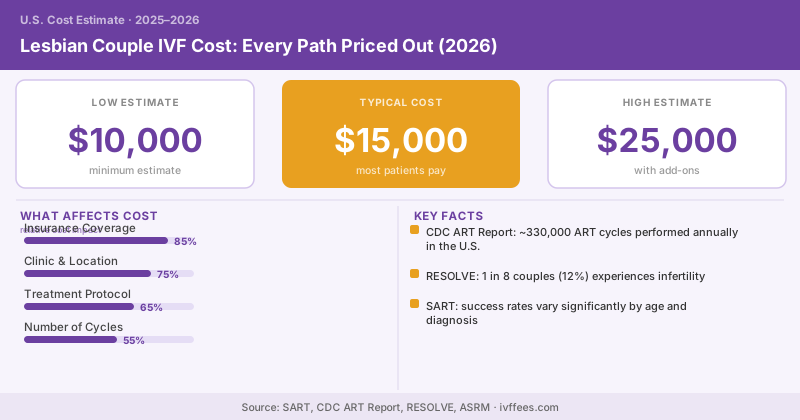
Most lesbian couples assume IVF is their only option. It usually isn’t. Two women building a family have more choices than almost anyone else—from a simple donor-sperm insemination that costs about a grand to a reciprocal IVF cycle where one of you provides the eggs and the other carries. The right pick depends on your bodies, your budget, and how involved you both want to be biologically. Here’s how the numbers stack up.
Family Equality’s research has consistently found that LGBTQ+ couples are far more likely to use donor insemination and assisted reproduction to grow their families. For lesbian couples, the path almost always starts with one decision: donor sperm.
Your Three Main Paths
| Path | Typical Cost (per attempt) |
|---|---|
| At-home / ICI with donor sperm | $1,000–$2,000 |
| Medicated IUI in clinic | $1,500–$4,000 |
| IVF (one partner’s eggs & uterus) | $12,000–$20,000 |
| Reciprocal IVF (shared biology) | $15,000–$25,000 |
The cheapest route is intracervical or intrauterine insemination with bank sperm. If one partner is under 35 with no fertility issues, this is the sensible starting point. Our IUI cost and donor sperm IUI cost guides cover the per-cycle math in detail, including how many attempts to budget for.
Reciprocal IVF: Sharing the Journey
This is the path that’s uniquely meaningful for two women. In reciprocal IVF—sometimes called co-IVF or partner IVF—one partner’s eggs are retrieved and fertilized with donor sperm, then the resulting embryo is transferred to the other partner, who carries the pregnancy. Both of you are physically part of bringing your child into the world.
It costs more because you’re doing a full IVF egg retrieval on one person plus an embryo transfer on the other, with separate monitoring and medications for each. Our dedicated reciprocal IVF cost guide digs into the cycle-by-cycle pricing.
Start with the cheapest path that fits your fertility profile. If both partners are healthy and under 35, medicated IUI at $1,500–$4,000 per cycle is the smart opener. Save reciprocal IVF—your priciest but most shared option—for when you specifically want both partners biologically involved, or when IUI hasn’t worked.
Don’t Forget the Sperm
Donor sperm from a licensed bank runs $900–$1,500 per vial. You’ll likely need several vials across attempts, and many couples buy extra to keep the same donor for siblings. There’s also annual storage. See our sperm donor cost guide for bank-by-bank comparison and what “open ID” donors add to the price.
If you’re considering a known donor (a friend or acquaintance), get a reproductive attorney involved before anyone donates. Without a clinic-mediated process and a signed donor agreement, the donor may retain parental rights or face child-support obligations. The legal fee is small insurance against a custody nightmare.
Insurance and Legal Steps
Coverage varies wildly. A growing number of states mandate fertility coverage that includes single people and same-sex couples, but many still define infertility in ways that exclude you. Beyond the medical bills, budget for legal work: even when both partners are married and on the birth certificate, attorneys still often recommend a confirmatory or second-parent adoption to lock in parentage nationwide.
For couples expecting to need multiple cycles, IVF financing options covers loans, grants, and multi-cycle packages worth comparing.
Frequently Asked Questions
What’s the difference between reciprocal IVF and regular IVF for us? In regular IVF, one partner provides both the eggs and carries the pregnancy. In reciprocal IVF, one partner provides the eggs and the other carries—so both of you are biologically connected to the experience. Reciprocal costs a few thousand more because it involves procedures on two people.
Can we both be legal parents from birth? In most states, a married couple on the birth certificate are both legal parents. But because parentage laws differ across states and aren’t always honored when you travel, many attorneys still recommend a second-parent or confirmatory adoption for ironclad nationwide protection.
Is IUI or IVF cheaper for a lesbian couple? IUI is dramatically cheaper—often a quarter to a third of IVF’s per-cycle price. If neither partner has fertility issues, most clinics start with medicated IUI and only move to IVF after a few unsuccessful cycles or if reciprocal IVF is your goal.