Male factor accounts for roughly 40–50% of all infertility cases, according to figures cited by the American Society for Reproductive Medicine — yet many couples spend their entire first workup budget testing her, not him.
If you’re starting a fertility evaluation as a couple, here’s what a proper male fertility workup actually costs and why it belongs at the start of the process, not an afterthought.
What a Male Fertility Workup Costs
| Test/Component | Low End | Typical | High End |
|---|---|---|---|
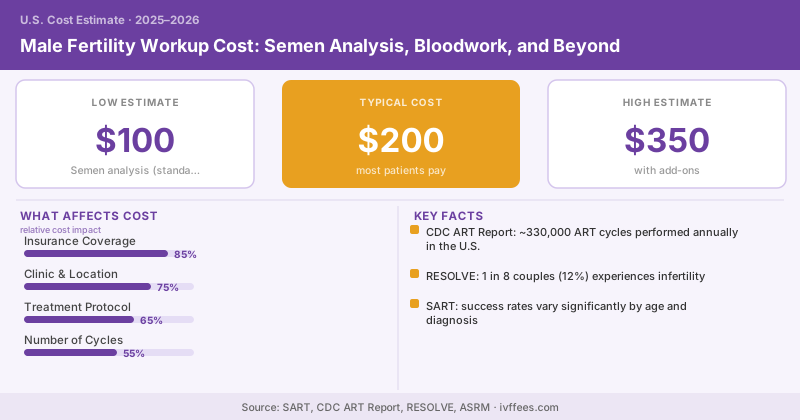
| Semen analysis (standard) | $100 | $200 | $350 |
| Hormone bloodwork (testosterone, FSH, LH) | $100 | $250 | $500 |
| Urologist physical exam/consultation | $150 | $300 | $500 |
| Sperm DNA fragmentation test (if indicated) | $200 | $400 | $600 |
| Total (basic workup) | $350 | $750 | $1,350 |
A basic semen analysis is often the first and cheapest test in the entire fertility evaluation process for either partner — a strong argument for doing it early rather than after months of female-focused testing and expense.
Why Male Testing Often Gets Delayed
Reproductive medicine has historically been organized around OB-GYN and female reproductive care, and that structural bias has meant male partners are sometimes referred for testing only after initial female workups turn up normal results — even though a semen analysis is faster, cheaper, and less invasive than most female fertility tests. Leading fertility specialists and organizations, including ASRM, now explicitly recommend simultaneous testing of both partners from the start of an infertility evaluation specifically to avoid this costly and time-consuming delay.
A basic semen analysis costs a fraction of most female fertility tests and can be completed within days. Doing it early, rather than after months of other testing, can save significant time and money by identifying a male factor issue before investing in additional female-focused diagnostics that may not be necessary.
What the Bloodwork Actually Checks
Hormone testing for men typically includes total and free testosterone, FSH, and LH — hormones that regulate sperm production and can indicate whether a low sperm count stems from a testicular production issue versus a hormonal signaling problem from the pituitary gland. This distinction matters enormously for treatment: a hormonal imbalance is sometimes correctable with medication, while a production issue at the testicular level may require a different approach, including procedures like testicular sperm extraction in more significant cases.
When Additional Testing Gets Recommended
If a standard semen analysis shows abnormal results — low count, poor motility, or abnormal morphology — your urologist may recommend additional testing like sperm DNA fragmentation analysis, which checks for genetic damage within sperm that a standard analysis doesn’t capture, or a scrotal ultrasound to check for a varicocele, a common and treatable cause of male infertility.
A single abnormal semen analysis result isn’t necessarily conclusive — sperm parameters can fluctuate significantly based on illness, stress, medication, recent ejaculation frequency, and even the time of year. Most urologists recommend repeating an abnormal semen analysis at least once, several weeks apart, before drawing firm conclusions or recommending treatment changes.
The Cost Case for Testing Both Partners Simultaneously
Beyond the medical logic, there’s a straightforward financial argument for simultaneous testing: identifying a treatable male factor issue early can redirect the entire treatment plan away from more expensive interventions that wouldn’t have addressed the actual problem. A couple who spends months and thousands of dollars on female-focused testing and treatment, only to eventually discover an undiagnosed male factor issue, has lost both time and money that earlier simultaneous testing could have saved.
The Bottom Line
Budget $350–$1,350 for a complete male fertility workup, with a basic semen analysis costing as little as $100–$350 as a starting point. Given how common and often treatable male factor infertility is, most fertility specialists now recommend this testing happen at the very start of a couple’s evaluation — not as a follow-up after female testing comes back inconclusive.