Mini IVF sounds cheaper. It often isn’t — and for many patients, it ends up costing more per baby than conventional IVF. Here’s why, and who it actually makes sense for.
Mini IVF (minimal stimulation IVF) uses lower doses of fertility medications — sometimes with oral medications like clomiphene instead of injectable gonadotropins — to retrieve fewer eggs intentionally. Clinics market it as a gentler, more affordable alternative. The reality is more complicated.
What Does Mini IVF Actually Cost?
| Cost Component | Low | Typical | High |
|---|---|---|---|
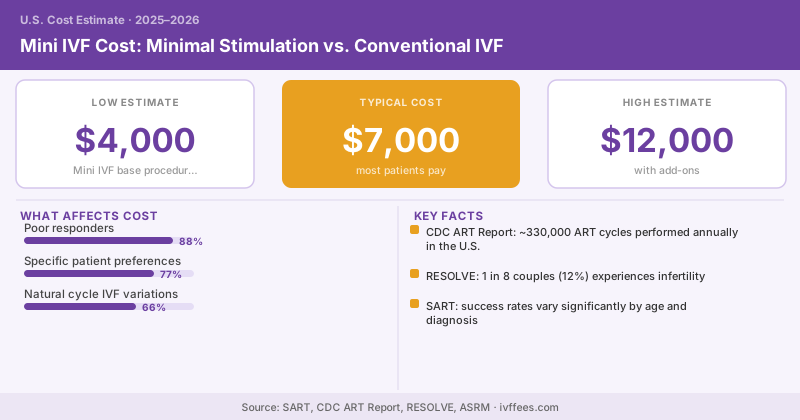
| Mini IVF base procedure | $4,000 | $7,000 | $12,000 |
| Medications (lower dose) | $500 | $1,500 | $3,000 |
| Monitoring appointments | $500 | $1,000 | $2,000 |
| Lab and embryology fees | $1,000 | $2,000 | $4,000 |
| Total mini IVF cycle | $5,000 | $10,000 | $18,000 |
| Conventional IVF (for comparison) | $12,000 | $18,000 | $30,000 |
At first glance, mini IVF looks like a significant savings. But that comparison doesn’t account for success rates. If conventional IVF has a 50% success rate per cycle and mini IVF has a 20–30% rate per cycle, you may need two or three mini IVF cycles to equal one conventional cycle outcome — at similar or greater total cost.
How Mini IVF Works Differently
In conventional IVF, you take high-dose injectable gonadotropins for 10–14 days to stimulate your ovaries to produce 10–20 mature eggs. The goal is volume — more eggs mean more embryos, more chances.
Mini IVF uses lower-dose injectables or oral medications (clomiphene, letrozole) to produce just 2–5 eggs per retrieval. The reasoning: quality over quantity. Proponents argue that more aggressive stimulation can reduce egg quality, and that a gentler approach may yield fewer but better embryos.
The evidence for this claim is mixed. Most large studies don’t show a quality advantage for mini stim, and the quantity disadvantage is real — especially for patients who already have diminished ovarian reserve and can’t afford to sacrifice eggs.
Who Mini IVF Actually Makes Sense For
There are legitimate clinical reasons to consider minimal stimulation:
Poor responders: Women who produce only 2–4 eggs with high-dose protocols anyway don’t benefit from the extra medication cost. Mini IVF may retrieve a similar number at lower medication expense.
Medical contraindications to high stimulation: Rare, but some conditions (prior ovarian hyperstimulation syndrome, certain hormonal sensitivities) make aggressive protocols risky.
Specific patient preferences: Some women strongly prefer a lower-hormone approach for personal or medical reasons, understanding the tradeoff.
Natural cycle IVF variations: Mini IVF is sometimes used as a middle ground between natural cycle IVF and full conventional.
- What is your clinic’s live birth rate per mini IVF cycle vs. conventional IVF for my age group?
- How many eggs do you expect to retrieve with mini vs. full stim?
- What is my expected cost per live birth with each approach?
- What’s the refund/cancellation policy if the cycle is cancelled due to poor response?
- Would you recommend mini IVF if cost weren’t a factor?
The Cost Per Live Birth Math
This is the number that matters. Let’s say:
- Conventional IVF: $20,000/cycle, 45% live birth rate → ~$44,000 per baby
- Mini IVF: $9,000/cycle, 25% live birth rate → ~$36,000 per baby
In this scenario, mini IVF does win on cost per live birth. But change the success rate slightly:
- Mini IVF at 20% success → $45,000 per baby (higher than conventional)
The math only works if your mini IVF success rate stays above ~22–25%. For patients over 38 with diminished reserve where conventional IVF might only produce a 25% rate anyway, mini IVF at 20% doesn’t save money — it just saves medication costs while losing eggs.
What Mini IVF Clinics Don’t Always Tell You
Some clinics market mini IVF heavily because it’s operationally simpler and allows higher patient throughput. Fewer monitoring appointments, simpler stimulation protocols, and reduced lab complexity make mini IVF faster to run.
That’s not a reason to avoid it — but it’s worth understanding the incentive structure. Ask your RE to honestly compare your expected outcomes with both approaches, in writing, before committing.
If a clinic pushes mini IVF primarily on cost grounds without discussing your specific ovarian reserve, age, and treatment history, be skeptical. The right protocol depends on your individual biology, not on what’s cheapest for the clinic to run.
Medication Cost Comparison
The biggest genuine saving in mini IVF is medication cost. Conventional IVF medications run $3,000–$7,000 per cycle. Mini IVF medications can run $500–$2,500 — a real difference.
For patients paying entirely out of pocket and particularly sensitive to medication costs (for example, those using oral protocols with clomiphene at $10–$50/month), the drug savings are meaningful. But they need to be weighed against the expected retrieval difference.
The Bottom Line
Mini IVF is a legitimate option for specific patients — particularly poor responders who don’t produce many eggs with full stimulation anyway. For typical patients with normal ovarian reserve, the cost savings are often illusory when you account for lower success rates. Run the cost-per-live-birth calculation for your specific situation before deciding, and make sure your RE gives you both options with honest outcome projections.