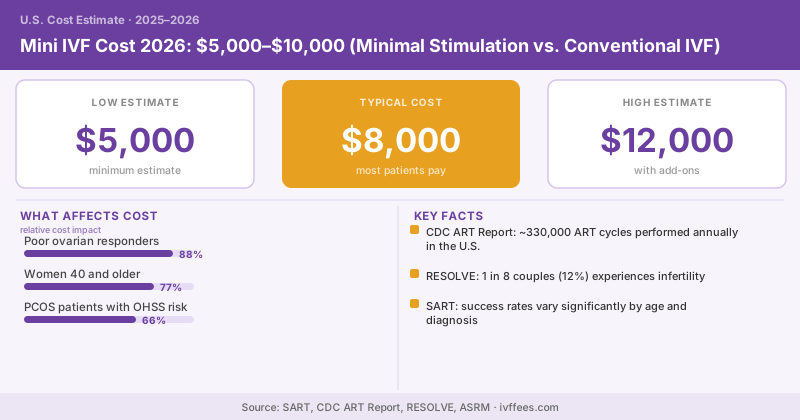
The $5,000 price tag sounds almost too good to be true next to the $20,000 quotes most fertility clinics hand you. Mini IVF — or minimal stimulation IVF — is real, it’s practiced at legitimate clinics across the US, and for specific patients it genuinely makes sense. But it’s not a bargain version of the same thing. It’s a different protocol with real trade-offs.
Here’s what you’re actually paying for, and who’s the right fit.
What Mini IVF Is
Conventional IVF uses high-dose injectable gonadotropins (FSH + LH) to stimulate the ovaries to produce as many mature eggs as possible — often 10 to 20+ in good responders. Mini IVF does the opposite. It uses either very low doses of injectables, oral medications (Clomid or letrozole), or a combination of both to produce 2 to 5 eggs per cycle.
The goal isn’t volume. It’s to retrieve a small number of higher-quality eggs at a fraction of the medication cost, in a more natural hormonal environment.
Most mini IVF protocols use clomiphene citrate or letrozole as the primary stimulation agent, sometimes with a small injectable boost. The result: fewer eggs, but significantly lower drug costs and a shorter, simpler monitoring schedule.
The Cost Breakdown
The biggest savings in mini IVF are in medications and — at some clinics — reduced monitoring visits.
| Cost Component | Mini IVF | Conventional IVF |
|---|---|---|
| Medications | $200–$800 | $3,000–$7,000 |
| Clinic/monitoring fees | $1,500–$3,000 | $3,000–$6,000 |
| Egg retrieval + lab | $2,500–$4,500 | $4,000–$8,000 |
| Embryo transfer (included or add-on) | $500–$1,500 | $1,000–$3,000 |
| PGT-A (optional) | $3,000–$6,000 | $3,000–$6,000 |
| Total per cycle | $5,000–$10,000 | $12,000–$25,000 |
The per-cycle savings are real. What you need to model is the number of cycles you’ll likely need.
Who Mini IVF Is Actually For
Not everyone saves money with mini IVF. The math changes dramatically depending on your diagnosis.
Poor ovarian responders. Women who already produce only 2 to 5 eggs with maximum stimulation doses are essentially doing mini IVF anyway — they’re just paying for the high-dose drugs and getting the same result. For this group, mini IVF can deliver similar outcomes at a fraction of the cost. The CDC’s 2022 ART Surveillance report shows that poor responders have significantly lower live birth rates per cycle regardless of protocol, underscoring that more medication doesn’t always mean more eggs.
Women 40 and older. Many REs argue that quality matters more than quantity at this age. Retrieving 3 high-quality eggs may produce better outcomes than retrieving 10 eggs with variable quality. Mini IVF’s lower-stimulation environment may support that, though evidence is mixed.
PCOS patients with OHSS risk. High-dose stimulation in women with polycystic ovary syndrome carries a real risk of ovarian hyperstimulation syndrome (OHSS), which can be serious. According to ASRM, OHSS affects approximately 1–2% of all IVF cycles in moderate-to-severe form. Mini IVF’s lower doses reduce this risk meaningfully.
Cost-constrained patients who want to try multiple cycles. Some patients would rather attempt three mini IVF cycles at $6,000 each than one conventional cycle at $18,000. Whether that math works depends entirely on their response to stimulation.
If you’re under 35, have normal ovarian reserve, and respond well to stimulation, conventional IVF is almost certainly the better choice. You’ll produce more eggs, more embryos, and potentially freeze extras for siblings — making the higher per-cycle cost more efficient over time. Mini IVF’s value proposition hinges on situations where high-dose stimulation doesn’t deliver much additional benefit.
Success Rate Trade-Offs
The honest picture: mini IVF has lower per-cycle live birth rates than conventional IVF in most patient populations. SART doesn’t publish separate success rates for mini IVF protocols, making direct comparison difficult. Published studies from clinics specializing in minimal stimulation show live birth rates per retrieval of roughly 15–25% across all ages — lower than the 35–40%+ seen in good-prognosis conventional IVF patients.
The caveat is the denominator. In poor responders, the gap narrows significantly. A woman who produces 3 eggs on a high-dose conventional protocol would likely produce 2 to 3 eggs on a mini IVF protocol — but at $10,000 less per attempt.
What Clinics Offer Mini IVF
Not every fertility clinic offers mini IVF, and those that do may have different definitions of what counts as “minimal stimulation.” Clinics with formal mini IVF programs include several academic centers and some independent practices. Be specific when asking: “What medications do you use, at what doses, and what’s your expected egg yield for a patient like me?”
Some clinics market “mini IVF” as a lower-cost option but still use substantial injectable doses — just slightly less than their standard protocol. That’s not true minimal stimulation. Ask for the specific medication protocol in writing before committing.
The Cumulative Cost Reality
The single most important number to model: how many cycles will you likely need? If mini IVF has a 20% per-cycle success rate for your profile and conventional IVF has a 40% rate, you’d need on average two mini cycles to match one conventional cycle — and two cycles at $7,000 each equals $14,000, versus $15,000–$18,000 for one conventional cycle. The savings shrink quickly.
For poor responders where conventional IVF also yields only a 15–20% success rate, that calculation shifts. Three mini cycles at $6,000 ($18,000 total) gives three attempts; three conventional cycles at $18,000 each would be $54,000. The math strongly favors mini IVF for patients who need multiple attempts and who produce few eggs regardless of protocol.
Cost estimates based on ASRM clinical guidelines, RESOLVE national pricing surveys, and CDC 2022 ART Surveillance Report. Individual clinic fees vary by location and protocol.