Imagine swapping a phone’s dead battery while keeping everything else about the phone the same — that’s roughly the concept behind mitochondrial replacement therapy, a technique that replaces the energy-producing mitochondria in an egg while preserving the intended parent’s own nuclear DNA.
It’s one of the most expensive and least accessible fertility treatments in the world today, and a big part of that cost comes from where you’re legally allowed to get it done.
Why the Price Is So High
| Cost Component | Low End | Typical | High End |
|---|---|---|---|
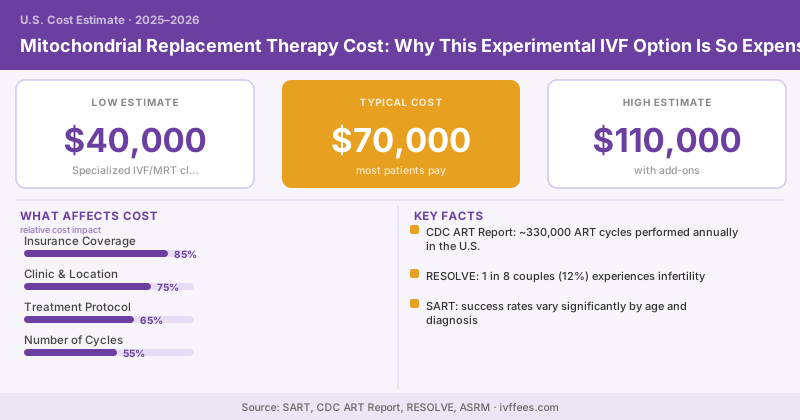
| Specialized IVF/MRT clinical fees | $40,000 | $70,000 | $110,000 |
| Donor egg program (mitochondria source) | $15,000 | $25,000 | $40,000 |
| Genetic counseling & testing | $5,000 | $10,000 | $18,000 |
| International travel & extended stay | $10,000 | $18,000 | $30,000 |
| Total | $70,000 | $123,000 | $198,000 |
Unlike standard IVF, mitochondrial replacement therapy — sometimes called “three-parent IVF” — isn’t offered at your local fertility clinic, no matter your budget. That restriction alone drives much of the cost.
Why It’s Not Available in the US
Since 2016, Congress has attached a rider to annual federal spending bills that specifically prohibits the FDA from using any funds to review applications involving research “in which a human embryo is intentionally created or modified to include a heritable genetic modification.” Mitochondrial replacement, because it results in an embryo carrying DNA from three genetic sources, falls under that prohibition. This isn’t a temporary FDA review delay — it’s a recurring legislative block that has to be renewed or removed by Congress, and there’s currently no clear timeline for that changing.
As a result, patients who need this treatment travel abroad to countries with different regulatory frameworks — the United Kingdom, which has a formal licensing process through its Human Fertilisation and Embryology Authority, along with clinics in Ukraine, Greece, and a few other countries offering it with less formal oversight.
Mitochondrial replacement uses a donor egg only for its mitochondria — the intended parent’s own nuclear DNA (the genetic material that determines most inherited traits) is transferred into the donor egg after its own nucleus is removed. This is fundamentally different from standard donor egg IVF, where the donor’s full genetic contribution is used. Don’t confuse the two when researching costs or providers.
Who This Treatment Is Actually For
Mitochondrial replacement isn’t a fertility booster for age-related decline or general infertility — it’s a highly specific intervention for the small number of patients carrying serious mitochondrial DNA diseases who want a genetically related child without risking transmission of that disease. Mitochondrial diseases affect an estimated 1 in 5,000 people according to figures cited by mitochondrial disease research organizations, and most of those patients pursue standard family-building options; MRT is relevant to a narrow subset specifically motivated to have a child carrying their own nuclear DNA.
International clinics offering mitochondrial replacement vary enormously in oversight and track record. The UK’s regulated pathway through the HFEA involves rigorous case-by-case licensing; clinics in some other countries operate with far less regulatory scrutiny. Research any clinic’s actual outcomes data and regulatory status thoroughly, and consult a genetic counselor and reproductive endocrinologist in the US before committing to international treatment.
What Drives the Enormous Price Range
Costs vary based on which country you travel to, whether you need a donor egg program bundled in (versus already having a mitochondrial donor arranged), how many treatment cycles are needed, and how long you need to stay for legal and medical requirements — some countries mandate longer residency or multiple in-person consultations before treatment can proceed.
The Bottom Line
Expect $70,000 to $200,000 or more for mitochondrial replacement therapy once travel, extended stays, and full clinical fees are included — a price driven as much by legal geography as by medical complexity. Because it isn’t currently available in the US for reproductive use, anyone considering it should start with a US-based genetic counselor and reproductive endocrinologist to confirm it’s actually the right option before researching international clinics.