In 2010 the diagnosis came with little hope. Today, women with premature ovarian failure who want a baby have several real paths — they just come at very different prices, from $1,000 a year in hormones to $35,000 or more for a donor-egg cycle.
Premature ovarian insufficiency (the term most specialists now prefer over “failure”) affects about 1% of women before age 40, according to ACOG. The ovaries stop functioning normally early, periods become irregular or stop, and natural conception becomes unlikely. But “unlikely” isn’t “impossible,” and the treatment options span a wide cost range.
Two Separate Goals, Two Separate Budgets
It’s worth splitting this up front, because the costs are completely different. Some women want to manage the health effects of low estrogen — bone and heart protection — which is relatively cheap. Others want to conceive, which is where the big numbers live.
| Treatment | Low | Typical | High |
|---|---|---|---|
| Hormone replacement therapy (per year) | $200 | $1,000 | $2,500 |
| Full diagnostic workup (FSH, AMH, genetics) | $500 | $1,500 | $3,500 |
| IVF with own eggs (if any reserve remains) | $12,000 | $18,000 | $28,000 |
| Donor-egg IVF cycle | $20,000 | $28,000 | $45,000+ |
| Frozen donor egg cohort | $14,000 | $20,000 | $30,000 |
| Embryo donation | $5,000 | $12,000 | $20,000 |
Hormone Replacement: The Affordable Part
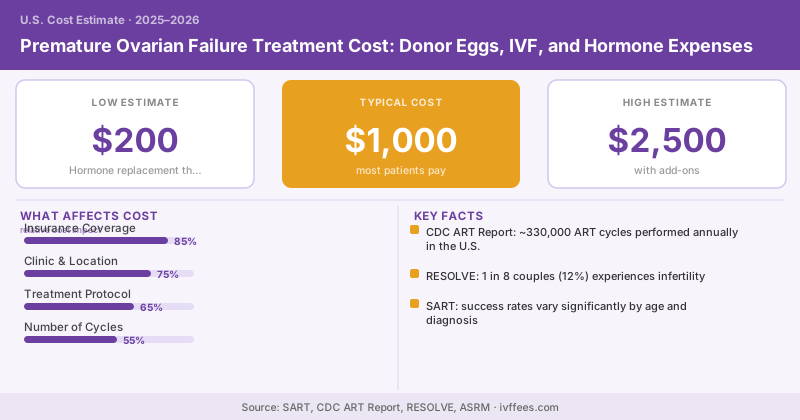
If conception isn’t the immediate goal, the priority is replacing estrogen to protect bone density and cardiovascular health. ACOG recommends HRT for women with POI until at least the natural age of menopause. This is the inexpensive part of the picture — often $200 to $2,500 a year, frequently insurance-covered as a medical (not fertility) treatment.
HRT also makes some women feel dramatically better, since POI can bring menopausal symptoms decades early. It does not, however, restore fertility.
Trying With Your Own Eggs
Here’s the hard truth: in established POI, IVF with your own eggs has low success rates because there’s little ovarian reserve left to stimulate. Some clinics will attempt it, especially early in the diagnosis when occasional ovulation still occurs — POI is intermittent, and spontaneous pregnancies happen in roughly 5–10% of women even without treatment.
A cycle still costs $12,000 to $28,000 with fertility medications, and the odds may be modest. Be clear-eyed with your RE about realistic per-cycle success before spending on multiple own-egg attempts. The egg retrieval itself may yield few or no eggs.
Donor eggs are the highest-success path for most women with established POI — pregnancy rates with donor eggs are largely independent of the recipient’s age and ovarian function. It’s also the most expensive option at $20,000–$45,000. Many women try a limited number of own-egg cycles first, then move to donor eggs rather than spending repeatedly on low-odds attempts.
The Donor-Egg Path
For most women with confirmed POI who want to carry a pregnancy, donor-egg IVF is the highest-success route. The eggs come from a screened young donor, are fertilized, and an embryo is transferred to your uterus (prepared with hormones, since POI doesn’t prevent carrying a pregnancy).
Costs run $20,000 to $45,000+ depending on whether you use fresh or frozen donor eggs and the donor agency fees. Frozen donor egg cohorts tend to be cheaper than fresh-cycle arrangements. Embryo donation — using embryos donated by another couple — is a lower-cost alternative, sometimes under $20,000.
POI is sometimes linked to genetic causes (like fragile X premutation or Turner mosaicism) or autoimmune conditions. Genetic and autoimmune testing is part of a proper workup, and a fragile X result has implications for any future children. Don’t skip the genetic counseling step — it can change which treatment path is safest and affects family planning beyond cost.
Insurance and POI
POI is a recognized medical diagnosis, so the diagnostic workup and HRT are frequently covered even by plans that exclude fertility treatment. Donor-egg IVF is rarely covered outside mandate states, and donor fees in particular are usually out of pocket. Given the high cost of the donor path, reviewing IVF financing options early is worth your time. A full fertility testing panel also helps confirm the diagnosis before you commit to an expensive treatment route.
Frequently Asked Questions
Can pregnancy happen naturally with premature ovarian failure? Yes, occasionally. POI is intermittent, not absolute — roughly 5–10% of women conceive spontaneously after diagnosis. That’s why “insufficiency” is the preferred term over “failure,” though spontaneous conception can’t be relied upon for planning.
Is donor egg IVF more successful than my own eggs in POI? Generally, yes, by a wide margin. Donor-egg success depends mostly on the donor’s age and the recipient’s uterine health, not on the recipient’s failing ovaries, so it offers the highest live-birth odds for confirmed POI.
Does HRT for POI affect future fertility treatment? No, and it may help. Estrogen replacement protects your overall health and can be coordinated with fertility treatment timing. It doesn’t restore egg supply, but it doesn’t harm your ability to carry a donor-egg pregnancy later.
Bottom Line
Premature ovarian failure treatment splits into two budgets: affordable hormone replacement to protect long-term health ($200–$2,500/year) and far costlier fertility paths. Own-egg IVF is possible but often low-odds; donor-egg IVF at $20,000–$45,000 offers the highest chance of pregnancy. Get a full diagnostic and genetic workup, then build a plan with your RE that matches both your goals and your budget.