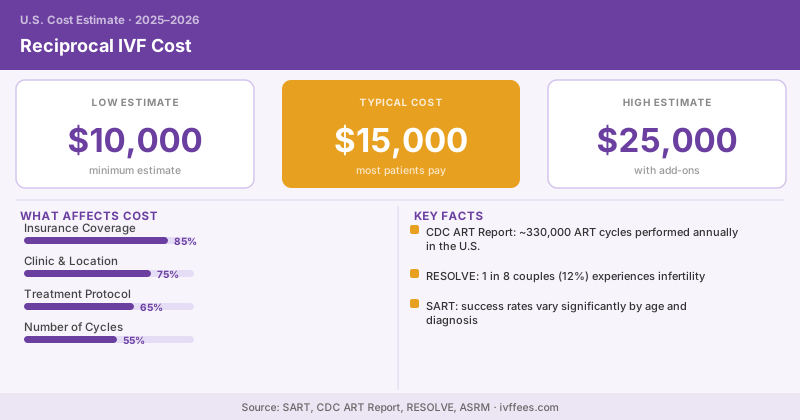
Most couples researching reciprocal IVF discover the cost the hard way — a quick search for “IVF cost” returns $12,000–$20,000 quotes, then the clinic coordinator explains that two people are going through the process, not one. The total lands closer to $25,000 to $45,000.
That’s not a scam. It’s just math. Two patients, two sets of procedures.
How Reciprocal IVF Works
Reciprocal IVF — also called partner IVF, co-IVF, or shared motherhood — is an option for female same-sex couples where both partners want a biological and gestational connection to their child. One partner (the “genetic mother”) undergoes ovarian stimulation and egg retrieval. Those eggs are fertilized with donor sperm to create embryos. The other partner (the “gestational mother” or carrier) carries the pregnancy.
The genetic mother contributes the chromosomes. The gestational mother carries the pregnancy. Both have a distinct biological role.
According to RESOLVE: The National Infertility Association, use of third-party reproduction options — including reciprocal IVF — has grown substantially as fertility clinics have expanded LGBTQ+ inclusive services. A 2023 survey by RESOLVE found that awareness and use of fertility preservation and alternative family-building options among same-sex female couples doubled over the prior decade.
The Full Cost Breakdown
You’re paying for two complete workups and two sets of procedures. Here’s how it adds up.
| Cost Component | Low End | High End |
|---|---|---|
| Egg provider: ovarian stimulation monitoring | $1,500 | $3,000 |
| Egg provider: medications (injectables) | $3,000 | $7,000 |
| Egg retrieval + anesthesia | $3,000 | $5,500 |
| Fertilization, ICSI, embryo culture | $1,500 | $3,500 |
| Carrier: uterine preparation monitoring | $1,000 | $2,500 |
| Carrier: medications (estrogen + progesterone) | $500 | $1,500 |
| Embryo transfer | $1,000 | $2,500 |
| Donor sperm (1–2 vials) | $800 | $1,800 |
| Legal fees (co-maternity agreement) | $1,500 | $3,500 |
| PGT-A (optional but often recommended) | $3,000 | $6,000 |
| Total (without PGT-A) | $13,800 | $30,800 |
| Total (with PGT-A) | $16,800 | $36,800 |
Most couples land in the $25,000–$45,000 range when accounting for real-world clinic fees, medications, and legal costs.
Why Both Partners’ Costs Are Non-Negotiable
Some couples ask whether the carrier partner’s monitoring fees can be minimized. Not really. The carrier needs:
- A baseline ultrasound and bloodwork before starting uterine preparation
- Serial estrogen monitoring during the lining-building phase
- A lining check ultrasound (ideally 7mm+ trilaminar pattern) before the transfer is confirmed
- Progesterone bloodwork after transfer
None of this can be skipped. The carrier’s uterine readiness directly determines whether the transfer proceeds — and a botched transfer means repeating the entire process. Clinics that offer reciprocal IVF bundle these costs into a “recipient monitoring” package ranging from $800 to $2,500.
In reciprocal IVF, it’s the egg-providing partner’s age and ovarian reserve — not the carrier’s age — that drives success rates. If you’re deciding which partner provides the eggs, the partner with better ovarian reserve and younger age generally gives you the best statistical odds. The CDC’s 2022 ART data shows live birth rates drop from ~44% per transfer for egg providers under 35 to ~18% for those 38–40, using fresh non-donor eggs.
Legal Requirements
This is where reciprocal IVF diverges sharply from standard IVF. You need a parentage or co-maternity agreement drafted by a reproductive attorney before the cycle begins — not after the baby arrives.
Why it can’t wait: in some US states, the gestational carrier (the partner who carries the pregnancy) is automatically presumed the legal mother at birth. Without a pre-birth order or co-maternity agreement on file, the genetic mother may not have parental rights without a court adoption proceeding.
Legal costs vary by state and attorney. Expect $1,500–$3,500 for a co-maternity/parentage agreement, and potentially more if your state requires a pre-birth order through the courts. States with well-established surrogacy law (California, Colorado, Nevada, Washington) typically have clearer and less expensive legal pathways than states with restrictive or ambiguous statutes.
Donor Sperm Selection
Both partners need to select donor sperm together — a decision that’s part clinical, part personal. Most couples work with a sperm bank that offers identity-release (open-ID) donors, who agree to be contactable by the child at age 18.
Sperm costs $800–$1,500 per vial. You’ll typically need one vial for each ICSI fertilization round; some couples buy a second vial as backup or to bank for future siblings.
Is PGT-A Worth It for Reciprocal IVF?
PGT-A (preimplantation genetic testing for aneuploidy) screens embryos for chromosomal abnormalities before transfer. It adds $3,000–$6,000 to total cost but reduces miscarriage risk and allows transfer of a single, chromosomally normal embryo.
ASRM’s position is that PGT-A is not universally recommended — but many REs do recommend it for reciprocal IVF patients where the egg-providing partner is 35 or older, or where the couple wants to minimize failed transfers given the higher total cost at stake.
Some clinics charge the full reciprocal IVF fee even if the cycle is cancelled before retrieval — for example, if the egg provider has a poor stimulation response. Ask specifically about the cancellation and refund policy before signing any financial agreement.
Which Clinics Offer Reciprocal IVF
Not all fertility clinics advertise or offer reciprocal IVF, though most large practices are equipped to provide it. Look for clinics that explicitly list “reciprocal IVF,” “co-IVF,” or “shared motherhood” on their website and have an LGBTQ+ family-building program. Practices affiliated with academic medical centers or large REI networks (CCRM, SGF, Shady Grove Fertility, RMA, UCSF) typically have established protocols and experienced staff.
Ask during your first consult: does the clinic have a dedicated nurse coordinator for reciprocal IVF cycles? Managing two patients in a single coordinated cycle requires organizational capacity that smaller practices sometimes lack.
The Bottom Line
Reciprocal IVF costs $25,000–$45,000 all-in for most couples. The higher cost compared to standard IVF reflects the reality that two patients are being treated, not one. For couples where both partners want a tangible biological role in their child’s conception, that investment is often deeply meaningful — and the legal groundwork you lay upfront protects both parents for the child’s lifetime.
Cost estimates based on ASRM clinical guidelines, RESOLVE national surveys, and published clinic fee schedules. Individual costs vary by clinic, state, and protocol.