The ultrasound tech filled Dana’s uterus with sterile saline solution, and thirty minutes later her RE had the clear uterine map he needed to plan her embryo transfer with confidence.
A saline sonogram — also called SIS or sonohysterogram — is one of the more affordable and informative steps in a fertility workup. Here’s what it costs and why your clinic might require it before treatment.
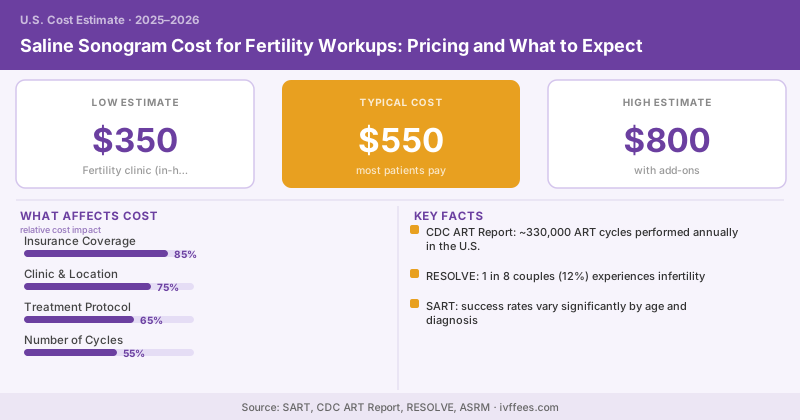
What a Saline Sonogram Costs
| Facility Type | Low End | Typical | High End |
|---|---|---|---|
| Fertility clinic (in-house) | $350 | $550 | $800 |
| Outpatient imaging center | $300 | $450 | $700 |
| Hospital-based facility | $500 | $750 | $1,100 |
| With insurance (copay/coinsurance only) | $0 | $100 | $350 |
Compared to an HSG, which requires X-ray imaging and a specialized contrast dye, a saline sonogram uses equipment most fertility clinics already have on-site — a standard transvaginal ultrasound probe plus a thin catheter to introduce saline — which keeps the base cost lower for most patients.
Why Filling the Uterus With Saline Matters
A standard pelvic ultrasound images the uterus with its walls collapsed against each other, which can hide small polyps, submucosal fibroids, or scar tissue that only becomes visible once the cavity is gently distended. Introducing sterile saline through a thin catheter separates the uterine walls temporarily, giving a much clearer, three-dimensional-feeling view of the entire cavity — a meaningful upgrade in diagnostic detail for a relatively modest additional cost and a procedure that typically takes under 15 minutes.
Not every clinic requires a saline sonogram before every IVF cycle, but many require it before a first cycle or before a frozen embryo transfer, specifically to rule out an unfavorable uterine environment before you invest in a transfer. Confirm with your RE whether it’s built into your specific protocol or something you should proactively request.
What Happens If Something Abnormal Shows Up
If a saline sonogram identifies a polyp, fibroid, or scar tissue affecting the uterine cavity, your RE will likely recommend a hysteroscopy — a minor surgical procedure to remove or correct the finding before proceeding with transfer. This adds cost and time to your treatment plan, but catching and correcting a structural issue before transfer is generally far cheaper than attempting (and potentially failing) a transfer into a uterine cavity with an untreated abnormality.
Timing in Your Cycle
Like an HSG, a saline sonogram is typically scheduled in the first half of your menstrual cycle, after bleeding stops but before ovulation, both to get the clearest imaging and to avoid any chance of disrupting an early pregnancy. Scheduling around this window is generally straightforward since the procedure doesn’t require the same advance coordination as an HSG’s contrast dye order.
Mild cramping and spotting after a saline sonogram are normal and usually resolve within a day, but contact your clinic if you develop fever, significant pain, or heavy bleeding, which could indicate infection — a rare but real risk with any procedure involving the uterine cavity. Most clinics screen for active infection before the procedure to minimize this risk.
Comparing SIS to Other Uterine Evaluation Options
A saline sonogram sits in the middle of the cost and invasiveness spectrum for uterine evaluation — more detailed than a standard pelvic ultrasound, generally cheaper and less invasive than an HSG’s X-ray and contrast dye process, and considerably cheaper than a diagnostic hysteroscopy performed in an operating room. Many REs consider it the best first step for uterine cavity evaluation specifically because of that balance.
The Bottom Line
Budget $300–$900 for a saline sonogram without insurance, generally less than an HSG or hysteroscopy for comparable diagnostic value on the uterine cavity specifically. Ask your RE whether it’s a required step in your specific treatment protocol, and know that if something abnormal turns up, a follow-up hysteroscopy is a common and usually straightforward next step.