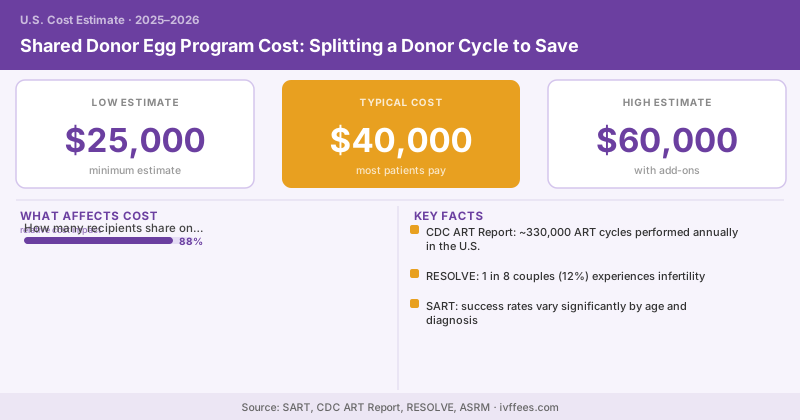
What if you could cut a fresh donor egg cycle nearly in half? That’s the pitch behind shared donor egg programs, where two or more recipients split the eggs from a single donor and split the cost too. Instead of paying $35,000 to $60,000 for an exclusive fresh cycle, each recipient pays roughly $14,000 to $22,000.
It sounds almost too good. There’s a real catch, and you need to understand it before you sign up.
How Egg Sharing Works
A single egg donor goes through one stimulation and retrieval cycle, producing a cohort of eggs — say, 16 mature eggs. In a shared program, those eggs get divided between recipients. Two recipients might each receive 8 eggs; sometimes three families split a high-yield donor. Each recipient then fertilizes her share, grows embryos, and transfers independently.
The donor’s medical costs, compensation, and screening — the expensive parts of a fresh cycle — get divided across everyone. That’s the source of the savings.
Cost Comparison
| Cost Component | Exclusive Fresh Cycle | Shared (2-way split) |
|---|---|---|
| Donor compensation | $8,000–$15,000 | $4,000–$7,500 |
| Donor meds & monitoring | $7,000–$13,000 | $3,500–$6,500 |
| Egg retrieval | $6,000–$10,000 | $3,000–$5,000 |
| Your fertilization & culture | $4,000–$6,000 | $4,000–$6,000 |
| Your embryo transfer | $3,000–$5,000 | $3,000–$5,000 |
| Agency / coordination | $8,000–$20,000 | $4,000–$10,000 |
| Estimated total per recipient | $35,000–$60,000 | $14,000–$22,000 |
Your own fertilization and transfer costs don’t shrink — those are individual to you. Only the donor-side costs split.
The Catch: Fewer Eggs
Here’s the tradeoff you can’t ignore. In a shared program you get half (or a third) of the donor’s eggs. Fewer eggs mean fewer embryos, fewer chances to freeze extras, and a lower probability of having a sibling embryo banked. If you only get 6 to 8 eggs and the attrition gods aren’t kind, you might end up with just one or two embryos.
For a one-and-done family, that’s often plenty. For someone hoping to bank embryos for two or three children, an exclusive cycle can deliver better long-term value despite the higher sticker.
Shared donor egg programs can save you $15,000 to $40,000 by splitting one donor’s cycle across recipients. The cost is egg quantity — you get a portion of the cohort, not the whole thing. It’s ideal for single-child families and budget-conscious recipients, less ideal if you want multiple children from one donor.
Egg Count and Allocation Rules
Programs handle low yields differently, and this is where you need to ask hard questions. If the donor only produces 10 eggs instead of an expected 18, how are they split? Does the first recipient get priority? Is there a minimum-egg guarantee? Some programs promise each recipient a set number of mature eggs and refund or re-cycle if the donor underperforms.
The American Society for Reproductive Medicine has noted that egg yield varies significantly even among young, healthy donors, so a clear allocation policy protects you from getting shorted.
Confirm the minimum-egg guarantee in writing. Ask exactly how eggs are divided if the donor’s yield comes in low, who gets priority, and whether you’re refunded if you receive fewer eggs than promised. Without a guarantee, a disappointing retrieval can leave you paying nearly full price for half the eggs you expected.
Success Rates in Shared Programs
Splitting eggs doesn’t lower the quality of any individual egg — your live birth rate per embryo is the same as an exclusive cycle. The difference is purely volume. With fewer embryos, you may have fewer transfer attempts before you need another donor cycle. SART tracks donor egg outcomes by clinic, so ask your program for its shared-cycle live birth data specifically.
Is Shared Right for You?
Choose a shared program if your budget is tight, you’re planning for one child, and the clinic offers a solid minimum-egg guarantee. Lean toward an exclusive cycle if you want siblings, maximum embryos to freeze, or the highest cumulative odds.
Worth comparing too: frozen donor egg cohorts, embryo adoption (often the cheapest donor path of all), and standard donor egg IVF. And no matter which you pick, IVF financing options can make the per-recipient cost more manageable.
Frequently Asked Questions
How many recipients share one donor? Usually two, occasionally three for a high-yield donor. The more recipients, the lower each person’s cost but the fewer eggs each receives. Two-way splits are the most common.
What happens if the donor produces too few eggs? That depends entirely on the program’s allocation policy. Good programs guarantee a minimum number of mature eggs per recipient and offer a refund or free re-cycle if they fall short. Always get this in writing before paying.
Is the success rate lower than an exclusive cycle? Per embryo, no — egg quality is identical. But because you receive fewer eggs, you have fewer embryos and possibly fewer transfer attempts, which can affect your cumulative odds across the whole journey. Compare it against the IVF cost of running a second cycle if the first doesn’t succeed.