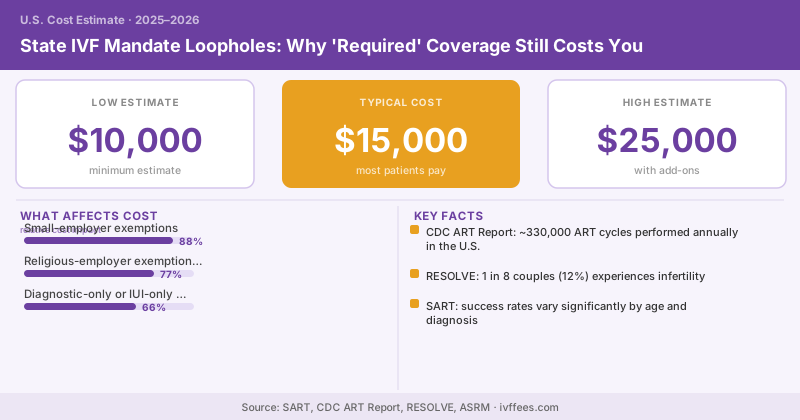
You moved to a state that “requires” IVF coverage, called your insurer, and got told no. You’re not crazy — and you’re not alone. State infertility mandates are riddled with exceptions, and the biggest one means roughly half of insured Americans aren’t protected by them at all. The result: you can live in a mandate state and still owe the full $15,000–$20,000 per cycle.
Here’s how the loopholes work, and what to do about them.
The self-funded plan loophole (the big one)
The single largest gap: state mandates don’t apply to self-funded (self-insured) employer health plans, which are governed by federal ERISA law instead of state insurance rules. KFF data shows roughly two-thirds of covered workers at large firms are in self-funded plans. If your employer self-funds its plan — common at big companies — the state mandate simply doesn’t reach you.
You can’t tell from your insurance card alone. Ask HR: “Is our plan fully insured or self-funded?” That one question often explains a surprise denial in a mandate state.
| Loophole | Who it affects | Your likely cost |
|---|---|---|
| Self-funded (ERISA) plan | ~2/3 of large-firm workers | Full price, $15K–$20K+ |
| Small-employer exemption | Workers at small companies | Often full price |
| Religious-employer exemption | Faith-based employers | Often full price |
| Diagnostic-only mandate | States that don’t require IVF | Testing covered, IVF not |
Other ways “mandated” coverage disappears
Small-employer exemptions. Many mandates exempt companies under a certain headcount (often 25, 50, or 100 employees), so small-business workers get nothing.
Religious-employer exemptions. Faith-based employers can often opt out on doctrinal grounds.
Diagnostic-only or IUI-only mandates. Some states require coverage of fertility diagnosis or IUI but not IVF itself. Check exactly what your state mandates in our mandate-by-state guide.
Medical-necessity and prior-treatment hoops. Even covered plans may require documented infertility, a number of failed IUIs, or specific diagnoses before IVF is approved.
Don’t assume “my state has a mandate, so I’m covered.” Verify three things in writing: (1) is your plan fully insured or self-funded, (2) does the mandate actually require IVF (not just diagnostics), and (3) what medical-necessity criteria apply. A wrong assumption can cost you a five-figure surprise bill.
What to do if a loophole hits you
If you’re stuck in a self-funded plan, the mandate won’t help — but your employer voluntarily can add fertility benefits, so it’s worth asking HR. Some self-funded employers offer generous fertility benefits anyway. If you’re wrongly denied under a plan that should be covered, file an appeal — our denial appeal guide walks through it.
A state IVF mandate is no guarantee of coverage. The self-funded (ERISA) loophole alone excludes the majority of large-firm workers, and small-employer, religious, and diagnostic-only exemptions exclude more. Ask HR whether your plan is fully insured or self-funded — that answer usually explains the bill.
When the mandate truly doesn’t reach you
If you’ve confirmed you’re outside the mandate’s protection, pivot to other levers: a grant, a refund program, the savings tactics in how to reduce IVF cost, and a full review of financing options. Knowing what insurance does and doesn’t cover helps you set realistic expectations.
Frequently Asked Questions
How do I know if my plan is self-funded? Your insurance card won’t say. Ask your employer’s HR or benefits team directly: “Is our health plan fully insured or self-funded?” Self-funded plans are governed by federal ERISA law and aren’t bound by state IVF mandates, which is the most common reason for denials in mandate states.
Can I switch to a fully insured plan to get mandate coverage? Usually not on your own — your employer chooses the plan structure. But a spouse’s employer might offer a fully insured plan subject to the mandate. Comparing both spouses’ plans is worth doing if one is fully insured in a mandate state.
Does a small-business exemption mean I have no options? No. You can’t rely on the mandate, but you can still pursue grants, refund programs, financing, HSA/FSA tax savings, and clinic discounts. Many patients without mandate protection successfully fund treatment by stacking these alternatives.